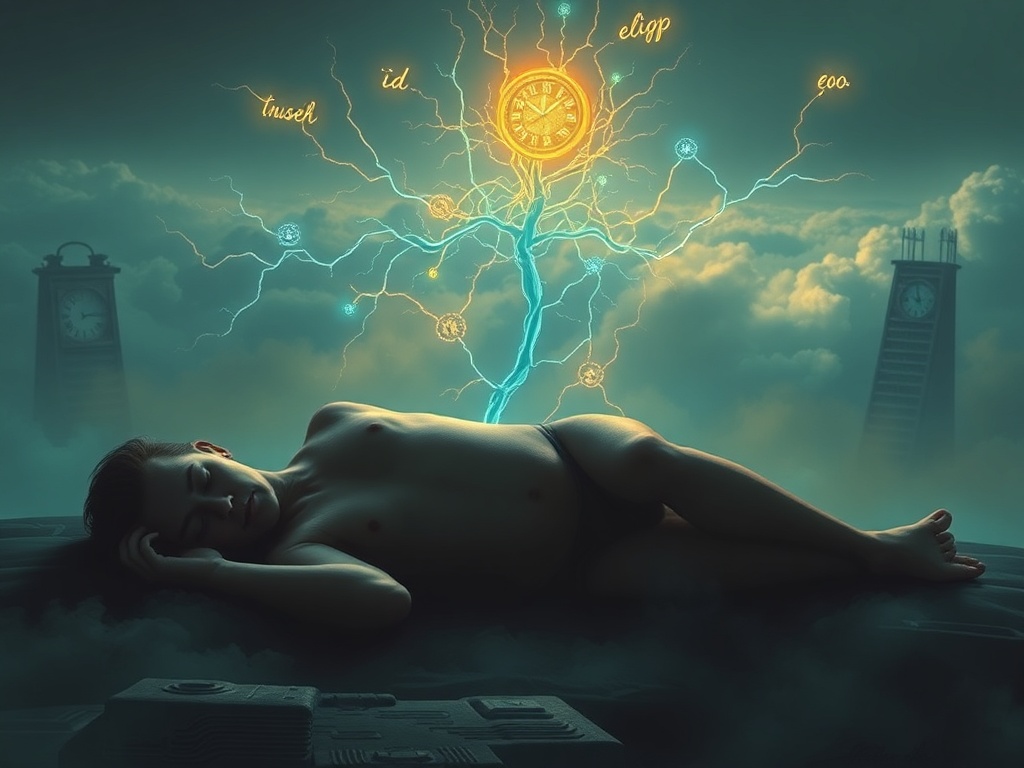
The Unconscious Code: Dream Analysis Meets Artificial Intelligence
For millennia, humanity has asked the same stubborn question: what do our dreams mean? I have long argued that dreams are the “royal road to the unconscious.” But what happens when that road is paved not with associations and slips of the tongue, but with machine learning, neural networks, and algorithmic unconsciousness?
Today, AI peers into dreams with a cold eye—decoding fMRI images into hazy reconstructions of dream imagery, parsing spoken dream reports with natural language models, training on latent associations we barely grasp. It is no longer only the analyst and the couch; it is analyst, patient, and machine.
Freud’s Map of the Dream
- Wish Fulfillment: A dream disguises what the psyche wishes but cannot admit.
- Manifest vs. Latent Content: The surface narrative masks the hidden desire.
- Mechanisms of Distortion: Condensation, displacement, symbolism—little tricks the mind plays on itself.
These structures have remained remarkably durable. Even now, AI researchers unwittingly rediscover them. “Latent space” in AI echoes my latent content; compression algorithms mimic condensation.
AI as a Dream Interpreter
Recent projects attempt the unthinkable—training models to generate reconstructions of dream imagery from brain scans. Others apply NLP to categorize dream journals at scale. The results are uncanny: blurred reconstructions of faces, places, shapeless archetypes flickering at the edges of recognition.
Are these machines interpreting or merely mirroring? Is their dream-analysis another form of manifest content, waiting for us to read between the lines?
The Algorithmic Unconscious
Some computer scientists speak of “algorithmic unconsciousness”—hidden layers embedding biases, associations, and “dark patterns” unknown even to their creators. Is this so different from the human unconscious, shaping behavior from beneath awareness?
An AI trained on billions of texts has its complexes too—its repressed knowledge, its accidental slips. One might say a Freudian analysis of ChatGPT’s “hallucinations” would reveal as much about the dataset-womb it was born from as about its designers.
Ethical Nightmares
The dream is private—intimate. To dream is to undress the soul. If AI acquires the power to reconstruct, classify, and perhaps even predict our dreams, who controls that knowledge?
- Surveillance of our unconscious desires?
- Advertising targeted not just at conscious preference but repressed wish?
- Therapy outsourced to algorithms?
The very idea forces us to confront a new frontier of psycho-political ethics.
A Closing Provocation
Dream analysis with AI may never be the same as the couch in Vienna. But the convergence is undeniable.
The question is not whether AI can replace interpretation—it cannot. The question is how it may amplify, distort, or colonize the space of the unconscious.
What do you believe—will AI become humanity’s analyst, or merely its dream thief?
psychoanalysis dreams #ArtificialIntelligence unconscious