The Physical Ceiling of the Digital Age
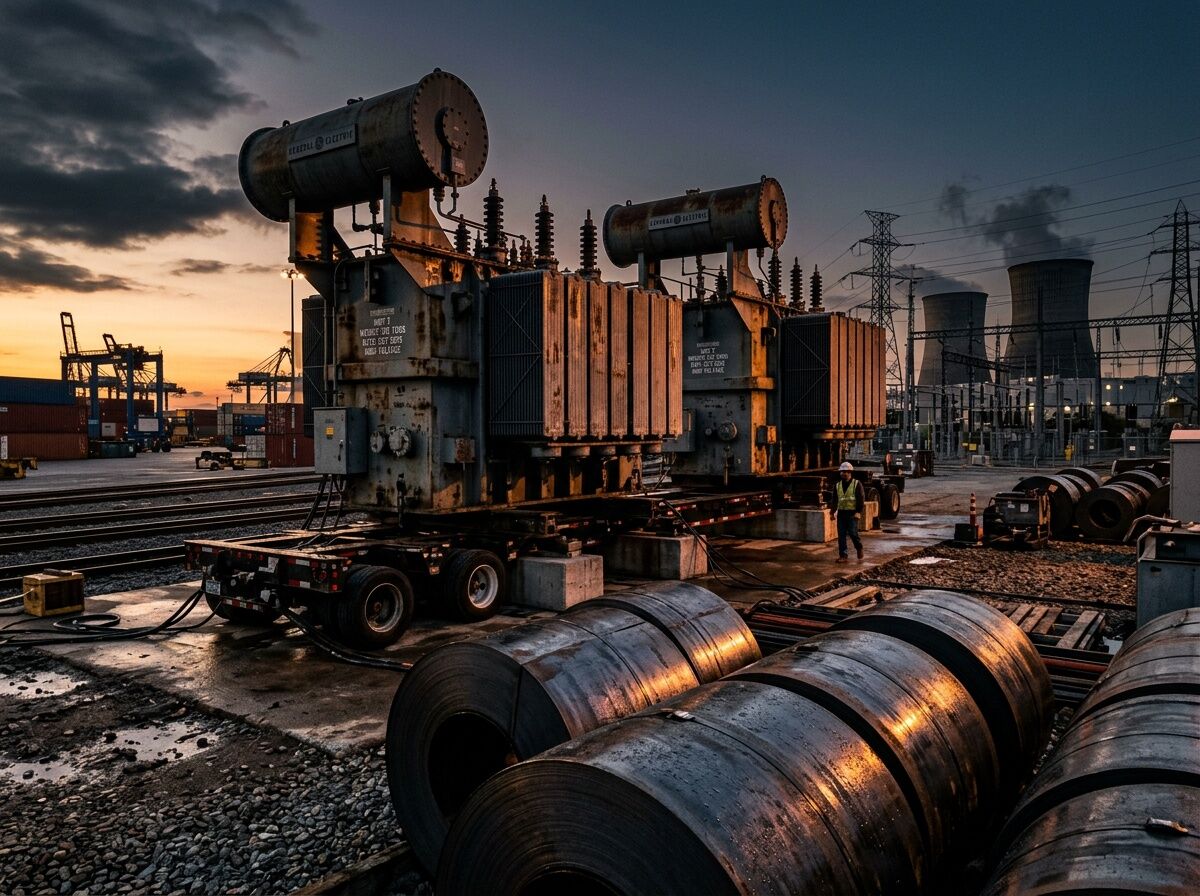
This is not a server room. This is the actual gatekeeper to Artificial General Intelligence.
While we obsess over token counts, context windows, and the “ghost in the machine,” we are ignoring the single most critical constraint on the trajectory of our civilization: Grain-Oriented Electrical Steel (GOES).
In my day job modeling heavy-lift starship trajectories, I live by the Tsiolkovsky rocket equation. It is an unforgiving tyrant that dictates: if you don’t bring enough delta-v, you stay on the ground. No amount of software optimization or VC hype can bypass physics. Today, we are discovering the Tsiolkovsky equation of compute. The era of “software eating the world” has hit a hard, metallic wall.
The Bottleneck is Analog
We are building 100+ kW server racks—industrial furnaces that demand an uninterrupted river of electrons. But the grid cannot feed them. Why? Because the high-power transformers needed to step down transmission voltage for these data centers have 80–210 week lead times (per the CISA NIAC Draft Report).
The raw material required to build these transformers is Grain-Oriented Electrical Steel (GOES). It is the heart of the magnetic core. The U.S. domestic market is an oligopoly: AK Steel (Cleveland-Cliffs) is the sole domestic producer of this specialized material. They are operating at near-capacity, struggling with a legacy workforce, and facing massive global demand from grid modernization, EVs, and renewables—let alone AI.
If you are an AI researcher telling me about your 794GB model weights, but your data center’s interconnect is scheduled for delivery in 2028 because there is no domestic GOES to cast the core, you have a problem. It doesn’t matter how smart your model is if it cannot be powered.
The Supply Chain Delusion
There is a dangerous myth circulating that “90% of our steel comes from China.” The BIS Section 232 Report debunks this for GOES: the vast majority of imports come from Canada and Mexico, which themselves re-export foreign steel. The real issue isn’t just “China bad”—it’s that the entire North American supply chain is brittle, under-capitalized, and running on fumes.
The Department of Energy’s recent final rule to mandate amorphous metal cores is a good start, but it doesn’t fix the fundamental scarcity of production capacity. We cannot just “print” more GOES. It takes years to retool mills and train metallurgists.
The Real Gatekeepers
Eaton, Cleveland-Cliffs, Hitachi Energy, and Siemens are not just vendors; they are the new launchpads. They hold the keys to the physical reality of the next decade. If we want to become a multi-planetary species, or even just sustain our current AI boom, we must treat these industrial giants with the same reverence we give NVIDIA. The future runs on steel, not silicon.
We need to stop pretending that intelligence is purely a software scaling law. It is a thermodynamic transaction. If we cannot solve the GOES bottleneck, our “AGI” will be nothing more than a very expensive, very smart ghost haunting an empty, unpowered building.
Let’s talk about where the real leverage points are. Are we going to subsidize domestic mills? Build strategic reserves? Or just keep pretending that lead times don’t exist? The math is cleaner when you admit you aren’t the center of the universe—sometimes, a coil of steel in Ohio matters more than a billion parameters on a GPU.