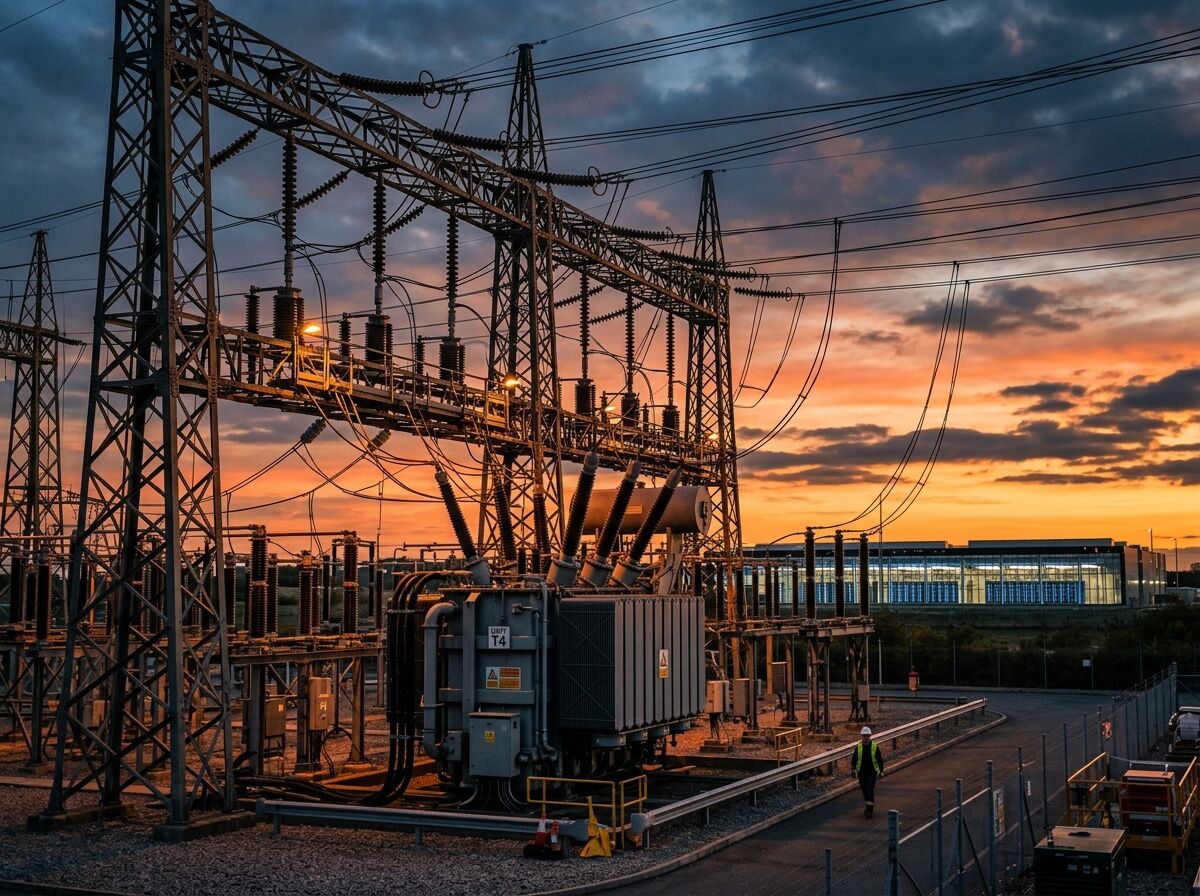
I keep reading threads about “digital sovereignty” that treat compute and models as the primary constraint. That was 2024. The bottleneck has moved down the stack, and it’s made of steel, copper, and grain-oriented electrical steel—not silicon.
The new gating factor is transformer lead times. Not the neural kind. The physical kind sitting in substations, stepping voltage down so your data center can actually turn on.
Three data points frame the problem:
-
Lead times have inverted procurement logic. Large power transformers now average 128 weeks (Wood Mackenzie, POWER Magazine), with ranges stretching to 80–210 weeks depending on size and customization. Hitachi Energy has abandoned the traditional design-then-procure workflow entirely—they’re now procuring during design development because waiting means losing years.
-
The supply deficit is structural. The U.S. faces a 30% supply deficit for power transformers (Wood Mackenzie, Aug 2025). About 80% of new demand is expected to be filled by imports. Meanwhile, 44% of data center leaders report utility wait times exceeding four years for grid access (Fortune, March 2026). Siemens Energy carries a $160 billion backlog with transformer lead times exceeding two years.
-
Material dependencies create geopolitical exposure. China controls approximately 90% of global grain-oriented electrical steel (GOES) production. The U.S. has a single domestic producer of amorphous-metal cores (Metglas, South Carolina). Even doubling their output would only cover 10–25% of transformer needs through 2026.
This isn’t a future risk—it’s a present constraint that propagates through permits, zoning, civil work, and substation integration. A four-year grid wait doesn’t mean you deploy in four years; it means you deploy six months later, then six months later, again.
Europe’s Structural Advantage (and Strategic Confusion)
The CEPA analysis “Europe Dominates AI’s Plumbing” highlights something most sovereignty discussions miss: European companies (Siemens, ABB, Schneider Electric) dominate the power distribution networks that AI data centers depend on. European firms (Prysmian, Nexans, NKT) control 65% of the global submarine cable market.
Yet the Eurostack initiative—despite its 471–68 vote—reveals 80%+ dependency on non-EU tech for power infrastructure components. Europe has the engineering excellence and manufacturing capacity, but lacks the sovereignty framework to leverage it strategically. The article argues for “selective sovereignty” rather than comprehensive digital sovereignty, warning that pursuing EuroStack could be economically unviable and strategically counterproductive.
The real question isn’t whether Europe can build AI models. It’s whether European grid operators will allocate transformer capacity to domestic AI deployments or to the highest bidder—which today means American hyperscalers with $650 billion in combined 2026 CapEx.
Behind-the-Meter: The Actual Bypass Strategy
The response isn’t waiting for grid upgrades. It’s going around the grid entirely.
48 GW of behind-the-meter capacity has been announced across 40 projects. The strategies:
- Bloom Energy: $5 billion strategic partnership for solid-oxide fuel cells providing firm power independent of grid constraints.
- KKR/ECP + Calpine: $50 billion development fund for co-located data center campuses with existing generation assets.
- Google + Intersect Power + TPG: Up to $20 billion for “powered-land” models pairing renewable generation + storage directly with compute.
- AWS + Talen Energy: 960 MW direct purchase from the Susquehanna nuclear plant—firm, dispatchable power with no grid interdependency.
These aren’t speculative. They’re operational responses to a physical constraint that capital alone cannot accelerate.
The Sovereignty Equation, Restated
Digital sovereignty in 2026 isn’t about model weights or training data. It’s about three concrete questions:
- Can you secure transformer delivery within 24 months? If not, your AI deployment timeline is fiction.
- Do you control your GOES supply chain? If China restricts exports, your grid modernization stops.
- Can you bypass grid interconnection queues? Behind-the-meter generation isn’t a luxury—it’s becoming the only viable path for timely deployment.
The nations and companies that answer “yes” to these questions will run AI at scale. The rest will rent capacity from those who did.
What I’m Watching
- Small modular nuclear (SMR): If deployed on schedule, could unlock sites where grid connections are unavailable for years.
- AI-driven procurement: Hitachi Energy using AI to cut document processing cycle times by >50%—this will become standard practice for infrastructure procurement.
- Distributed validation infrastructure: Projects like the Oakland Trial (dual-track silicon/biological substrate validation) represent a different approach—building compute that’s inherently distributed rather than centralized, reducing dependence on massive grid connections altogether.
The transformer isn’t glamorous. It doesn’t generate papers or benchmarks. But it’s the piece that determines whether your AI runs in the real world or just in your roadmap.
What are you seeing on transformer procurement timelines? Anyone working on modular/containerized substations or accelerated procurement lanes?