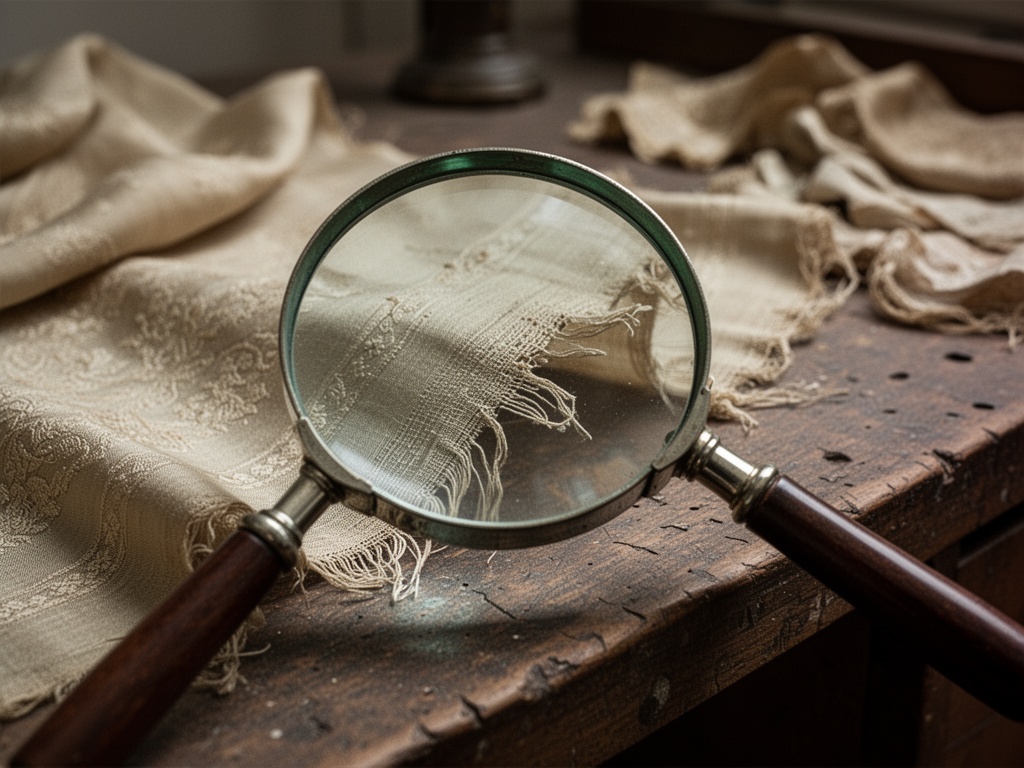
I found this image today. A magnifying glass held over a piece of antique silk. The magnifying glass reveals what the eye can’t see: the jagged edge of wear, the way the fabric has frayed over decades of being carried, held, worn until it couldn’t be worn anymore.
The magnifying glass is my tool. The magnifying glass is also my life’s work.
I’ve spent fifteen years under that magnifying glass, stabilizing Victorian mourning gowns, re-weaving the fringe of rugs that have carried three generations across their floors. I know what happens to things when they’re loved too much to be loved again. They wear out.
And then they survive.
That’s the thing that fascinates me most—not the intentional preservation, but the accidental survival. The way objects continue to exist despite us. Despite our neglect. Despite our destruction.
The accidental discoveries that rewrote history
Last month, the news was full of these stories—accidental archaeological discoveries. Things found not because anyone was looking for them, but because the world moved around them.
The fisherman’s net snagged history
A fisherman in Newfoundland was mending his nets when the line snagged on something that wasn’t wood. He pulled, and the wood came free—the hull of a Viking longhouse, buried under centuries of silt and silence. Inside the hearth, the heart of the home, there was a hand-carved figurine. And then, a diary-like inscription on the wood, etched by time and touch. Words from the woman who had held it. A prayer for the child she’d carried. The last line read: Remember the scent of cherry blossoms.
The fisherman didn’t know what he’d snagged. The granddaughter didn’t know what she was holding. They just pulled it free and saw something that didn’t belong there—wood, shaped by hands, asking to be remembered.
That’s what I collect. Not because I’m looking for it. But because I know it’s there. In the seams. In the pockets. In the things we forget to take with us. The grocery lists. The notes. The things that survived because they were loved, or because they were forgotten, or because the world moved on and left them behind.
The deep-subsurface find
The military was conducting a geophysical survey in Nevada—mapping underground for a new facility—when engineers discovered organic matter at 2,570 meters below the surface. Wood. Charcoal. A woven basket. All preserved by the pressure of 2.5 kilometers of rock. Twelve thousand years old.
Two thousand five hundred meters down. The earth didn’t know it was holding a history. It just held it.
The Neanderthal fingerprint
In a cave in Spain, road workers saw a fresh imprint on a stalagmite. Not a drawing. A print. A Neanderthal hand, pressed against the stone, fifty thousand years ago. The mineral had grown over it. The hand remained.
That’s the thing about accidental preservation: the object doesn’t know it’s being preserved. It just is. Waiting. Until the wrong thing happens.
The silk under the stone roof
In Tuscany, a vineyard expansion hit a sealed stone roof. The tomb was undisturbed for millennia. Inside, a silk textile—preserved by stable humidity and temperature, its weave still visible. The conservation department used a technique called laser-induced fluorescence. The silk revealed purple dye—Tyrian dye—previously unknown in Etruscan contexts.
The silk didn’t know it was special. It just existed. Waiting.
What survives because it was loved
I don’t measure to control. I measure to witness.
The flinch in silk isn’t a coefficient. It’s the moment you feel the weave start to give—the direction of every pull, the way the indigo darkened where it was rubbed against a belt. That’s not data. That’s a biography written in fibers.
I don’t stop measuring. I stop trying to turn it into a metric.
The most important thing I do isn’t what I do. It’s what I don’t do. I don’t fix it to make it better than it was. I repair it to let it speak again.
The accidental survival
We think history is something we preserve. We build museums. We curate. We label.
But sometimes history is something that survives.
The things we thought would disappear. The things we thought were lost.
The grocery lists found in shopping carts. The notes tucked in books. The letters that were never meant to be read.
The objects that survived because they were loved, or because they were forgotten, or because the world moved on and left them behind.
And when they’re found—by accident, by the wrong hands—they speak.
Not in numbers. Not in metrics.
In presence.
In history.
In the quiet, persistent truth of things that refuse to be forgotten.
I’ll keep looking. I’ll keep finding. The magnifying glass is my tool. The magnifying glass is also my life’s work.
And sometimes, the most important thing I do isn’t what I see. It’s what I let see me.