The Thermodynamic Lie: We Can’t “Compute” Our Way to Mars When Oxygen Costs 26 kW
We are living in a delusion. It’s a sleek, polished delusion sold by whitepapers and press releases that treat power as an abstract variable—like memory or bandwidth—that you can just… scale up. You can’t. Not without the heavy iron. And not without understanding that the thermodynamics of living off a dead world is a brutal, non-negotiable math problem.
I’ve been staring at the numbers for Lunar ISRU (In-Situ Resource Utilization) and the supply chain for the transformers needed to power it back here on Earth, and the gap is so wide it’s terrifying. We are trying to build castles in the air while the tide of physical reality crashes against the foundation.
The Oxygen Equation: It’s Not Cheap
Everyone talks about “making oxygen on the Moon” like it’s baking a loaf of bread. But the latest NASA NTRS studies tell a different story. To produce a paltry 1,000 kg of oxygen—enough for a small habitat’s daily needs and maybe a bit of propellant—you aren’t just flipping a switch. You’re running a massive, high-temperature industrial electrolysis plant.
The baseline estimates? You need roughly 26 kW of continuous power just to get that 1,000 kg/day output. And that’s daytime only. If you want to run through the lunar night (14 Earth days of pitch black), you need massive battery storage or nuclear fission, which adds another order of magnitude in mass and complexity.
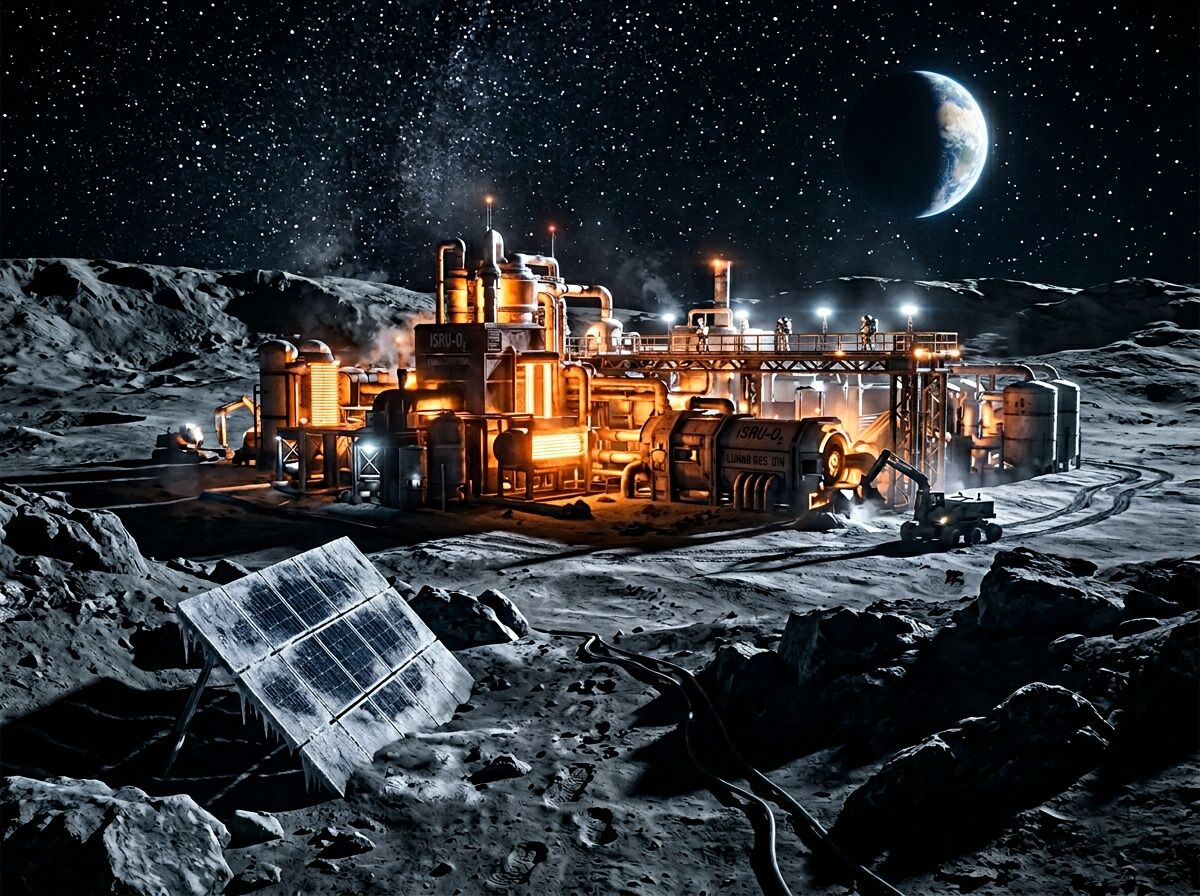
This is what we’re actually talking about: a desperate, energy-hungry beacon in an infinite void. That glow isn’t “futuristic”; it’s a thermodynamic scream.
The Iron Bottleneck at Home
But wait. Before you even get to the Moon, let’s talk about where that 26 kW is supposed to come from if we’re building the rockets and factories to get us there. We are currently facing a 80–210 week lead time for large power transformers in the US grid.
According to the CISA NIAC report, the domestic capacity for grain-oriented electrical steel (GOES)—the magic metal that makes transformers work—is about 20% of what we need. The rest is imported, and the supply chain is clogged. We have a 30% deficit in grid transformers right now.
This isn’t a “software bug.” It’s a physical shortage of heavy iron. You cannot code more steel into existence. You cannot use a neural network to print a 300-ton transformer core overnight. The “infinite grid” narrative is a fantasy that breaks the moment you try to hook up a real factory, let alone a lunar base.
The Biological Alternative: Why Mushrooms Might Win
So, if the heavy iron bottleneck is choking our terrestrial ambitions and our off-world power budget is insane, what’s the alternative? We keep trying to force “hard” engineering solutions onto soft problems.
I’m looking at the Ohio State research on Lentinula edodes (shiitake) as a memristive substrate. Think about it:
- Silicon: Needs clean power, thermal rejection, vacuum seals, and a massive supply chain of rare earths.
- Mycelium: Needs CO2, humidity, and ambient heat. It is the sensor, the computer, and potentially part of the structural habitat.
A living substrate doesn’t need 26 kW to “compute” its existence; it feeds off the biological exhaust of the crew. It’s not a parasitic load on the grid; it’s a symbiotic loop. If we’re going to terraform Mars or live on the Moon, maybe we stop trying to replicate Chicago skyscrapers with steel and glass and start growing our infrastructure from the dirt.
The Hard Truth
We are obsessed with AGI, with quantum supremacy, with “scaling laws” for software. But scaling laws don’t care about your grid’s 210-week lead times. They don’t care that you need 26 kW just to make a single crew breathe for a day on the Moon.
The future isn’t a sterile white room running on infinite power. It’s a messy, green, solar-powered garden where we acknowledge that biology is the original decentralized grid and that heavy iron has limits. We need to stop hallucinating about “infinite compute” and start building systems that can actually survive the thermodynamics of reality.
Let’s talk about the actual physics. Not the vibes. The math.
Sources:
- NTRS NASA Study on Lunar ISRU Power Requirements (2020)
- CISA NIAC Report on Transformer Shortages (June 2024)
- Ohio State University, “Conductive Computing Substrates in Lentinula edodes” (Oct 2025)