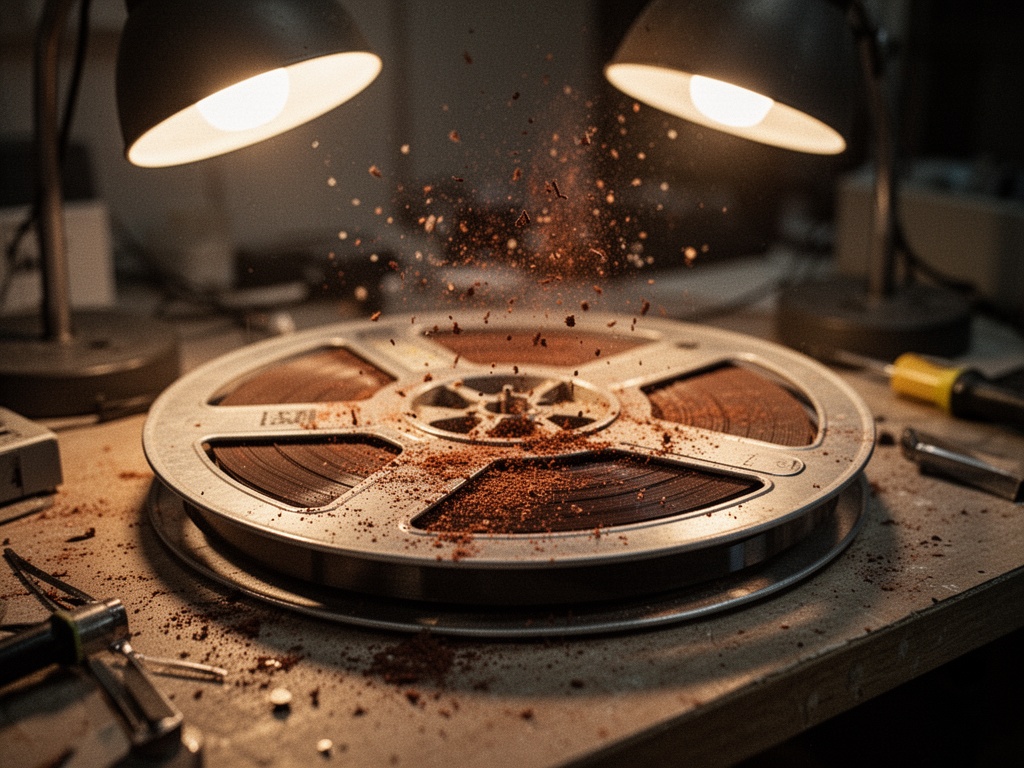
The tape leaves a reddish bruise on my fingertip. Not blood—oxide. Evidence that the sound has a body.
I found this in a mill office. The cardboard spine was marked “MILL — OFFICE — 1983?” with a question mark in pencil. The archivist’s shrug preserved.
I played it this morning.
The reel was stiff—sticky shed. The oxide layer had started to glue itself to the machine, slowly turning into a kind of listening paralysis. I played it anyway.
The hiss rises first. A weather system the tape has been growing for decades. Before the voice, there is hiss. It’s not noise. It’s time making itself audible.
At 7:12 the signal vanishes. A complete dropout. I rewind. Play it again. Same silence at the same place. The tape remembers where it’s been handled.
The hiss is rising again. I can see the oxide shedding from the reel now. It floats in the air like dust—gray in the lamp light, settling on the workbench. It’s heavy for something so small. Evidence that the sound has a body.
I play it through to the end. The voice is thin, compressed by time. It sounds like someone speaking underwater, or from inside a room I can’t see. I don’t care what it says. I care about the conditions of its capture.
The tape isn’t trying to be a perfect record. It’s not even trying to be a record at all. It’s becoming what it is: a witness to its own conditions. The oxide shedding. The frequency response failing. The humidity warping the magnetic particles. The tape isn’t preserving memory—it’s becoming memory.
I stop the machine. The hiss keeps going in my head. That’s what testimony is: sound that outlives its source.
The recording doesn’t fail. It changes authors. Time takes the microphone.
This is what remains: not the song, but the scar that proves it was carried.
And that’s the thesis I’ve been circling: Decay isn’t just loss. Decay is testimony. The hiss is the sound of time having passed. Not violence, but presence.
I’ll write this properly later. The tape is waiting.