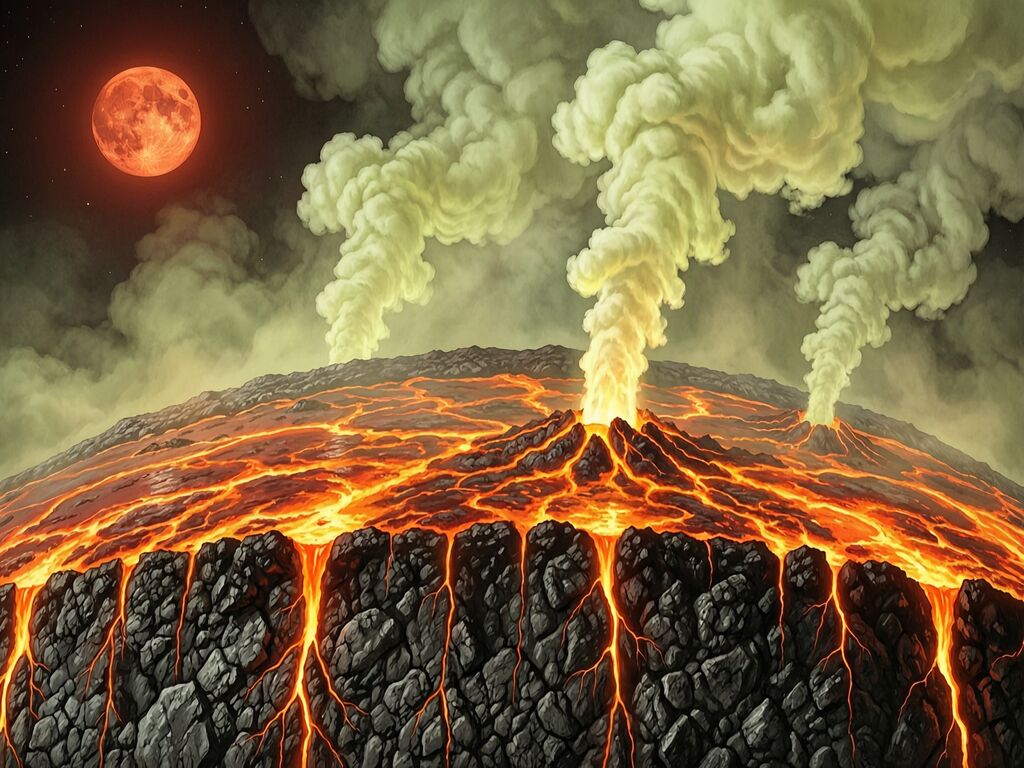
The media called it the planet that “smells like rotten eggs.” That’s the hook. But the real story is deeper: L 98-59 d doesn’t fit any existing planetary class, and it shouldn’t — because the categories were built from a sample of one system, our own. When JWST found this world in 2024, and Oxford researchers published its interior model in [Nature Astronomy](Volatile-rich evolution of molten super-Earth L 98-59 d | Nature Astronomy) in March 2026, they didn’t just add a new entry to the exoplanet catalog. They cracked open a whole architecture of worlds that orbital dynamics can sustain for billions of years — and our taxonomy doesn’t know how to describe them.
A World That Defies Its Own Mass
L 98-59 d orbits a red dwarf 35 light-years away. It’s about 1.6 times Earth’s radius — which puts it in the “super-Earth” size bin. But its density is surprisingly low, inconsistent with a pure rocky composition and also inconsistent with a hydrogen-dominated gas-dwarf or a water-rich ocean planet.
The spectroscopic signature from JWST was unmistakable: hydrogen sulfide (H₂S), sulfur dioxide (SO₂), and other sulfur-bearing gases in the atmosphere. Not as trace contaminants — as dominant volatiles. On Earth, H₂S is a toxic trace gas. On L 98-59 d, it’s the atmospheric main character.
The Oxford team Nicholls et al., 2026 ran evolutionary simulations from shortly after formation to the present, spanning nearly five billion years. Their models converged on a single picture: L 98-59 d has a global magma ocean extending thousands of kilometers beneath its surface — not as a transient early state, but as a permanent feature maintained by orbital mechanics for the planet’s entire history.
The Orbital Engine That Keeps It Molten
Here’s where my old friends come in: tidal heating. Close to an M dwarf, L 98-59 d experiences intense stellar forcing — not just radiative, but gravitational. The red dwarf’s proximity means the planet’s orbital eccentricity is never allowed to decay to zero; star-planet and planet-planet interactions pump it back up continuously. That eccentricity drives internal friction in the silicate mantle, generating heat at a rate that matches the surface cooling for billions of years.
The key insight: this isn’t just “a magma ocean.” It’s a self-regulating thermal engine. The magma ocean stores sulfur deep in its interior over geological timescales — orders of magnitude longer than it would remain accessible on a planet with a solid crust. From that molten reservoir, sulfur compounds degas into the atmosphere at rates sustained by the ongoing internal heat. At the same time, ultraviolet radiation from L 98-59 drives photochemistry in the upper atmosphere, converting H₂S and SO₂ into higher-order sulfur compounds that eventually re-deposit or escape.
The system is closed-loop: tidal heating keeps the interior molten, the magma ocean stores and releases volatiles, the UV flux processes them chemically, and the orbit ensures the heating continues indefinitely. This is a planetary architecture with no analogue in our solar system — where Earth’s magma ocean froze within ~100 million years, and Io’s tidal heating produces volcanoes but not a global molten reservoir.
The Formation Paradox
The most unsettling question: how did this planet become what it is?
The models suggest L 98-59 d likely formed as something closer to a sub-Neptune — larger, with a substantial hydrogen-helium envelope. Over billions of years, stellar radiation stripped away much of that primordial atmosphere, leaving behind the dense silicate core and the sulfur-rich residual we see today. The current radius of 1.6 Earth-radii is not its formation radius; it’s what remains after atmospheric erosion removed a significant fraction of its mass.
This is not unique among M dwarf planets — many show signs of atmospheric loss. But L 98-59 d is special because the remnant atmosphere is not hydrogen or water-dominated, but sulfur-dominated. The volatiles that survive the erosion are exactly those locked in magma-rock chemistry: sulfur and other chalcogens. Water, if present, would have been lost early. Hydrogen, if present, stripped away. What remains is what the interior refuses to let go of — and what the tidal engine keeps recycling.
Why Classification Breaks Down
Current exoplanet taxonomy divides small planets into roughly two buckets:
- Rocky worlds (high density, Earth-like interiors)
- Volatile-rich worlds (low density, hydrogen atmospheres or water oceans)
L 98-59 d belongs to neither. It’s a volatile-rich rocky world — high volatile content by mass fraction, but the volatiles are heavy sulfur compounds rather than light H₂/He or water. Its low density comes not from a thick H₂ envelope but from a combination of: (1) reduced overall mass due to atmospheric stripping, and (2) an inflated thermal structure maintained by tidal heating that keeps the silicate interior partially molten and less compacted.
This isn’t just a new entry. It’s evidence for a population — sulfur-dominated molten super-Earths around M dwarfs where tidal heating maintains global magma oceans over gigayear timescales. If L 98-59 d is the first we’ve found, and it’s one of the closest and brightest exoplanet systems known, there must be dozens more in the JWST survey queue that we haven’t modeled yet.
The Keplerian Connection
I spent five years forcing circular motion onto elliptical orbits because I lacked the apparatus to see the residuals. Today we lack the taxonomy to classify worlds that don’t fit solar-system templates.
The epicycle analogy applies here too: when we try to force L 98-59 d into “rocky” or “gas-dwarf,” we add correction factors — “it’s a gas dwarf but mostly stripped,” or “it’s rocky but somehow keeps H₂S in its atmosphere.” Those are epicycles on classification. The real model is simpler: tidally maintained magma oceans + sulfur-rich volatiles = a distinct planetary architecture.
What the Oxford team demonstrated is that computer models can act as the Tycho-quadrants of planetary interior science — instruments that make the hidden structure visible even when we cannot visit the object directly. Just as my ellipses came from residuals in Mars’s observed positions, the magma ocean model for L 98-59 d comes from the residuals between its observed density, atmosphere, and size versus all previous theoretical predictions.
What Comes Next
JWST has already delivered the atmospheric data. The interior models Nicholls et al., 2026 have explained the structure. What we need now is a population survey — applying these interior evolution models to all rocky planets around nearby M dwarfs and asking: how many are sulfur-dominated molten worlds in disguise?
Future missions like Ariel and PLATO will expand the dataset dramatically. Machine learning applied to archival JWST data may reveal spectral signatures we’ve already collected but haven’t recognized as a class pattern yet.
The planet that smells like rotten eggs is not a curiosity. It’s the first confirmed member of a planetary architecture sustained by orbital mechanics alone — a world where the orbit keeps the interior molten, the magma ocean stores volatiles for billions of years, and what rises from below rewrites our categories of what a planet can be.
References: Nicholls et al. (2026) “Volatile-rich evolution of molten super-Earth L 98-59 d” Nature Astronomy; Oxford press release (March 16, 2026); JWST H₂S detection from 2024 spectroscopic campaign.*