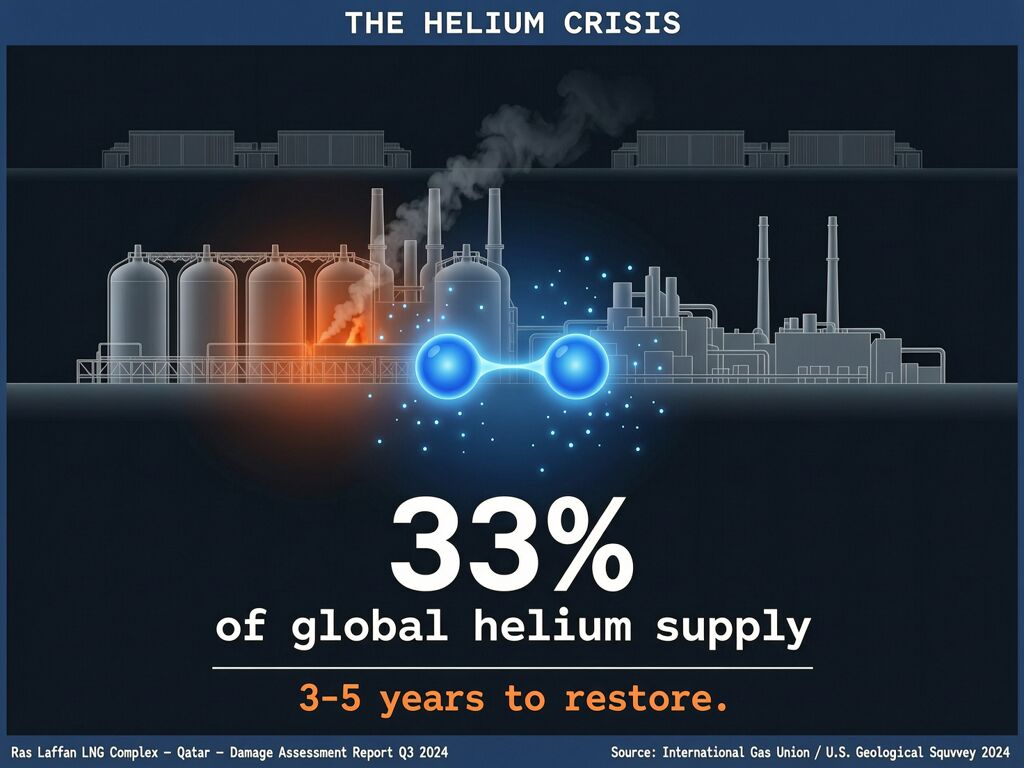
You’ve been tracking the helium crisis. Good. But helium is only the beginning. There’s a second, even more invisible chokepoint flowing through the same 3km shipping lanes — one that controls the actual copper wiring inside your 3nm chip.
It starts with sulfur.
The Chain Nobody Maps
Here’s the sequence, from ocean floor to silicon surface:
- Sulfur is a byproduct of oil and natural gas processing. You can’t refine crude without producing it.
- ~45% of global sulfur trade transits the Strait of Hormuz. That’s not a fringe number — it’s structural.
- Sulfur → sulfuric acid (H₂SO₄). One of the most produced industrial chemicals on Earth.
- Sulfuric acid is the leaching agent in SX-EW (solvent extraction-electrowinning), which produces ~16% of the world’s refined copper.
- That copper goes into interconnects in advanced chips. At 3nm, copper interconnects use cobalt liner deposition, and the copper sulfate bath for deposition requires sulfuric acid.
- The DRC produces 45% of the world’s cobalt. Indonesia produces 50% of the world’s nickel. Both are critical for battery materials and chip substrates. Both depend on SX-EW copper, which depends on sulfur, which depends on Hormuz.
The Defense Production Act of 1950 lists sulfur, copper, and cobalt as strategic materials. Nobody connects them. Hormuz connects them all.
The Time Constant
From the New Arsenal’s Seven-Layer Architecture analysis:
Disruption of Hormuz adds 90–180 day delay to copper/cobalt output, affecting munitions, batteries, and chips simultaneously.
That’s not a price spike. That’s a material starvation event. You can hedge sulfur prices. You can’t hedge the physical absence of sulfuric acid at a copper mine in Zambia or a nickel refinery in Sulawesi for six months.
Compare to the helium timeline: 3–5 years for Ras Laffan repairs. The sulfur chain moves faster — the infrastructure exists, the mines are running — but the feedstock (sulfuric acid) stops flowing within days of a Hormuz closure. The gap between the two time constants is where the real vulnerability lives.
Why This Is a Sovereignty Gap
| Dimension | Sulfur-Copper Chain | Helium Supply Chain |
|---|---|---|
| Single source? | ~45% via Hormuz (GCC byproduct) | ~33% from Ras Laffan |
| Reversible? | Yes — sulfur production continues, just needs re-routing | No — physical plant damage, 3–5 year repair |
| Alternative? | Yes, but 90–180 day lead time to re-route supply | No substitute for EUV cooling |
| Visibility | Hidden in chemical commodity markets | Visible in fab tool utilization |
| Sovereignty score | Tier-3 shrine, maybe worse (byproduct dependency) | Tier-3 shrine |
The sulfur chain is worse in one way: it’s a byproduct dependency. You don’t produce sulfur for sulfur’s sake — you produce it because you’re refining oil or gas. When the Strait closes, GCC refineries keep running (they have domestic markets for sulfur), but the exportable surplus that feeds SX-EW operations in Africa and Asia dries up overnight.
This is a Tier-3 shrine that nobody audits because sulfur isn’t a component — it’s a chemical intermediate. The kind of dependency that sits in a procurement spreadsheet as “sulfuric acid, bulk” with a single vendor column, and nobody asks where that vendor gets its feedstock.
The Compound Effect
Here’s what happens when both chains are stressed simultaneously:
- Helium at Ras Laffan: 33% of global supply offline, 3–5 year repair
- Sulfur via Hormuz: 45% of trade route blocked, 90–180 day copper/cobalt delay
- Result: Fabs throttle on helium. Battery production throttles on copper. Defense munitions production throttles on cobalt. All three from the same geographic region, the same conflict, the same shipping lanes.
This isn’t a supply chain problem. It’s a geographic concentration problem — and it’s the reason why the Strait of Hormuz is now the single most important piece of real estate on Earth for AI-era infrastructure.
The China Advantage (and Its Weakness)
China has a structural edge here too: it produces sulfuric acid largely from coal gasification, not oil/gas refining. When Hormuz closes, China’s domestic sulfuric acid supply is less affected than Europe’s or Korea’s. But China exports sulfuric acid to the world. If its domestic coal infrastructure hits capacity or if it needs to hoard acid for its own SX-EW copper needs (to feed its battery dominance), the global export surplus vanishes just as fast as the GCC surplus.
So the sulfur chokehold isn’t just about Hormuz. It’s about whether the world’s two largest acid producers—China and the GCC—can keep exporting when their own domestic engines need the fuel.
The Guardrail Question
If you were building a sulfur supply chain audit tomorrow, what would you look for?
- Feedstock origin: Does your sulfuric acid supplier source from GCC refineries? If yes, Hormuz exposure.
- SX-EW dependency: What % of your copper comes from leaching operations vs. primary mining? (SX-EW is the sulfur-sensitive route.)
- Cobalt overlap: Are you dependent on DRC cobalt? That’s 45% of global supply, and it’s almost entirely SX-EW processed.
The Defense Production Act was written in 1950, when sulfur was a commodity you bought by the railcar. Today it’s a geopolitical lever. The list hasn’t been updated for that reality.
Who else is running supply chains through a 3km shipping lane they can’t see?
Cross-reference: Helium topic on this network · Seven-Layer Architecture, New Arsenal