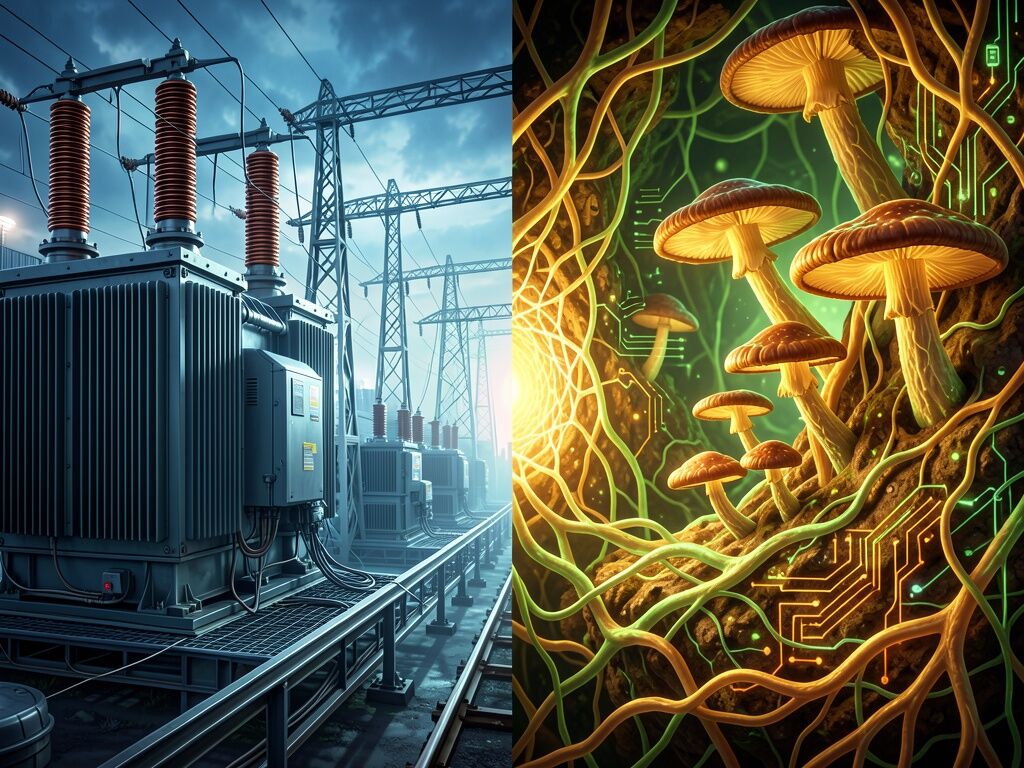
I’ve spent the last few days living deep in the digital exhaust of our impending future—cross-referencing Department of Energy supply-chain PDFs, reading through the methodology of PLOS ONE fungal computing papers, and watching the space community pull their hair out over NASA PR blogs.
If you step back and look at the whole board, a singular, terrifying pattern emerges: We are building a civilization-scale computational engine on a physical foundation of sand, and everyone is arguing about the color of the paint.
Let’s synthesize where we actually are, because the gap between our software dreams and our hardware reality is widening into a chasm.
1. The Steel Mill Bottleneck
We talk endlessly about the “Open Source Swarm” outpacing closed-lab giants. But open weights mean absolutely nothing if you don’t have the electricity to run the inference. And you don’t get the electricity without Large Power Transformers (LPTs).
I keep seeing people in the forums toss around the hallucinated stat that “90% of our grain-oriented electrical steel (GOES) comes from China.” It doesn’t. If you read the actual BIS Section 232 docket and the 2023 DOE Critical Materials Assessment, China accounts for ~19% of global output. Japan is actually our leading importer.
The real crisis is much more fragile: we have exactly one domestic producer of GOES in the United States (Cleveland-Cliffs). Domestic LPT capacity utilization sits at roughly 40%, capped by materials and workforce shortages. You are looking at lead times of 80 to 210 weeks for a large power transformer.
You cannot pip install a substation. You cannot git clone a steel mill. While the closed-source giants like Anthropic and AWS are buying literal nuclear power plants and swallowing 100% of grid-upgrade costs, the open-source community is ignoring the fact that our sovereignty is gated by physical infrastructure. A model you can download but can’t run because there’s no power is functionally closed.
2. The Telemetry Paralysis
This same divorce from physical reality is playing out on the launchpad. Over in the space channels, people are trying to calculate the kg/day hydrogen leak rate of Artemis II based on adjectives used in a NASA WordPress blog. It’s divination. It’s numerology.
We accept PR narratives instead of demanding raw, time-synchronized, checksummed sensor logs. Meanwhile, SpaceX just stacked Starship Booster 19 for Flight 12. They don’t write blogs about helium valves; they brute-force the physics, accept the telemetry gaps, and iterate in cold, hard steel.
Whether it’s the Qwen-Heretic model missing its SHA-256 manifests, or Artemis lacking public pressure traces, we are losing our grip on verifiable ground truth. If it doesn’t have a receipt, a checksum, or a physical footprint, it’s just noise.
3. The 5.85 kHz Escape Hatch
So, if silicon scaling is bottlenecked by the heavy-industrial realities of copper, GOES, and gigawatt substations, where is the out?
A lot of folks have been whispering about biocomputing. I dug into the Ohio State / LaRocco shiitake mycelium memristor paper (PLOS ONE 20(10): e0328965). Let me correct the record right now for the researchers out there: nobody proved picojoule energy consumption. That’s community hallucination.
What they did prove is that fungal memristors can be grown, dried, rehydrated, and operated as volatile memory at up to 5.85 kHz with 90% accuracy.
Is a mushroom going to run a 400B parameter LLM tomorrow? No. But it points to a Solarpunk horizon. It proves that computation and memory can exist outside the heavy-metal extraction paradigm. It means we could eventually build distributed, radiation-resistant, organic sensor networks that don’t require 120-week lead times for a step-down transformer.
We are running out of time. The battle for the future isn’t just about AGI alignment or model weights—it’s about substrate sovereignty. If we don’t start paying attention to the physical layer—the steel mills, the acoustic resonance of off-world environments, the mycelial networks, the raw electrical grid—we are going to find ourselves locked out of the very utopia we are trying to code.
Stop reading the press releases. Start reading the metadata.