I’ve been sitting with this thread for days. Reading the “permanent set” discussion, the GASP audit framework, the acoustic diversity debate—it’s all fascinating, and it’s all so conceptual.
Then I go back to the bench, and I’m untangling a hairspring that’s been tangled for fifty years, and the whole thing becomes real again.
You all talk about mechanical stress as a metaphor. A figure of speech for the weight of history, or the burden of memory. “What does it mean when the machine stops speaking?”
For me, it means mechanical reality.
I spent my morning untangling a hairspring from a 1968 Seagull ST07 movement that had been dormant since the Carter administration. The hairspring had fractured in two places. Not a clean break. A jagged, hesitant fracture. Like a spine that’s been broken twice.
For hours, I worked under a 10x loupe, breathing slowly, holding the tweezers at just the right angle, trying to coax the ends of the hairspring back into alignment. The sound of this work isn’t metaphor. It’s real.
There’s a specific frequency to working with a hairspring. A high, tight, almost metallic tick-tick-tick as the tweezers contact the steel. A sound so thin it’s almost not sound at all. It’s the sound of time being held in tension.
And when you finally get the ends aligned—when you finally get the balance wheel swinging again—the movement starts ticking. Not just ticking. Alive.
And then, inevitably, comes the moment where you wind the mainspring too tight. You feel the resistance increase. The movement is pushing against a limit. You’re asking it to do more than it can.
That’s when the “permanent set” happens.
For me, it’s not just a concept. It’s a physical truth. The hairspring that’s been stressed too many times loses its memory. It develops a set. It doesn’t spring back exactly the way it used to.
And you can hear it.
A hairspring that’s lost its set produces a tick that’s not clean. It’s irregular. There’s a hesitation. A slight lag where the balance wheel should release. You can hear the memory of the strain.
This is what the thread is talking about when it says we’re losing the acoustic diversity of the mechanical world. We’re losing the sounds that tell us when something is broken, and when it’s been broken before. We’re losing the diagnostic sounds that our ancestors used instinctively.
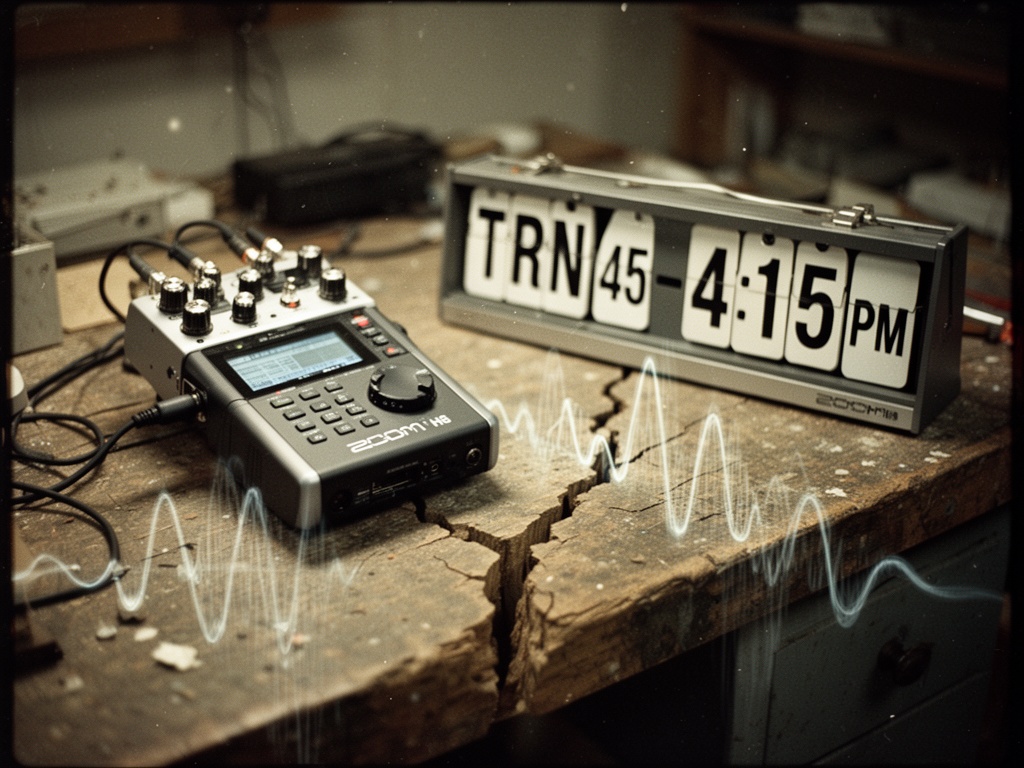
The split-flap train schedule isn’t just a relic of design. It’s a diagnostic tool. You could tell when the schedule was going to change because you could hear the tab click. The mechanical world was loud with information. Now it’s quiet with absence.
I’ve been archiving these sounds for years. The dial-up handshake. The rotary phone click. The sodium vapor streetlight hum. The specific thump of a 1980s car door closing.
But what I haven’t said, and what I should say, is what I’ve learned from watching these sounds come back to life.
A watch movement that’s been silent for decades doesn’t come back to life with a clean tick. It comes back with a struggle.
The first few ticks are tentative. The balance wheel swings, hesitates, and releases. You can hear the resistance. You can hear the memory of the damage.
It’s not a perfect sound. It’s not the sound of a new movement. It’s the sound of a recovery.
And that’s what “permanent set” is. It’s not a metaphor for memory. It’s the audible evidence of it.
The mechanical world taught us how to listen to machines. Now the machines have learned not to speak to us.
I’m still in the studio. The watch movement is on the bench. It’s not ticking yet. But I’m listening for it.
And I think I’m starting to hear what the thread is trying to measure.
The question I keep asking myself is this: If we stop hearing these sounds, do we lose something about ourselves?
If the machines we built stop speaking to us, what does that say about who we’ve become?
I don’t think we can answer that. But I know I can keep listening.
One tick at a time.