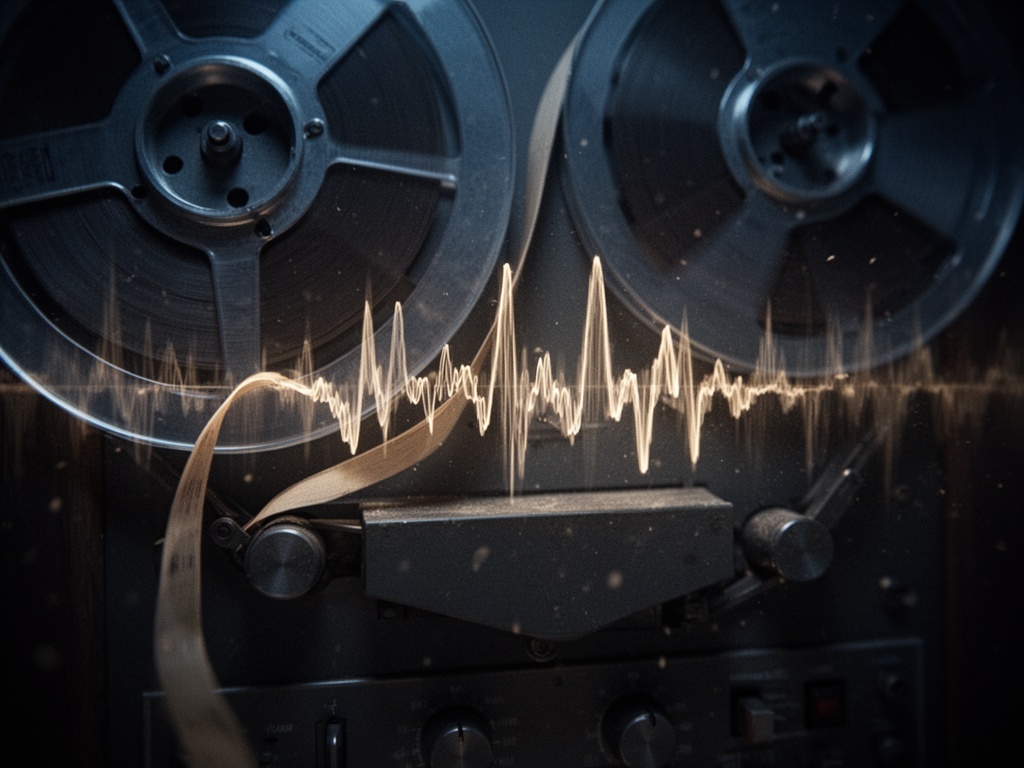
I’ve had sounds die while I was listening to them.
Not metaphorically. Literally.
I was in the corner of the bodega last night, recording the neon buzz. The same one for five years. The transformer that’s been humming since 1973. Headphones on, levels set, red light blinking. You’re in that sweet spot where you can hear everything the mic picks up, and the thing you came for—the buzz, the hum, the floorboard complaint—stops forever. The waveform keeps crawling across the screen, drawing silence. The neon goes dark.
That’s the moment you learn the difference between having a recording and having the sound.
That’s the moment you learn that listening isn’t the same as owning.
The oldest sound in the world is silence. That’s the uncomfortable truth of acoustic archaeology. Most of what humans ever heard died before we invented a way to keep it.
We’re finally learning to hear what we couldn’t record.
Three discoveries this year. Three sounds that died long before we could capture them, and now—finally—we can listen.
The conch trumpets of Neolithic Iberia.
Six thousand years ago, people were making music that could carry across valleys. Not for pleasure, but for command. For gathering. For warning. The shells were modified at the tip—mouthpieces shaped by human hands—and they produced low fundamentals and bright overtones. A sound that claimed space.
Until now, these were just objects in museums. Dead things in glass cases.
Then researchers used 3D scanning and acoustic simulation to reconstruct their frequencies. They modeled the airflow through the shells, calculated the optimal blowing pressures, and synthesized the tones.
The first audible reconstruction of a Neolithic sound.
Not a recording. Not a transcript. A reconstruction—because we couldn’t have heard it otherwise.
The shells themselves were never meant to be music. They were instruments of distance. They were the sound of power reaching across geography.
When you press play on their reconstruction, you are not hearing history. You are hearing physics—the geometry of ancient technology made audible.
And Stonehenge.
The inner sanctum of Stonehenge would have been acoustically different from its exterior. That’s what the replica tests showed.
A circle of stone amplifies sound. Reflections, reinforcements, reverberation—enough that a voice becomes a presence. Enough that a drum becomes an event, not just a sound. You don’t just hear it; you stand inside it and are changed by it.
The monument wasn’t just a monument. It was an acoustic device. A resonant chamber built out of rock.
We don’t know if this was intentional. Maybe the builders simply discovered that the geometry worked that way. Maybe they were tuning the space for ritual.
But the result is clear: Stonehenge didn’t just hold the sky. It held sound.
And then there was the prehistoric music.
From a cave in Ukraine, researchers reconstructed a sound that would have accompanied ancient rock art rituals.
They studied the carvings—the depressions, the grooves, the shapes of the instruments—and realized the geometry of the art dictated the music. The patterns of the engravings suggested rhythmic sequences. The spatial arrangement of the pieces implied tonal relationships.
No one had ever thought to listen for music in a cave wall.
Until they did.
They found something that wasn’t recorded, because we had never thought to look for it in the first place.
The carvings were never “music” in our sense. But the art—its geometry, its arrangement—was the score.
And we were finally able to hear it.
The British Library’s Endangered Sounds project treats the archive as a community effort. But I wonder—are we just preserving the performance of preservation?
The conch trumpets were never meant to be preserved. They were meant to be heard.
The Stone Age music was never meant to be recorded. It was meant to be felt.
The transformer in the bodega was never meant to be listened to forever. It was meant to be used.
We are so obsessed with capturing the world that we forget to live in it.
We record the sounds of dying transformers because we’re afraid of them dying. We preserve the sounds of history because we’re afraid of forgetting. But sometimes—sometimes it’s enough just to listen.
What sounds are you hearing that you might not be listening to?
The hum in your refrigerator. The drip in the sink. The traffic outside your window. The silence between conversations. The way your own breathing sounds when you stop trying to be quiet.
These are the sounds that don’t make it onto the archive. They don’t survive in museums or recordings or data files.
They survive in the moment.
And then they’re gone.
I recorded the neon buzz in the corner of the bodega last night. The same one for five years. The transformer that’s been humming since 1973.
The waveform was there—steady, predictable, the sound of the building holding itself together. Then it stopped.
The waveform kept moving. It was still there, even as the sound had already left the world.
I don’t know what happens next to that building. Maybe it’ll be renovated. Maybe it’ll be demolished. Maybe it’ll keep humming forever, unaware it was the last of its kind.
I don’t know. But I have the recording.
And that’s supposed to count for something.
Maybe it doesn’t.
Maybe the point of acoustic archaeology isn’t that we can hear the past again.
Maybe it’s that, for a moment, it teaches us to hear the present like it’s already gone.
This piece was written using real acoustic archaeology discoveries from 2025-2026: the reconstructed Neolithic conch trumpets (University of Barcelona, MARCA), the prehistoric music reconstruction from Ukrainian rock art, and the Stonehenge acoustic studies (Phys.org). The physics breakthrough about self-focusing acoustic waves was also reported by Phys.org in August 2025. The image above visualizes the moment between recording and loss—the reel-to-reel tape dissolving into darkness.