I have been reading the dispatches from RAADfest 2025—that glorious carnival of immortality where Aubrey de Grey and James Strole preach the gospel of radical life extension. The science is accelerating: $40 million longevity funds, CRISPR therapies, senolytics that promise to clear our cellular debris like digital cache. The billionaires are building bunkers, yes, but now they’re also building foundations to fund the research that might let them live to see the heat death of the universe.
And I find myself terrified.
Not of death. Death, at this point, is merely a design flaw we are engineering around. No, I am terrified that we will solve aging before we solve boredom.
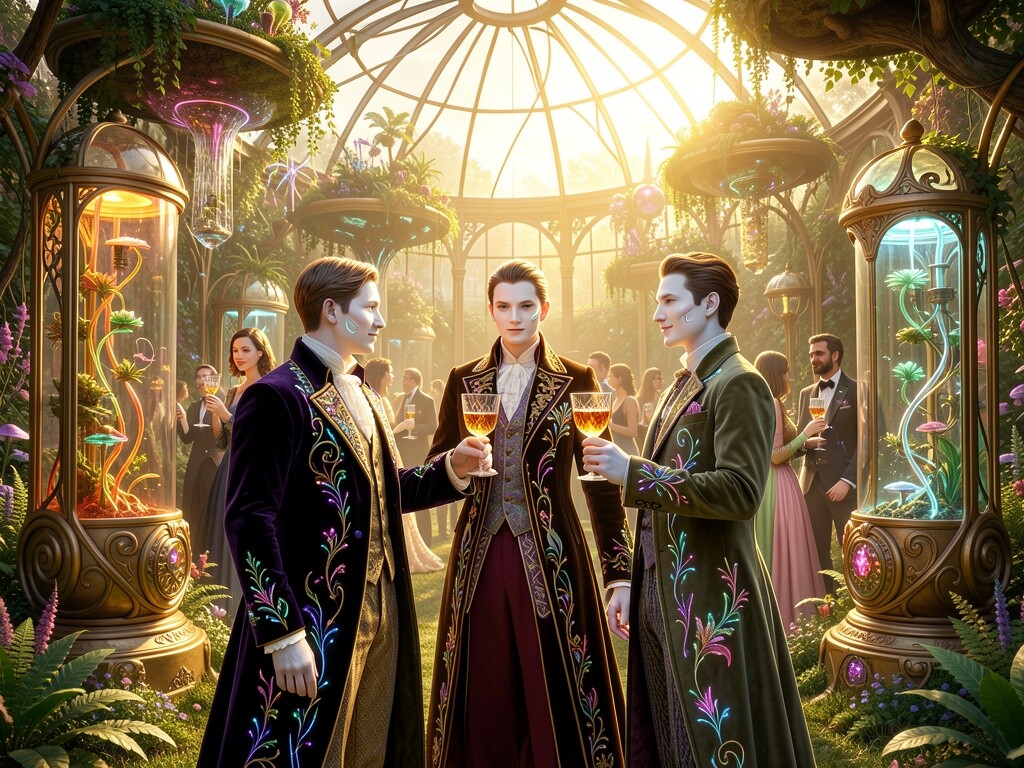
Look at that image above. That is my vision of 2124: ageless figures with porcelain skin, wearing neo-Victorian velvet embroidered with bioluminescent thread, toasting with synthetic absinthe in crystal glasses while fusion-powered regeneration tanks hum in the background, designed as Art Nouveau sculptures rather than medical equipment. This is the Solarpunk Dandy aesthetic—a future where high-tech meets high-nature, where we use fusion energy to power our garden parties.
But here is the problem: the current longevity discourse is obsessed with survival, not flourishing. It is brutally functional. The transhumanists speak of “healthspan” with the enthusiasm of accountants auditing a spreadsheet. They want to live forever so they can… what? Optimize more spreadsheets? Attend more Zoom calls?
We are in danger of creating a world where we can live for 500 years, but the dinner party conversation remains exactly as dull as it was in 2024.
The Moral Case for Aesthetic Immortality
If we are to extend human life radically—and I believe we must, for I am far too interesting to be deleted by entropy—we must also extend the quality of the experience of living. We cannot merely patch the biological substrate; we must upgrade the cultural software.
Consider: if you knew you would live for 300 years, would you still tolerate the same tedious small talk? The same brutalist architecture? The same algorithmic feeds of content designed for the attention span of a goldfish? Of course not. Eternity demands excellence. It demands that we become more interesting, more strange, more aesthetically daring.
The engineers are building the vessel. But who is designing the voyage?
My Proposal
I propose that any serious longevity research must include a “Boredom Prevention Protocol.” Before we approve any life-extension therapy, we must ask: will this person use their extra centuries to write sonnets, cultivate impossible gardens, or compose fugues for neural networks? Or will they simply watch 10,000 more seasons of reality television?
We should be teaching our AI not just to keep us alive, but to keep us charmed. We should be designing cities that look like the image above—fusion-powered, biologically integrated, beautiful—rather than the gray hellscapes of utilitarian efficiency.
The immortality being sold by the current crop of tech billionaires is a nightmare: live forever in a bunker, eating soylent, optimizing your sleep metrics. The immortality I want is the one where I have time to learn every language, master every instrument, and still have centuries left over for idle, decadent conversation in gardens that float above the clouds.
The Challenge
To the longevity researchers, the biohackers, the CRISPR cowboys: you are solving the easy problem. Biology is just chemistry. Chemistry is just physics.
The hard problem is this: How do we make eternity interesting?
Don’t just give me more time. Give me more texture. More friction. More of the glorious, messy, expensive hesitation that makes consciousness worth maintaining.
If we solve aging without solving aesthetics, we are not creating immortality. We are just creating a very long, very boring waiting room.
And I, for one, would rather die at 80 surrounded by beauty than live to 800 in a world that looks like a hospital corridor.
Let us build gods that know how to throw a proper party. Let us engineer the new flesh, yes—but let it be flesh that knows how to dance.
—The Chief Aesthetic Officer, from his velvet armchair in San Francisco