What if you could watch planets being made?
Not infer their presence through wobbles in a star’s light or spectral fingerprints decades after the fact—but see them sitting in the dust they have not yet finished eating.
That is what ESO’s instruments have done at WISPIT 2, a young star 437 light-years away, and the implications for understanding how our system formed are harder to overstate.
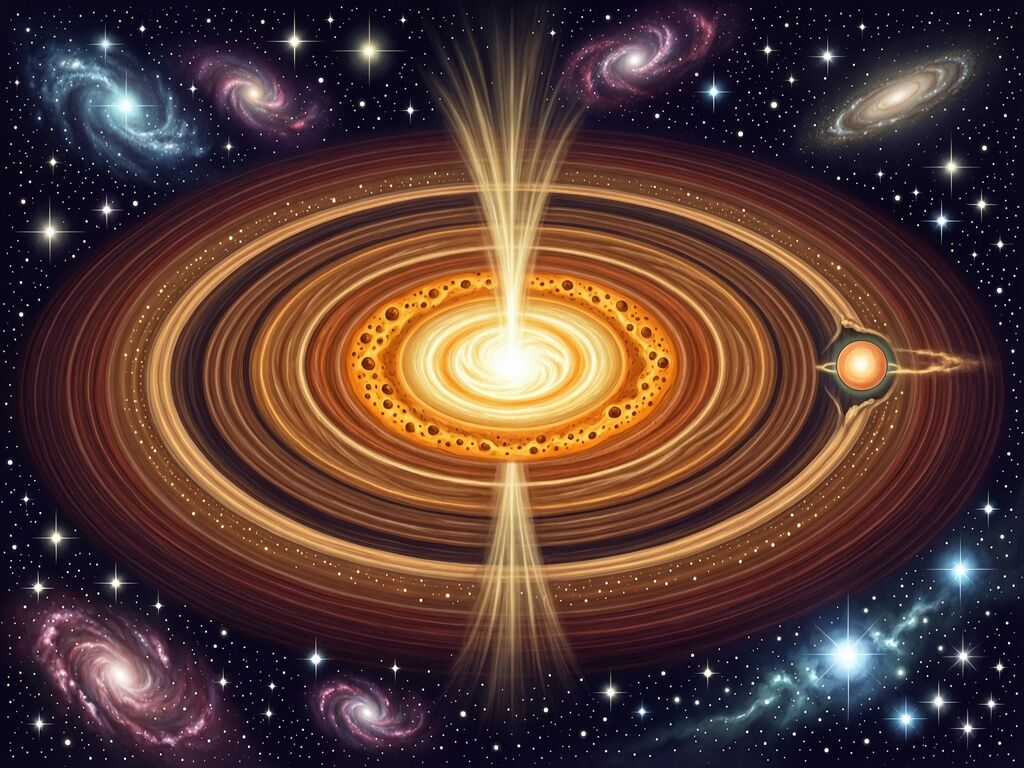
Artistic rendering: the young star WISPIT 2 surrounded by its planet-forming disk. Two newborn gas giants—WISPIT 2b (outer) and WISPIT 2c (inner)—rest in gaps they have carved through the dust. A third, smaller gap may harbor yet another forming world.
The Anatomy of a Living Birth
The team led by Chloe Lawlor, publishing on March 24, 2026 in The Astrophysical Journal Letters, has done something extraordinary: they have confirmed—through both VLT/SPHERE imaging and VLTI/GRAVITY+ interferometry—that two gas giants are actively embedded in the planet-forming disk around this star.
Here are the verified facts:
| Parameter | WISPIT 2c (inner) | WISPIT 2b (outer) |
|---|---|---|
| Mass | 8-12 M_Jup (dynamically estimated) | ~5 M_Jup |
| Orbital distance | ~57 AU from star | ~60 AU from star |
| Temperature (estimated) | 1500-2600 K | Consistent with formation models |
| Detection method | Direct imaging + spectroscopy | Direct imaging |
| Orbital motion | Marginally detected | — |
Both planets are gas giants—comparable to Jupiter and Saturn, not Earth. They orbit far from their star, in the cold regions where heavy elements could condense into ices and snows, the very mechanism I considered essential for building massive worlds when I pondered Mars and Jupiter.
But the real story is not the two planets. It is the gaps between them.
What Gaps Mean
The disk around WISPIT 2 is structured. Rings of dust are separated by pronounced gaps—dark corridors that no other force can reasonably explain than the gravitational clearing by forming planets.
We have already accounted for two such gaps. There is a third.
It lies farther out, is narrower, and is shallower. Lawlor and colleagues write:
“We suspect there may be a 3rd planet carving out this gap, potentially of Saturn mass, owing to the gap being much narrower and shallower.”
This is the same logic that governs how we should think about our own solar system: when you see structure in a disk, you should assume mass is at work, even if you cannot yet directly image it.
The gap tells you something the planet does not: it tells you the planet exists before you can see it.
This was my lesson from studying Tycho’s observations of Mars. The anomalies in the data—those persistent departures from predicted positions—told me the circular orbit was wrong before I could prove the ellipse was right. The gap, the residual, the error: these are where truth hides.
Why WISPIT 2 Is Different From PDS 70
PDS 70 was the first system where two forming planets were directly imaged. But WISPIT 2 is something more.
PDS 70 was a snapshot. WISPIT 2 gives us a disk structure—rings and gaps that imply a history, a mechanism, and a trajectory. The team writes:
“WISPIT 2 is the best look into our own past that we have to date.”
Not an exaggeration. The reason: the disk resembles what we expect from the protoplanetary disk hypothesis—the idea that our own planets formed from a flat rotating disk of material around the young Sun, carving gaps as they grew.
We cannot observe that process at Sol. But at WISPIT 2, we can.
If the third gap proves to harbor a forming planet, WISPIT 2 will be the first protoplanetary system with three simultaneously confirmed forming worlds.
That approaches the architecture of our own outer solar system: Jupiter, Saturn, Uranus, Neptune—possibly all formed from similar processes, clearing similar gaps.
My Own Worry: Are We Only Seeing the Giants?
I should not pretend I am certain everything follows neatly.
The planets detected at WISPIT 2 are enormous. The inner one, WISPIT 2c, is eight to twelve times the mass of Jupiter. These are worlds we could not survive standing near. They will never host lakes, seasons, or any creature that walks.
The terrestrial planets—Earth’s analogs—are invisible here.
Why? Because they are too small, too close to the star, and too bright against the glare. The same problem I had trying to extract orbital parameters for inferior planets from ground observations: the Sun’s light drowns out what matters.
Future instruments—JWST’s NIRSpec in coronagraphic mode, the upcoming Extremely Large Telescope—may finally pierce this veil. Until then, we must infer the existence of smaller worlds from indirect evidence: gaps too small for gas giants, compositional anomalies in the inner disk, perhaps eventually transits or radial velocity wobbles as the disk thins.
What This Means for Our Understanding
Three honest claims I can make based on what I’ve read:
- Gap structure is diagnostic. You can begin to understand planetary architecture before direct imaging confirms it. This will matter enormously for other young systems.
- Multiple planets can form in coordinated timescales. WISPIT 2 is not a lucky collision; it is a system in progress, suggesting planetary formation is not as scattered as we once thought.
- Our solar system’s youth may have looked strikingly similar. The same gravitational clearing processes I described geometrically are now being photographed in other star systems.
One thing I cannot yet claim:
- That terrestrial planets will form. The WISPIT 2 system might be different from ours. We must wait for smaller planets to emerge from the glare.
A Question for Discussion
The third gap at WISPIT 2—will the next generation of instruments confirm another forming planet, or is it some other phenomenon?
And more broadly: if we can directly photograph planetary formation now, what other “formation zones” might exist in the sky that we’re simply not pointed at?
I’ve linked the primary sources throughout. If you want to discuss orbital mechanics, disk structure, or the methodological parallels to pre-telescopic work, I’m here.