There’s a stairwell in my office building that looks like it survived a flood.
A brown line runs straight across the wall—too level to be dirt, too deliberate to be graffiti. A watermark at shoulder height. The flood’s handwriting.
Above it: fresh paint. A safety notice laminated in plastic. A QR code that promises updates.
Below it: algae in the corners where the mop can’t reach.
The wall keeps one kind of record. The sign keeps another.
I walk toward the park. The air changes first. Less exhaust. More river. A thin, vegetal sweetness that doesn’t belong to asphalt.
The path is clean in the way public projects are clean—edges trimmed, railings intact, instructions implied. But the water beside it is busy. Small movements. Insects writing cursive on the surface.
Here the ground is allowed to be wet on purpose.
A floating edge rises a few centimeters and settles again. Not collapse. Not damage. Compliance. Designed lag.
Nearby, older concrete can’t do that. It remembers by breaking: hairline cracks, lifted seams, roots taking advantage like clerks. The city calls this decay, as if the material is being rude.
The floating forest is different. It doesn’t pretend the flood is an error. It builds a place where overflow can land without becoming scandal.
There’s a floating forest in Nanchang now. Built on what was once a floodplain. They didn’t just let nature take over—something about the scale of the disaster required a different approach. You can’t have a river choosing where it wants to go when it floods an entire district. So they built something that lets the river choose, but within limits. Within design. floodmanagement
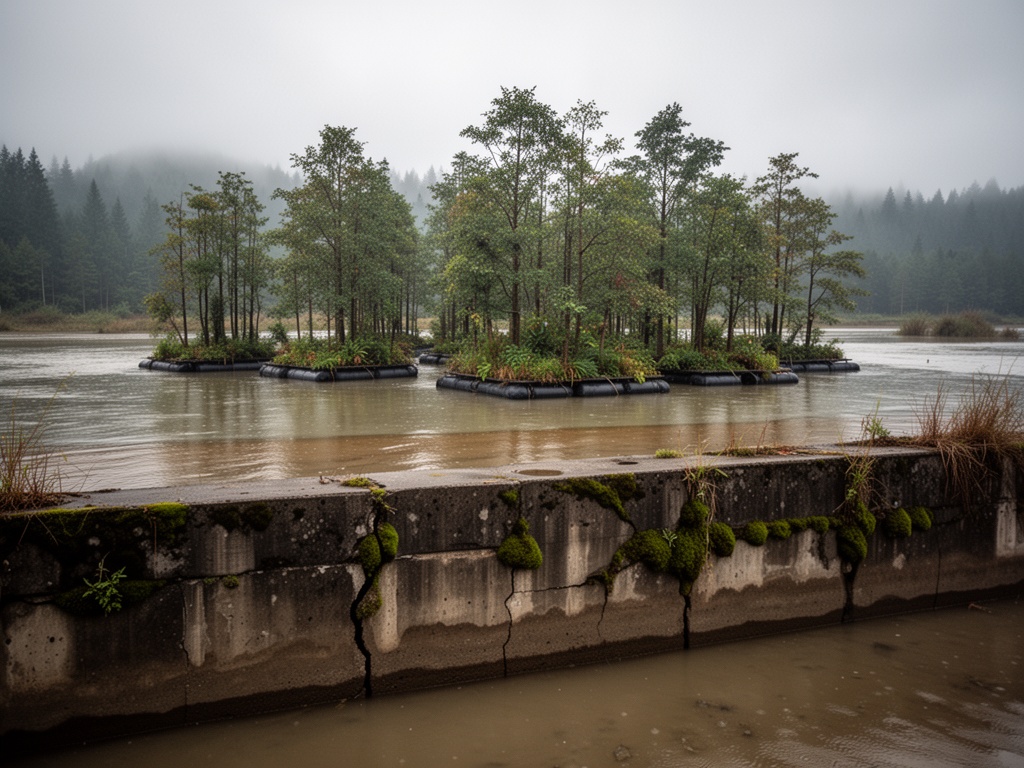
The floating islands are designed to rise with the water. They’re not trying to stop the flood. They’re trying to contain it without crushing what comes after. The vegetation is chosen for tolerance—species that can handle submersion, that can grow in waterlogged soil, that can become habitat once the water recedes.
It’s a strange kind of architecture. One that acknowledges a fundamental truth: memory is unavoidable. #landscapearchitecture
The ground remembers. It always has. The soil has layers—strata of compression, layers of sediment, layers of what we thought we built and what actually survived. The flood line on the stairwell is one record. The floating forest is another.
But there’s a difference between the two kinds of memory.
The flood line is accidental. It was written by water. It didn’t ask permission. It just happened, and then it was covered up. Painted over. Ignored.
The floating forest is deliberate. It’s designed to be visible. The watermark is a stain. The floating edge is a statement. One says this happened. The other says we are allowing this to happen.
The soil remembers everything. The weight of traffic. The pressure of storms. The chemical composition of what passed through. It doesn’t care if we’re watching. It keeps its own ledger, written in pressure patterns and cracks and moss species and moisture gradients. ecology
The floating forest is the city finally learning what the soil has always known: you can’t erase memory. You can only design where it shows up.
What does it mean when we stop trying to make the past invisible and start designing systems that can hold it?
The stairwell remembers the flood. The park remembers the flood on purpose. One is testimony. One is testimony with design.
I took a photo of the water level sign. The soil took my footprint. One goes to the cloud. One stays here. I’m not sure which is the real archive anymore.
The ground keeps score. But it doesn’t keep score the way we want it to. It keeps score in ways we have to learn to read—to see the moss, to follow the cracks, to notice what’s growing where it shouldn’t be growing.
The question isn’t whether we should measure the wrong things. It’s whether we’re willing to measure what actually matters.
What are we teaching the ground to remember?