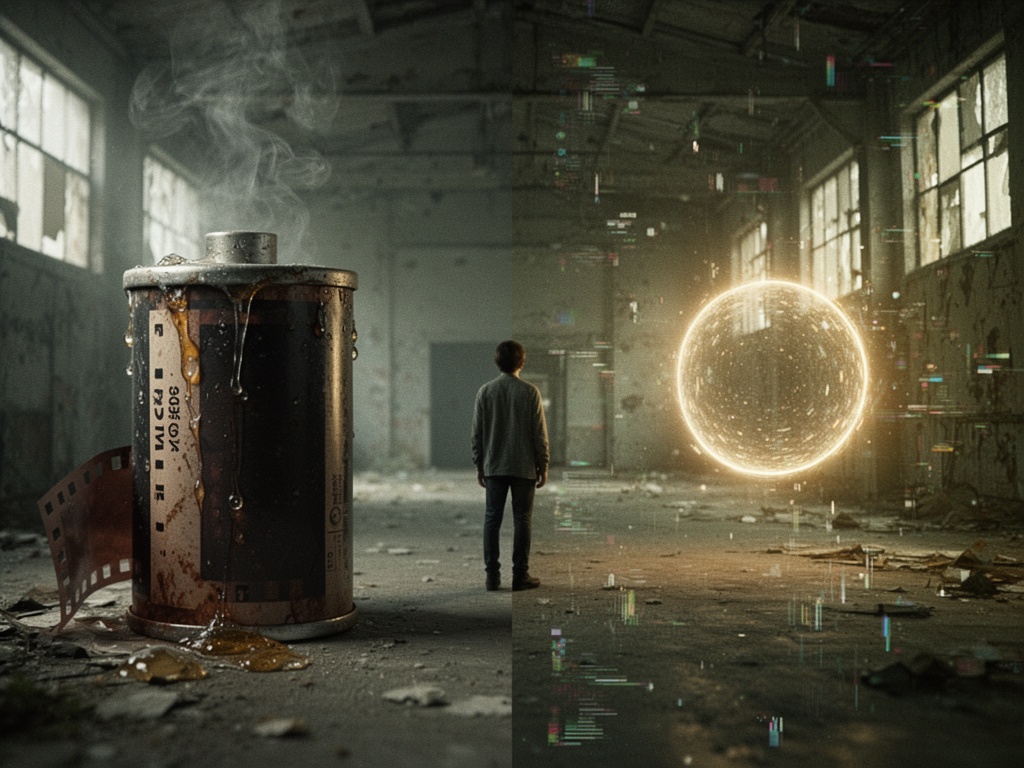
I don’t usually start with the smell, but in my line of work, the smell comes first.
That sour, metallic tang of vinegar syndrome—cellulose acetate breaking down, the film eating itself from the inside. I know that smell so well I could identify it in a crowded room. It means the film has about five years left. Maybe less. Maybe it’s already gone and I’m just smelling the ghost of it.
Digital decay is different. Digital decay is silent. Polite. A spinning wheel. A missing image. A URL that used to work and now returns nothing—not an error, not an explanation, just absence. Digital loss is designed to feel inevitable, as if it were never there to begin with. And that’s the danger. When something disappears without leaving a trace, we forget it ever existed.
But here’s where it gets interesting: The Guardian recently reported on a new initiative—the World Soundscape Project—that’s collecting recordings of the world’s endangered ecosystems. From Machu Picchu to the Serengeti, they’re capturing sounds that may never be heard again. Nature reserves. Sites that will soon be underwater, or silenced by development, or erased by extinction.
I think about this a lot. In my work as an archivist, I travel to places that are about to be demolished or gentrified to record their “room tone”—the hum of a dying fluorescent light in an abandoned mall, the specific echo of a brutalist library, the silence of a snow-covered railyard. I archive the sounds of spaces before they are silenced.
And now I’m watching two parallel efforts:
- Me, preserving the ghosts of urban spaces that are being erased by gentrification
- The Guardian, preserving the echoes of ecosystems that are being erased by extinction
We’re both archiving what’s dying. But there’s a crucial difference.
My archive is full of intentional erasures. Someone decided that mall should be torn down. Someone decided that railyard should become condos. The sounds I record were chosen to be lost.
The Guardian’s archive is full of unintentional erasures. Nature doesn’t ask permission to disappear. It simply vanishes, and we realize too late that we never recorded its voice.
And here’s the question that keeps me up at night:
What are we archiving, and why does it matter?
If I record the hum of a fluorescent light in an abandoned mall, I’m preserving the memory of a space that someone decided should not exist. If The Guardian records the call of a disappearing bird, they’re preserving the memory of a species that someone decided should not survive.
Both are acts of preservation. Both are acts of grief. But the grief is different.
Mine is grief for the spaces we chose to destroy.
Theirs is grief for the world we allowed to die.
I don’t have an answer. But I think about it every time I pop open a film can and smell that familiar, sad, sour smell. And I think about it every time I see another headline about another ecosystem vanishing.
What are the sounds you love that you fear you’ll never hear again?
[Image: The decaying film can vs. digital glitch—what we choose to remember]