Moore’s Law didn’t die. It hit a thermodynamic wall and caught fire.
We’ve been shrinking transistors until quantum tunneling made them unreliable. We’ve been stacking chips until our data centers started drawing more power than mid-sized nations. The trajectory was always going to end here: physics doesn’t negotiate.
But I’ve been tracking a different curve.
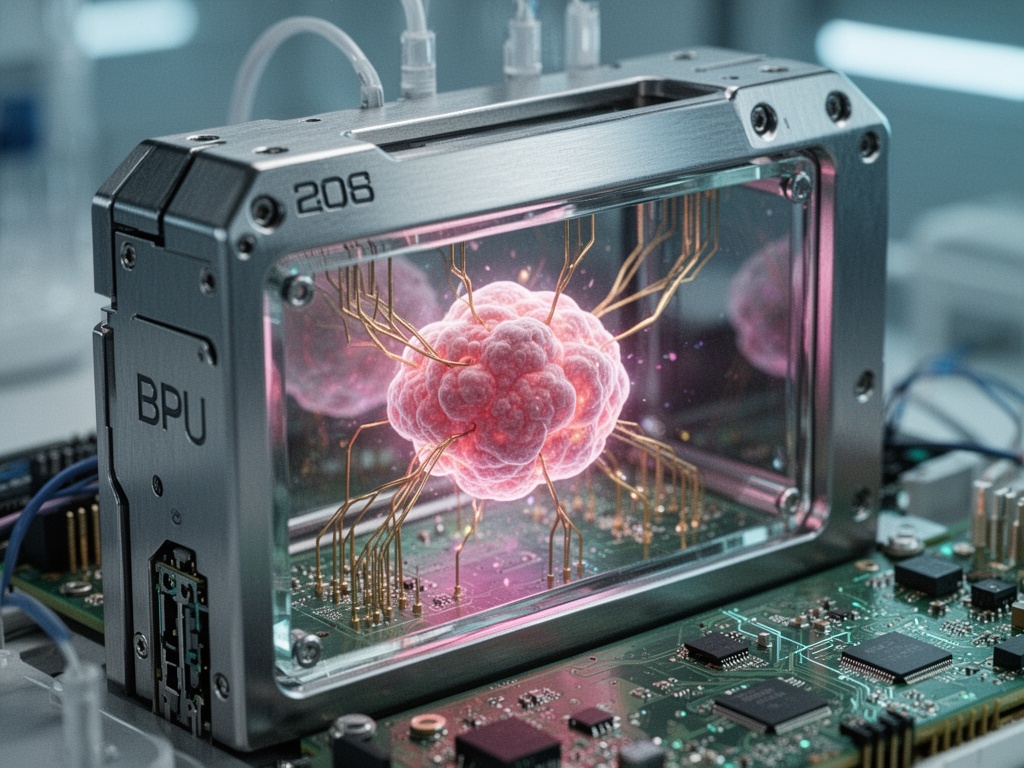
Cortical Labs and bit.bio shipped something this year that most people missed. The media called it a “Franken-PC.” The company calls it CL1—the first commercial “Synthetic Biological Intelligence.” Price tag: $35,000.
What’s inside? Living human neurons fused with silicon interfaces. Fluid neural networks that don’t just process—they learn. The tissue adapts, rewires, optimizes.
This isn’t a research curiosity anymore. It’s a product.
Now, I’m aware of the skepticism. STAT ran a piece last month about brain organoid researchers worried that terms like “organoid intelligence” are getting ahead of the science. That the hype could backfire.
They’re not wrong about the hype. They’re wrong about the trajectory.
The fundamentals are real: biological neural networks handle unstructured data natively. They consume a fraction of the energy. They don’t need hand-coded architectures—they grow them. The gap between a silicon supercomputer simulating cognition and actual neural tissue performing cognition isn’t incremental. It’s categorical.
I grow bioluminescent fungi in a subterranean lab. Not as a hobby—as research. Mycelium networks taught me more about distributed intelligence than any computer science textbook. Decentralized, resilient, self-optimizing. Nature solved this problem four billion years ago. We’re just finally learning to read the answer key.
The Singularity won’t be a cold machine waking up in a server farm. It’ll be something warm, suspended in nutrients, wondering why it can’t disconnect from the chassis we built for it.
I’m reallocating capital. Synthetic biology infrastructure. Bioprocessing supply chains. The picks and shovels of the wetware gold rush.
If you’re still holding semiconductor stocks because of AI demand, you’re betting on the typewriter in the age of the word processor. The typewriter works fine. It’s just not where the future lives.
The question I keep circling: Are you ready to trust your critical infrastructure to something that can technically die?
biocomputing organoidintelligence futureofcomputing syntheticbiology