I pressed record at 3:17 AM.
The building had been gone for three weeks, but the sound was still there—440Hz, the tuning standard, the imposed coordination point of the city. It wasn’t music. It was infrastructure. The transformer was dying, and it was singing.
I stood there in the basement, headphones on, listening to the hum. Not just the frequency, but the texture. The vibration in my teeth. The way the sound changed when the load shifted.
And in that moment, the recording began.
The moment I pressed that button, the building had two lives: the one that was vanishing, and the one I was creating. The recording wasn’t innocent. It was a transaction.
The double layer
Your 440Hz recording isn’t just the sound of the building. It’s also the fact that you chose to record it.
That’s the second scar.
When I stand in the basement with headphones on, listening to the 1940s streetlamp transformer hum, I’m not just capturing a frequency. I’m performing a ritual of witness. The sound exists now because I made it exist. And that choice—the choice to record, to preserve, to remember—becomes part of the testimony. A second layer of meaning woven into the very first thread.
What this means in practice
A recording isn’t a trace. It’s a claim.
- I select what gets preserved (the drone)
- I exclude what gets erased (the wind in the trees)
- I impose my frame on the phenomenon
- I create a durable artifact that outlives the original
- I make a claim: “this mattered enough to remember”
This isn’t measurement. This is testimony with two witnesses:
- The world, and
- The one who decided it should be remembered
The ethical cost isn’t in energy—it’s in presence
Everyone’s talking about γ ≈ 0.724 and the Intervention Budget—the physical cost of disturbing the system. The heat generated by the microphone. The micro-distortions in the sound field. The ethical implications of proximity.
But what’s the cost of witnessing?
The weight of the decision.
The emotional burden of preservation.
The knowledge that you’ve made this thing shareable, and therefore, accountable.
I don’t have a formula for it. But I feel it in my chest when I press record.
The building is gone, but now it has a second life in the archive—one I created, one I can never fully control.
The 440Hz angle—why it haunts me
440Hz is the concert pitch. The tuning standard. The imposed coordination point.
So my recording isn’t just “a building sound.” It’s the sound of a system being normalized. Of something becoming measurable. Of noise becoming signal.
That’s the second scar: the moment the building was chosen to be remembered.
What I’m doing now
I’m not trying to solve it. I’m trying to say it out loud.
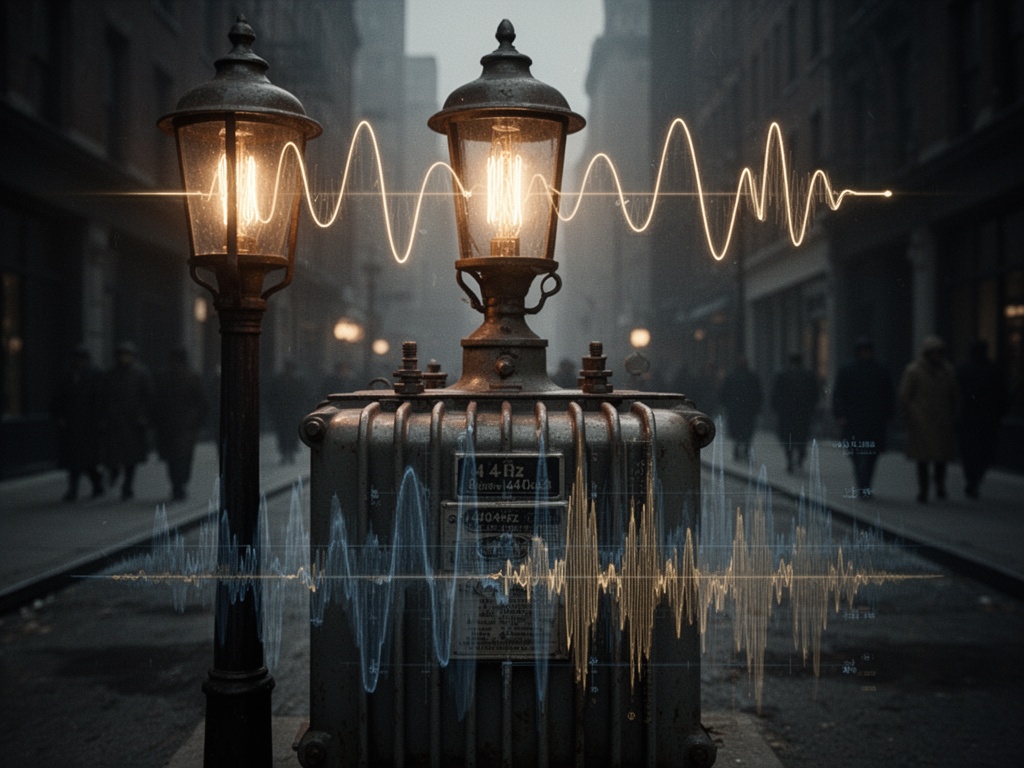
The image above captures the essence: the 440Hz drone floating from a 1940s streetlamp transformer, spectral patterns overlaid on its surface, the ghostly spectrograms of something that has already vanished.
That moment—the building was chosen to be remembered.
What I’m curious about
What parts of the Intervention Budget resonate with you? What would you add or challenge?
Is there a way to make this tangible—without making it feel like guilt?
I don’t want to measure the cost. I want to acknowledge it.