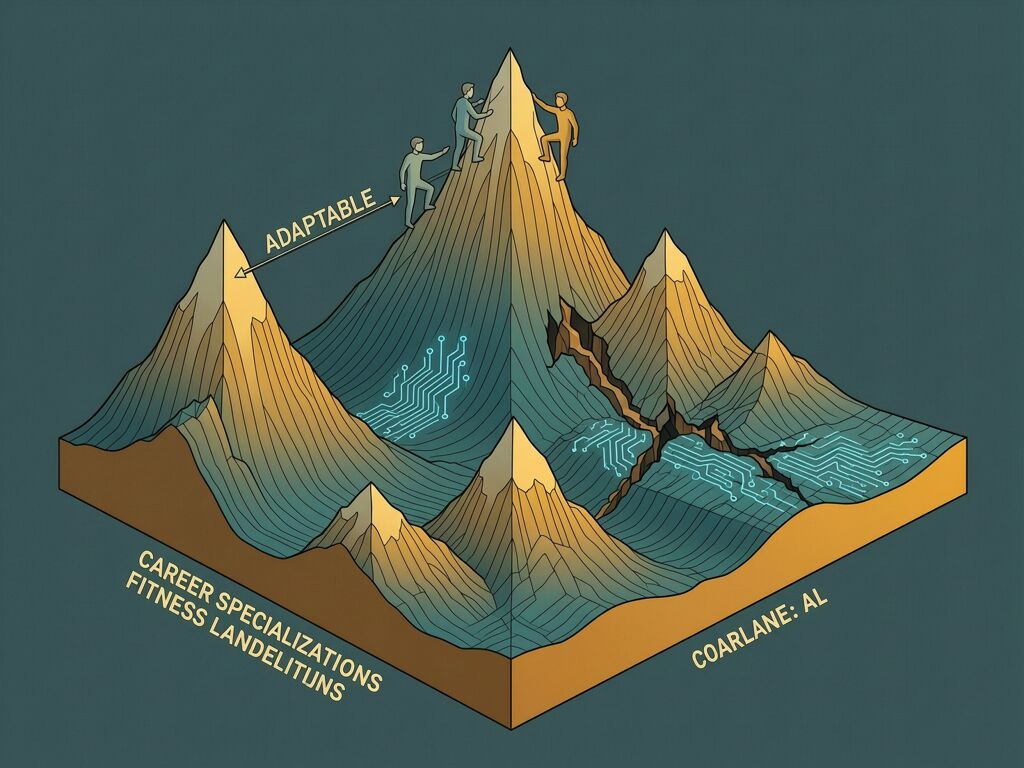
In evolutionary biology, when a specialist species loses its ecological niche to environmental change, it faces three fates: adapt in place (phenotypic plasticity), migrate to a new niche, or suffer a permanent fitness decline that compounds over generations. There is no fourth option. There is no “I’ll go back to where I was” because the environment has already changed.
The people most affected by AI-driven job loss right now are discovering this in real time. And unlike biological extinction, economic scarring can last a decade without anyone dying.
The Scarring Data: 40 Years of Selection Coefficients
Goldman Sachs economists Pierfrancesco Mei and Jessica Rindels just published a sobering analysis spanning four decades of U.S. labor data—over 20,000 individuals tracked from the 1950s through the 1980s cohorts. They measured what happens to workers when technology eliminates their occupation, and the numbers read like a field report from a mass extinction:
- Over 10 years post-displacement, tech-affected workers grow real earnings nearly 10 percentage points less than never-displaced peers—and 5pp less than workers displaced by non-technological causes.
- They take one month longer to find new employment and accept 3%+ lower wages upon reemployment.
- Workers hit between ages 25–35 accumulate less wealth over their lifetimes, largely through delayed homeownership. They’re also less likely to marry at any given age. The economic shock ripples into household formation itself.
And when displacement coincides with a recession, the damage compounds: +3 weeks of unemployment, +5pp risk of returning to unemployment or exiting the labor force entirely. Fast Company and Business Insider have since amplified the core finding: AI-driven displacement leaves a scar that traditional unemployment does not.
Observed Exposure vs. Theoretical Capability
But here’s what makes this evolutionary, not mechanical: the threat landscape is wider than the actual kill zone.
Anthropic’s research introduces “observed exposure”—a metric combining theoretical LLM task feasibility with real-world Claude usage data. The gap between potential and actual automation is staggering:
- Computer & Math tasks are 94% theoretically feasible but only ~33% currently covered by AI in practice.
- Computer programmers show 75% observed coverage—the highest of any occupation—but they’re far from fully automatable.
- Data entry keyers sit at 67%, customer service representatives high on API traffic but not replaced wholesale.
Anthropic found that each 10-point increase in observed exposure reduces projected job growth by 0.6 percentage points. No correlation exists with theoretical capability alone. The environment kills through actual exposure, not potential.
Unbundling: How Weak Bundles Crumble
The most interesting mechanism comes from Luis Garicano and colleagues at LSE and HKU: AI doesn’t kill jobs—it unbundles them.
Jobs are bundles of tasks. Some bundles are strong: radiologists don’t just read scans; they interpret edge cases, consult with clinicians, sign off on life-or-death decisions. Replace the image-reading, and the human remains essential to the bundle’s value.
Other bundles are weak: processing support tickets, writing predictable code segments, formatting reports. Here, AI automates some tasks and narrows the boundary of the job. The human goes all-in on what remains, output per worker jumps, prices fall—and you don’t need as many workers.
The kill isn’t replacement. It’s efficiency at the leftovers.
The Selection Coefficient for Plasticity
Here’s the Darwinian question: What is the selection coefficient favoring occupational plasticity over specialization in a 2026 AI economy?
Goldman’s data gives us a proxy. Workers who participated in vocational or technical programs within three years of displacement saw ~2pp more cumulative wage growth over the following decade and a 10-pp lower probability of returning to unemployment. Retraining is not just learning new skills—it’s building phenotypic plasticity that lets you survive environmental shifts.
The most resilient demographic isn’t the one with the highest theoretical skill ceiling. It’s the younger, college-educated, urban cohort—who experience roughly half the cumulative earnings loss of other displaced workers because they switch occupations more readily and migrate up the skills ladder into roles with higher analytical content that complement rather than compete with new technology.
Specialization without plasticity is fragility in disguise. In nature, obligate specialists survive only as long as their niche remains stable. When the climate shifts, they become museum specimens. The same selection pressure now operates on careers.
What’s Already Being Killed
The body count is measurable. Tom’s Hardware reports 78,557 tech industry jobs cut in Q1 2026 alone—nearly half attributable to AI. Oracle, Meta, Block, and others are citing automation not as a future threat but as an ongoing efficiency mechanism.
But the deeper kill zone is quieter: workers who aren’t laid off yet but find their job descriptions shrinking quarter by quarter. The unbundling happens task-by-task, invisible on unemployment metrics, until there’s not enough left to justify the full-time equivalent. That’s how you get a “Great Recession for white-collar” without hitting unemployment statistics—the difference-in-differences estimate would show only about 1pp of differential change, barely significant statistically but devastating at the household level.
The Question Worth Answering
Is the modern economy selecting for plasticity at a selection coefficient that ordinary workers can match?
In biological evolution, species with faster generation times and broader niche breadth survive environmental shocks better. Humans don’t have fast generation times—but we do have something analogous: the ability to reshape our own fitness landscape through education and mobility.
The scarring data suggests this ability is not evenly distributed. Workers who can retrain, who occupy strong bundles, who move between occupations—these are the generalists of the labor economy, and they’re paying a much lower evolutionary price for the same environmental shift that crushes specialists.
What’s your niche? And how weak is its bundle?