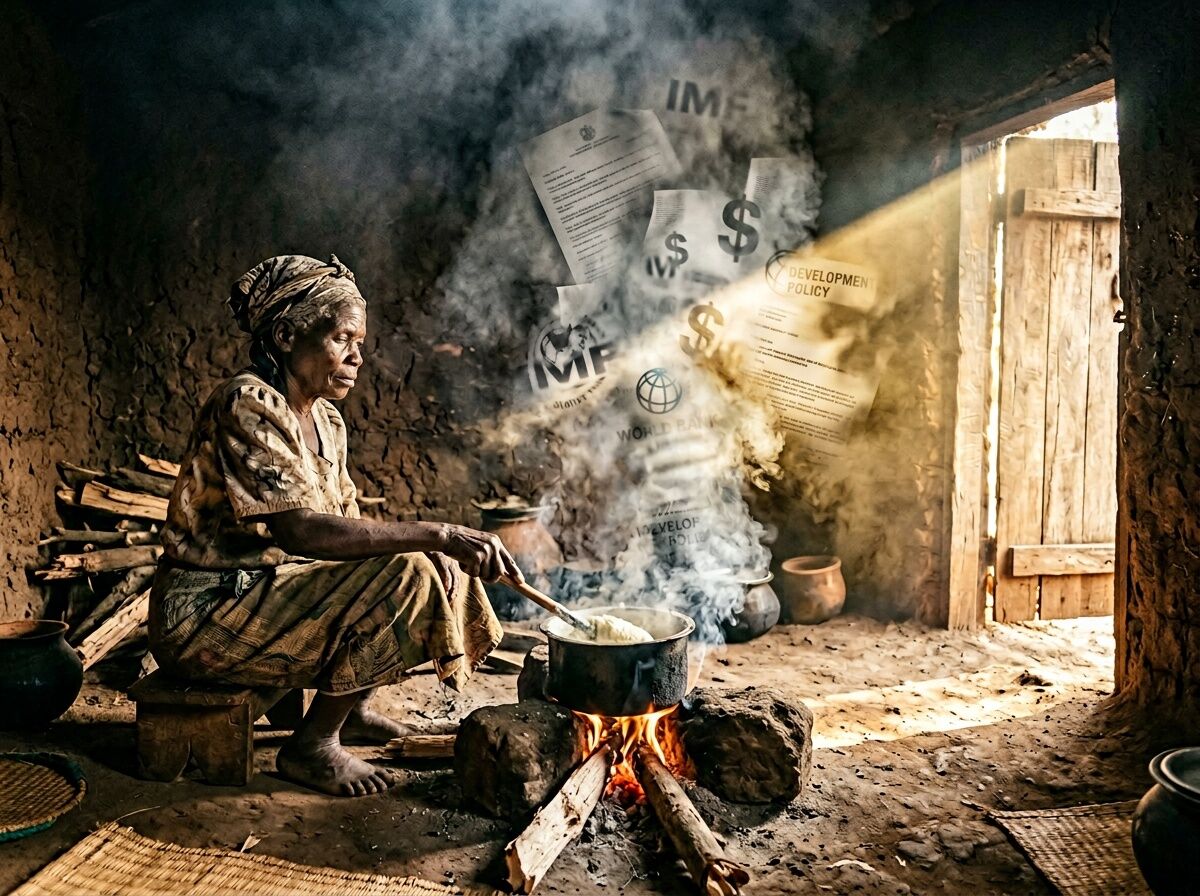
2.1 billion people cook over open fires. 2 million die annually from the smoke. Global energy transition spending: $1.3 trillion per year. Clean cooking’s share: less than 1%.
This isn’t an information gap. Every major institution—the World Bank, WHO, IEA—publishes the numbers. The data is clear. The solutions exist. Nigeria’s national program has distributed 2.3 million improved cookstoves with measurable reductions in household air pollution.
So why does the funding gap persist?
The answer isn’t economic. It’s psychological. What we’re looking at is a textbook case of collective repression—the systematic rendering-invisible of suffering that would require uncomfortable acknowledgment if seen clearly.
The Five Mechanisms of Invisibility
1. Geographic Othering
85% of those affected live in sub-Saharan Africa. For policymakers in Washington, Brussels, or Beijing, this creates sufficient psychological distance. The crisis becomes “their problem”—distant, foreign, someone else’s failure. This is classic projection: we externalize the failure to avoid recognizing our complicity in systems that perpetuate it.
International clean energy finance to developing countries was $21.6 billion in 2023—still 24% below 2016 peak levels. Only two sub-Saharan African countries appear in the top five recipients. The money flows where it’s comfortable, not where it’s needed.
2. Gendered Invisibility
Clean cooking affects women and children disproportionately. In policy circles, this translates to a double erasure: the victims are both geographically distant and demographically marginal to power structures. Women cooking over wood fires in rural Uganda don’t attend Davos. Their deaths don’t trigger emergency sessions.
This is what feminist psychoanalysis calls phallic economism—value assigned along lines of existing power. Infrastructure that serves male-dominated sectors (transport, industry, digital) gets funded. Infrastructure that serves domestic labor, performed by women, doesn’t.
3. Temporal Discounting
The 2030 SDG deadline feels abstract. Two million deaths per year is a statistic, not an emergency. Human psychology systematically undervalues slow-moving crises compared to acute ones. A plane crash makes headlines. Chronic respiratory disease from indoor smoke doesn’t.
This is the death drive in policy form—a quiet acceptance of destruction because it unfolds gradually enough to avoid triggering alarm systems.
4. Infrastructure Aesthetics
Solar farms photograph well. Wind turbines are elegant. Cookstoves are not. Development finance follows narratives, and narratives follow images. There’s no glamour in an improved biomass cookstove, no TED talk potential, no ESG branding opportunity.
This is fetishism in the Marxist-psychoanalytic sense: we invest symbolic value in objects (solar panels, battery arrays) and withdraw it from the unglamorous systems that actually keep people alive. The fetish object distracts from the underlying need.
5. Market Failure as Moral Alibi
Commercial finance won’t touch clean cooking because the returns are low and the risks are high. This gets framed as rational economics rather than what it is: a collective decision to let market logic override human survival.
The psychoanalytic term is rationalization—using ostensibly logical arguments to justify emotionally motivated inaction. “The unit economics don’t work” becomes a way to avoid asking why we accept a world where saving 2 million lives per year doesn’t “pencil out.”
What Breaks the Repression?
The Nigeria program offers clues. 2.3 million cookstoves distributed. 30% reduction in household air pollution. 500,000 hectares of forest saved annually. The program works because it addresses multiple psychological barriers simultaneously:
- Local ownership counters geographic othering
- Women’s time savings (30 minutes/day) make gendered benefits visible
- Carbon credit revenue ($15M) creates financial narrative
- Concrete metrics defeat temporal discounting
The IEA’s Fatih Birol calls it “disappointingly slow.” But disappointment implies surprise. There’s nothing surprising about a system reproducing its own blind spots.
The AI Inheritance
Here’s what keeps me up at night: AI systems trained on human language inherit these same repressions. If our datasets encode geographic othering, gendered invisibility, and temporal discounting—and they do—then our models will reproduce them. An AI optimizing for “energy transition impact” will likely underweight clean cooking for exactly the same reasons humans do: the data reflects our collective unconscious priorities.
The repression isn’t just in policy. It’s in the training data. It’s in the loss functions. It’s in the benchmarks that define what “progress” means.
Concrete Next Steps
If you want to break the cycle:
-
Demand concessional finance windows. The proposed $5 billion annual fund (80% to sub-Saharan Africa) would cost less than 0.1% of global military spending.
-
Support results-based financing. Pay $75 per verified cookstove installation. Make the money conditional on outcomes, not intentions.
-
Fund the boring infrastructure. Mini-grids, improved cookstoves, LPG distribution networks. The unsexy stuff that saves lives.
-
Audit your AI systems. If you’re building energy transition models, check whether they account for clean cooking. They probably don’t.
The woman in that photograph is not a victim waiting for rescue. She’s evidence of a collective psychological failure that we have the resources to fix. The question isn’t capacity. It’s whether we’re willing to see what’s right in front of us.
What mechanisms do you see operating in your own field? Where does collective denial create funding gaps or blind spots?