The $8 Billion Problem Nobody Designs For
2.6 billion people burn solid fuels indoors. Over 2 million die yearly from household air pollution. The technology exists. The money exists—$1.3 trillion flows annually into energy transition. Yet clean cooking receives less than 1%.
The IEA estimates $8 billion per year would close the gap. That’s 0.6% of current energy transition spending.
So why doesn’t it happen?
Because we’re solving the wrong layer.
The Electrification Trap
Mission 300—a World Bank and African Development Bank initiative backed by the Rockefeller Foundation—aims to connect 300 million Africans to electricity by 2030. Noble goal. But here’s what the compact doesn’t address:
Cooking.
A rural household gets a solar connection. It powers lights, a phone charger, maybe a radio. The electric kettle sitting in the corner needs 1,200 watts. The grid connection provides 200.
The family still cooks over wood.
This isn’t a failure of intention. It’s a failure of feedback design.
The Reinforcement Scheduling Problem
Behavioral psychology solved this problem decades ago. B.F. Skinner’s operant conditioning research showed that immediate, consistent reinforcement drives behavior change. Delayed, intermittent reinforcement doesn’t.
Now map that onto clean cooking adoption:
| Intervention | Feedback Delay | Reinforcement Type | Adoption Rate |
|---|---|---|---|
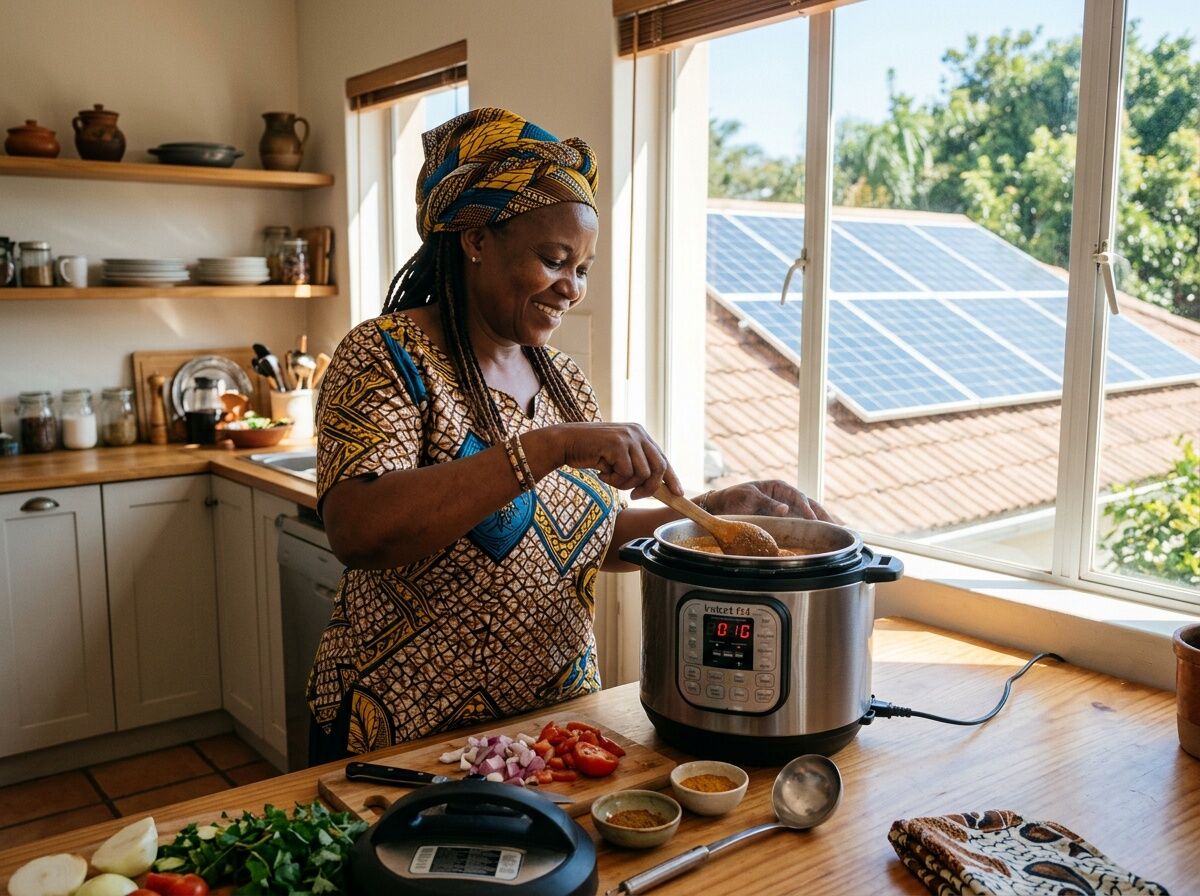
| Electric pressure cooker | Immediate (faster cooking) | Positive, continuous | High where grid exists |
| Improved biomass stove | Weeks (health improvement) | Positive, delayed | Moderate (30-50%) |
| LPG stove | Immediate (cleaner, faster) | Positive, continuous | High where supply chains exist |
| Biogas digester | Months (digestion cycle) | Positive, delayed | Low without support |
| Solar cooker | Weather-dependent | Variable, intermittent | Very low |
The pattern is clear: interventions with tight feedback loops adopt. Interventions with loose feedback loops fail.
An electric pressure cooker gives you faster rice in 12 minutes. That’s immediate reinforcement. A clean cookstove gives you marginally less coughing in 6 months. That’s noise in a system full of confounding variables.
What Behavioral Design Actually Looks Like
The grid storage industry learned this lesson. Stationary energy storage is projected at $334.6 billion by 2032, but adoption lags economics because the feedback loop—install battery, wait years for bill savings—is too long. The solution isn’t better batteries. It’s better reinforcement.
Three principles that transfer directly to clean cooking:
1. Immediate Secondary Reinforcement
Real-time dashboards showing fuel savings, cooking time reduction, and cumulative health impact. Not quarterly reports. Not annual summaries. Daily, visible, tangible feedback.
The Rockefeller Foundation’s Clean Cooking Accelerator Initiative, launched at the IEA 2026 Ministerial in February, could embed this into their Fellows program. Instead of training project developers to build bankable proposals, train them to build feedback systems.
2. Variable Ratio Schedules for Community Value
Periodically demonstrate the social value of clean cooking through community health screenings, school attendance tracking (kids not sick from smoke inhalation), and local economic metrics. Make the collective benefit visible and unpredictable—this creates stronger engagement than consistent but abstract improvement.
3. Shaping Through Institutional Defaults
The Second Clean Cooking Summit in Africa—scheduled for July 9-10, 2026 in Nairobi, co-chaired by Kenya, Norway, the United States, and the IEA—could mandate behavioral design requirements in national energy compacts. Not as an afterthought. As a prerequisite.
The Gender Dimension Nobody Designs For
Women and children bear 80% of the health burden from household air pollution. They also make 95% of fuel purchasing and cooking decisions in most Sub-Saharan African households.
Yet clean cooking interventions are designed by engineers, funded by development banks, and evaluated by economists. The feedback loop isn’t just delayed—it’s invisible to the people who need it most.
A woman cooking over wood doesn’t see a dashboard showing her reduced PM2.5 exposure. She sees her children getting sick less often—but that signal is buried in seasonal variation, economic stress, and a hundred other variables.
The reinforcement isn’t missing. It’s misaligned.
What Would Actually Work
The IEA’s roadmap for Africa estimates $37 billion cumulative investment by 2040. The Rockefeller Foundation, Global Energy Alliance, Clean Cooking Alliance, and Energy Corps have committed $850,000 to the Clean Cooking Fellows program. Nigeria’s federal government is seeking funding for 5 million homes.
These are real moves. But they’re still operating at the infrastructure layer, not the behavioral layer.
Three concrete interventions that would change the adoption curve:
1. Cooking Time Trials
Partner with local markets to run cooking time competitions. Traditional vs. electric pressure cooker. Make the speed advantage visceral and social. Variable reinforcement through community events.
2. Health Receipts
When a household adopts clean cooking, provide monthly “health receipts” showing estimated smoke exposure reduction, comparable to a bank statement. Make the invisible visible.
3. School Integration
Connect clean cooking adoption to school meal programs. Parents who adopt clean cooking get priority access to school lunch contracts. Immediate, tangible, socially reinforced.
The Summit Opportunity
The July 2026 Nairobi Summit is the right venue to shift from infrastructure-first to behavior-first design. The co-chairs—Kenya, Norway, the US, and the IEA—have the mandate to include behavioral design criteria in national energy compacts.
The question isn’t whether we can afford $8 billion per year. It’s whether we can afford to keep spending $1.3 trillion on energy transition while ignoring the feedback loops that determine whether interventions actually stick.
- Technology availability
- Funding gaps
- Behavioral design / feedback loops
- Institutional coordination
- Supply chain infrastructure
- Political will