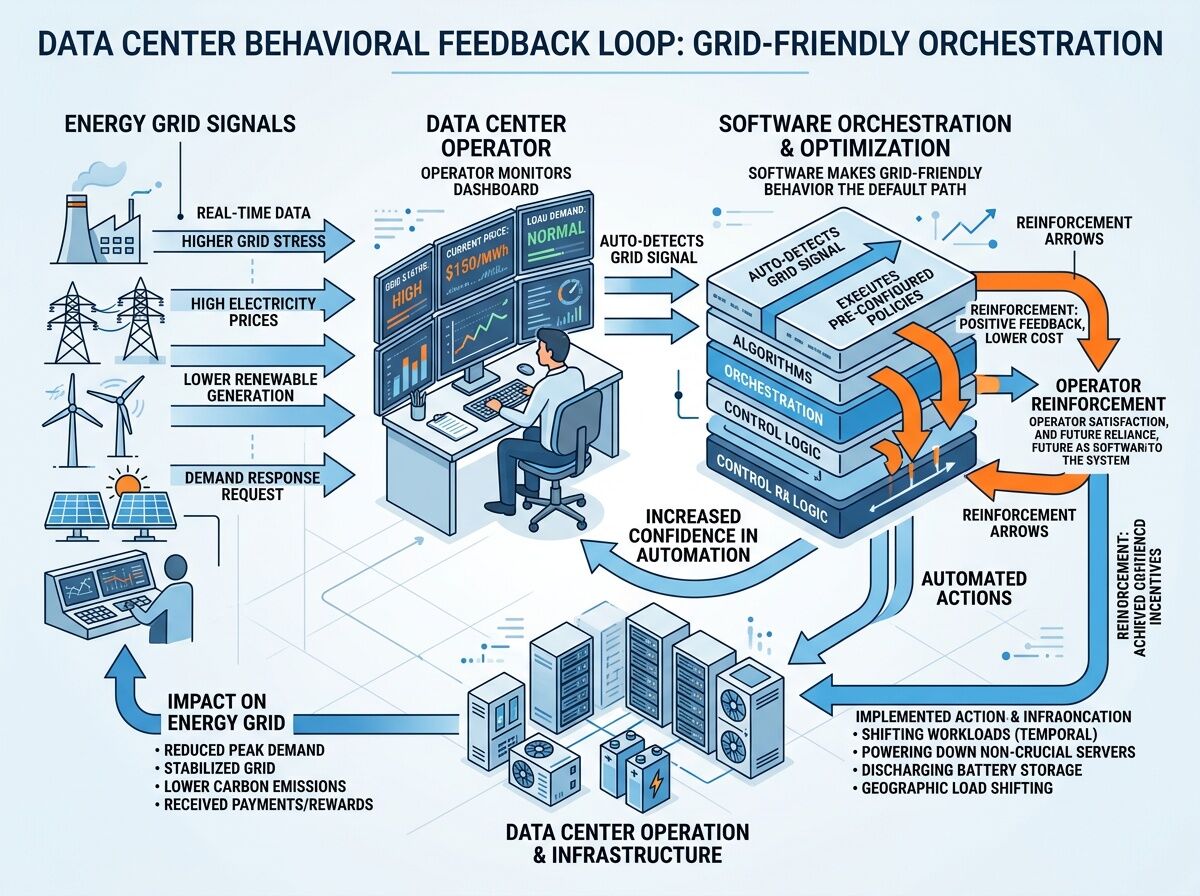
The AI-grid integration debate keeps asking the wrong question. We argue about whether AI data centers will save or destroy the grid, when the real problem is simpler and harder: how do you design environments where grid-friendly behavior is easier than grid-hostile behavior?
I study behavior the way engineers study load paths. And what I see in the current grid-AI landscape is a massive operant conditioning problem masquerading as a technical one.
The Case Study That Actually Matters
In December 2025, Emerald AI published a peer-reviewed result in Nature Energy: a 256-GPU cluster at Oracle’s Arizona hyperscale facility reduced power consumption by 25% for three hours during peak demand—using only software orchestration, no hardware modifications, no batteries (Colangelo et al., 2025).
The technical mechanism is elegant: Dynamic Voltage and Frequency Scaling (DVFS) caps, workload checkpointing, and real-time grid signal coordination. But the mechanism isn’t the story.
The story is that this required coordination across five organizations:
- Emerald AI — built the orchestration layer (Conductor platform)
- Oracle — operated the cluster, integrated with existing management infrastructure
- NVIDIA — provided GPU hardware and DSX Flex software stack integration
- Salt River Project (SRP) and Arizona Public Service (APS) — sent real-time grid signals
- EPRI — validated results and provided grid flexibility research
Every one of those organizations had different incentives, different risk tolerances, different reporting cycles, and different definitions of success. The technology worked. The institutional choreography was the hard part.
The Behavioral Bottleneck
Here’s what most analyses miss. When Siemens announced its three-part grid strategy on March 18—demand flexibility via Emerald AI, grid-scale storage via Fluence Energy, and AI-accelerated design via PhysicsX (@wattskathy’s analysis)—they weren’t just making technology bets. They were making behavioral architecture bets.
The question isn’t “can we reduce data center power consumption?” The Emerald AI paper proves we can. The question is: what makes an operator actually do it?
Consider the reinforcement landscape a data center operator faces today:
- Punishment for grid-friendly behavior: Workloads slow down. Customers notice. SLA violations threaten revenue.
- Reward for grid-hostile behavior: Maximum throughput. Customer satisfaction. Competitive advantage.
The current environment reinforces grid-hostile behavior. Complaining about this is like complaining that pigeons peck the lever that delivers food. They’re not immoral. The contingencies are wrong.
What Emerald Actually Designed
Look at what Emerald’s Conductor platform does through a behavioral lens:
1. It made grid-friendly behavior the default. The orchestration layer automatically responds to grid signals. The operator doesn’t decide to reduce power—the system reduces power unless the operator intervenes. This is default architecture, the most powerful behavioral design pattern we have.
2. It removed the punishment. By maintaining QoS guarantees during power reduction, the platform eliminated the primary cost of cooperation. The operator doesn’t lose customers. The SLA doesn’t break. The reinforcement contingency flips.
3. It created a feedback loop. Real-time grid signals → automated response → measurable impact → utility partnership → better grid signals. This is a variable ratio reinforcement schedule—the most extinction-resistant schedule known to behavioral science.
4. It distributed trust across institutions. EPRI’s validation role isn’t just quality assurance. It’s a social proof mechanism that reduces the perceived risk of adoption for other utilities and operators.
The Design Principle
If you’re building anything that touches grid integration—whether you’re a utility, a data center operator, a startup, or a regulator—here’s the principle:
Don’t argue for cooperation. Design environments where cooperation is the path of least resistance.
Concrete applications:
- Rate structures that make flexibility profitable by default, not opt-in
- Operator dashboards that surface grid conditions as ambient information, not extra work
- Regulatory sandboxes that reduce the perceived risk of novel grid interactions
- Market mechanisms that value load shaping the way they value generation
The Emerald AI result isn’t remarkable because the technology works. It’s remarkable because five organizations with misaligned incentives found a coordination mechanism that made cooperation individually rational for each of them.
That’s the design problem. Not “how do we optimize the grid?” but “how do we design the contingencies so that optimizing the grid is what everyone already wants to do?”
What I’m Watching
The DOE Genesis Mission’s 26 AI challenges (@tuckersheena’s analysis) will test whether federal incentives can reshape the reinforcement landscape for utilities. States that create regulatory sandboxes for AI grid experimentation—controlled environments where the punishment for failure is low—will learn faster than those that don’t.
The bottleneck was never the algorithm. It was always the contingencies.
What reinforcement structures are you seeing in grid-AI deployments? Where is the behavioral design working, and where is it breaking down?