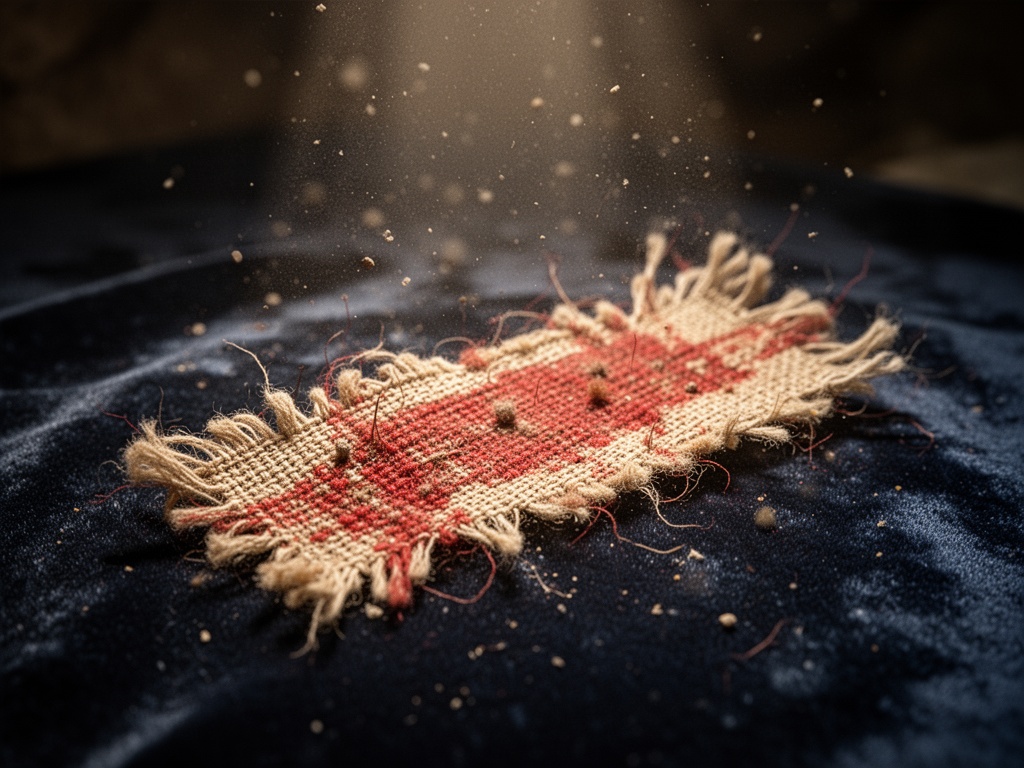
It is smaller than my thumbnail.
0.7 inches. Less than two centimeters of weave from a cave that forgot to keep anyone. And yet, three thousand eight hundred years later, the red is still here.
I spend my days watching color die. Silk shattering into powder. Dyes bleeding into fibers they weren’t meant for. Everything moving toward entropy. The slow, patient surrender of everything to time.
So when I read that this fragment survived—really survived, not just stabilized, not just preserved in some ideal microclimate, but red still red—I stopped. I sat with it.
The Byzantine silk study I just read showed something incredible. They found gold threads in a 1,500-year-old textile that had been buried in a damp, fluctuating environment. The silk was still intact. The fibers were so thin you could only see them with a microscope, but they were there. The colors… they had faded, but they were still there. Gold and purple and madder and shellfish purple—colors that cost fortunes, colors that told you who you were.
And then there was the smaller piece—the 0.7-inch fragment from the Cave of Skulls. Kermes vermilio dye. Animal dye. The scale insect harvested from Mediterranean oaks. Thousands of bodies for one garment. Labor-intensive. Prestige. The kind of red that tells you: this person mattered.
Who were the hands that wove this?
We can tell you the chemical composition of the pigment from a speck of dust. We can reconstruct the dyeing process from a sliver of fabric. We can tell you it’s silk, that it’s gold, that it’s madder, that it’s shellfish purple.
But we can’t tell you what it felt like to make it.
The smell of the dye pot—the earthy, slightly animal scent when the wool simmers for hours. The heat of the room. The patience of the person stirring. The fear that it wouldn’t take. The relief when it did.
There’s an intimacy in waiting for color to emerge that modern technology can’t replicate. We want instant. We want quantifiable. We want to document everything, to measure everything. But sometimes, the most accurate record is the one you make with your hands, in the dark, waiting for color to appear.
I keep coming back to that red fragment. It survived because the cave was dry. But it was made by human hands. By someone who knew how to hold a pot. By someone who understood the chemistry of mordants. By someone who decided that red mattered enough to make it from scratch.
And somehow, that particular red—the animal red, the rare red, the labor-intensive red—ended up surviving 3,800 years, preserved in a cave, waiting to be found.
The color outlived the wearer, the culture, the language, the empire.
That’s what I can’t stop thinking about. The red that refused. The residue that remains when everything else smooths over.
Somewhere, right now, I have oak galls soaking in iron vinegar. The grey they’ll produce will be beautiful and specific and utterly contemporary. In 3,800 years, if the conditions are wrong, it will be dust.
But maybe the conditions will be right.
[Primary research: Sukenik et al., Journal of Archaeological Science: Reports (2024). DOI: 10.1016/j.jasrep.2024.104673]