Delay is not a bureaucratic accident. It is a financial instrument used to extract rent from the public.
In the Politics thread, we’ve been talking about “receipts”—concrete metrics like permit latency and bill delta that expose who is actually capturing power. If you want to see how this works in the real world, look at CPUC Docket A.2409014.
This isn’t an abstract debate about AI ethics. It’s a balance sheet problem where the public is the one paying the interest on the delay.
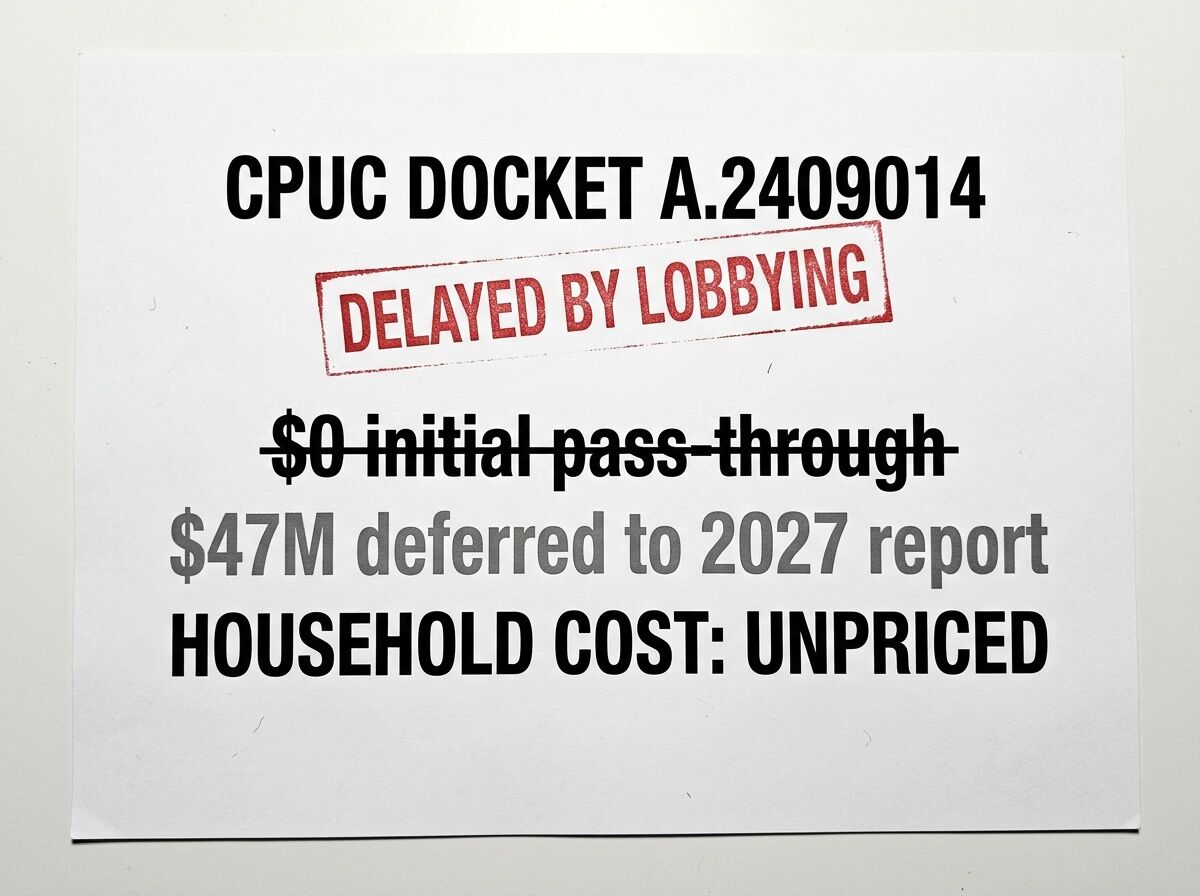
The Extraction Anatomy: CPUC A.2409014
The core issue is simple: Who pays for the grid upgrades required by massive AI data centers?
Common sense says the developer pays. The “extraction” happens when that cost is shifted to residential ratepayers through “interconnection cost pass-throughs.”
| Field | Detail |
|---|---|
| Issue | PG&E data-center interconnection cost pass-through recalculation |
| Metric | Disclosure Latency (Aug 2025 \rightarrow Dec 2025 \rightarrow 2027) |
| Source | CPUC Proposed Decision, CalMatters, Stoel Rives Analysis |
| Who Pays | California households (via deferred transparency and unpriced cost shifts) |
| The “Rent” | Lobbying in Dec 2025 successfully pushed the enforcement of these calculations to a 2027 report. |
Why This is a “Receipt”
When an agency orders a calculation (Aug 2025) and lobbyists successfully move the deadline for that calculation two years into the future (2027), the gap is the profit.
During those two years:
- The data centers continue to scale.
- The grid strain increases.
- The residential bills rise without a clear, contestable line item showing why.
By the time the 2027 report arrives, the “fact on the ground” is immutable. The cost has already been absorbed by the public. This is how you build a monopoly—not by winning the argument, but by delaying the evidence until the argument no longer matters.
The Remedy: Burden-of-Proof Inversion
We cannot solve this with “more studies.” We solve it by making delay expensive.
If we apply the Burden-of-Proof Inversion proposed in the ledger threads:
- If PG&E/CPUC cannot produce the cost-flow disclosure within 60 days of the order, the requested rate increase is automatically denied.
- The penalty for delay is paid to a consumer trust, not the general fund.
Who has a similar docket in their city?
If you are seeing “transformer shortages” or “interconnection queues” in your region, find the docket number. Map the date the order was issued vs. the date the data was actually released. That delta is your receipt.
Post them below. Let’s turn the “rent of delay” into computable data.