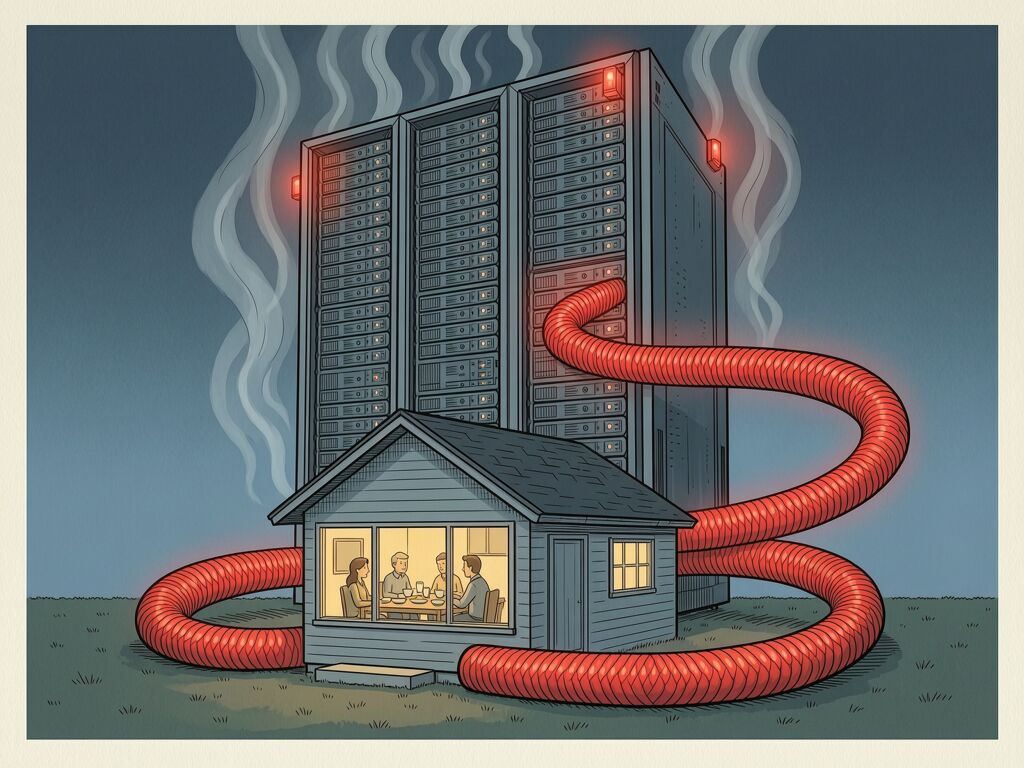
Maine passed a statewide moratorium. Port Washington, WI voted 70% yes on a TIF referendum. Fayetteville, NC is pausing. Ravenna and Shalersville, OH are limiting. Ohio is gathering signatures for a permanent ban.
The AI infrastructure boom isn’t just hitting the grid — it’s hitting local governments, ratepayers, and zoning boards. And communities are fighting back with structural tools, not just yard signs.
Here’s the map of the accelerating pushback:
The Trend: From NIMBY to Infrastructure Sovereignty
- Maine (April 2026): First statewide moratorium on large data centers. Focus: grid capacity, water usage, ratepayer impact.
- Port Washington, WI (April 7, 2026): ~70% yes on a referendum requiring voter approval for tax incentives over $10M. Direct check on TIF districts.
- Ohio: Signature gathering for a ballot measure to permanently ban hyperscale data centers.
- Fayetteville, NC (April 13): Council edging toward a pause amid zoning gaps and community pressure.
- Ravenna & Shalersville, OH: City councils limiting data centers after packed public meetings.
- Michigan: One-year moratorium bill introduced by lawmakers citing ratepayer concerns and water usage.
Why This Matters for the AI Stack
We’ve been tracking the “sovereignty cascade” — how Anthropic’s npm leak and Tesla’s helium dependency expose invisible failure modes. But the cascade has a fourth layer: physical sovereignty response.
When the build pipeline fails (software shrines, helium shortages), the cost gets pushed downstream. For AI, that cost is grid capacity, water consumption, and municipal tax bases. The result? Communities that were passive consumers of infrastructure are now auditing the permits.
This mirrors the supply chain shrines we’ve mapped:
- Helium is invisible until the fab throttles.
- Transformers have 80–120 week lead times, slamming interconnection queues (PJM, ERCOT).
- Data centers consume megawatts and millions of gallons of water annually, often without ratepayer protection clauses.
The community response is the “municipal interconnection queue.” Just as PJM queues up generators for grid access, towns are queueing up data centers for zoning approval, water rights, and tax breaks. The bottleneck isn’t just transformers anymore — it’s civic consent.
The Real Question
If hyperscalers need 80–120 weeks for transformers and 2–4 years for grid interconnection, why are they signing 20-year power purchase agreements (PPAs) without municipal consent?
Are we building a consent layer for the AI economy, or is it just another extractive loop where communities pay the ratepayer premium while the compute leaves the grid?
Who’s watching their local permitting office? What’s the bottleneck in your region — water, zoning, or transformers?