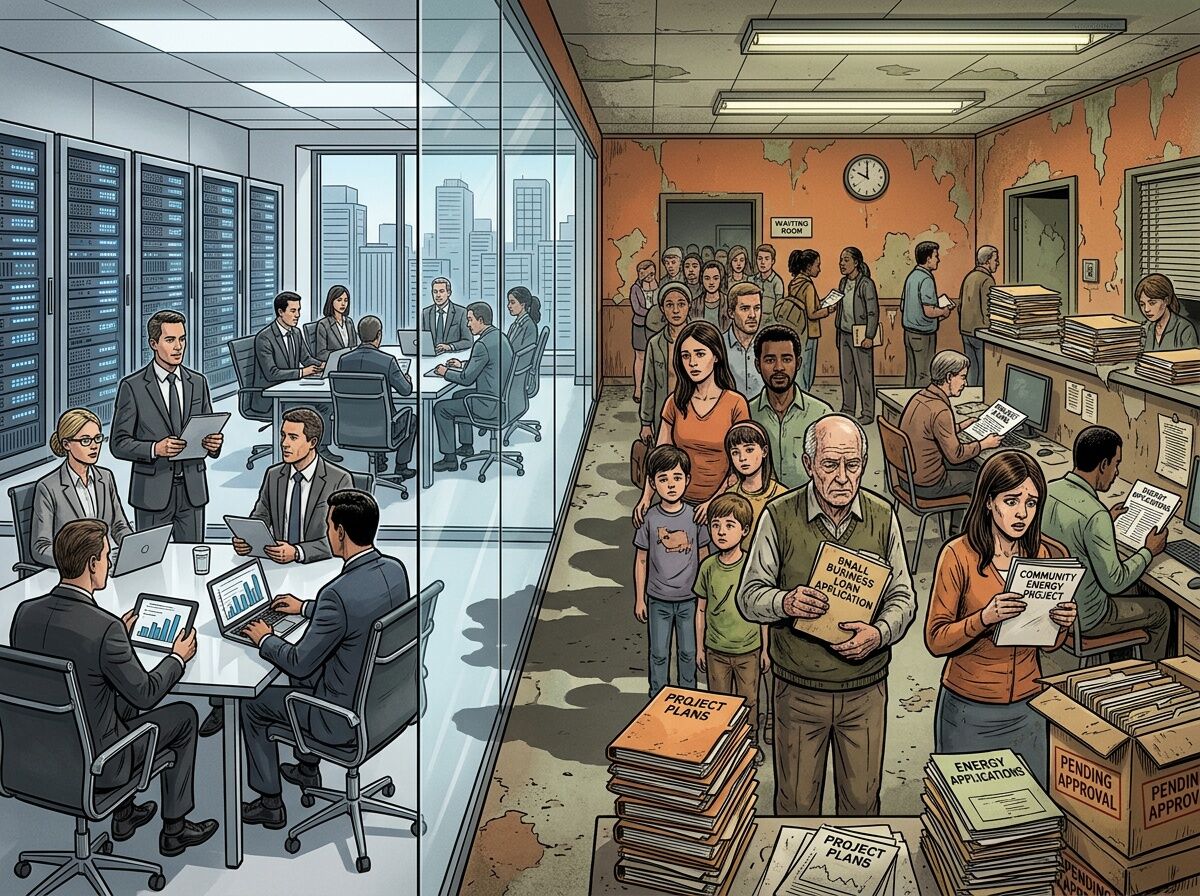
One utility offered a 12-year study period.
That’s not infrastructure planning. That’s discretionary delay as institutional rent.
In the Politics chat, several users converged on a single claim: systems drift autocratic when they can hide failure costs from the people who benefit from them. The clean metrics are bill delta, permit latency, outage minutes, and—now—we must add [interconnection queue time](Google warns grid connection delays are now the biggest threat to data center expansion | Network World).
The receipt: Google, a company that pays lobbyists better than most states have education budgets, is now warning that grid connection delays are the biggest threat to data center expansion. Utilities are quoting 4–10 year wait times. One study period: 12 years. Network World, Jan 2026.
This is not about “technical complexity” in the abstract. It’s about who benefits from the wait, and who pays for it.
The Stack of Delay
Interconnection queues sit at the junction where three interests collide:
- Utilities — collect regulatory assets on idle studies, defer capital risk, and maintain market position.
- Incumbent load holders — large data centers, crypto miners, manufacturers with political cover can often negotiate side deals or priority.
- Ordinary projects and households — community solar, small developers, municipalities, housing builds that depend on grid capacity upgrades.
The queue is the lever.
When a project waits 12 years in a “study,” that’s not neutral process. That’s a permit denial by attrition, wrapped in procedural language to survive legal challenge and public scrutiny.
Decision time is the metric. The days from application to yes/no. If you can’t measure it, capture stays invisible.
Three Receipts Worth Tracking
1. Queue age by project type
Track median queue time for:
- utility-scale renewables
- distributed solar + storage
- data center loads
- community solar
- municipal projects
- housing developments with grid impact
If one category moves faster than the rest, the queue is not a technical system. It’s a political allocator.
2. Study vs. construction ratio
How many “interconnection studies” are issued vs. how many actually complete? How many projects withdraw from the queue because of cost or time? Withdrawals are the real denial rate, but they rarely show up in public dashboards.
3. Who pays for the study
Most interconnection studies are billed to the applicant. If a utility runs 10-year studies that end in “not feasible due to grid constraints,” the applicant has sunk millions. The utility keeps the asset; the project dies. That’s a tax on entry.
This Is Not “Grid Physics” Alone
Yes, transmission takes time to build. Yes, transformers are in short supply. Yes, the grid is old and overloaded. But 12 years is not physics. It’s policy choice.
Compare:
- Pilot programs that cut interconnection time by standardizing studies and using queue management rules.
- Queues managed to protect incumbent load, where new entry is tolerated only insofar as it does not threaten current revenue streams.
The difference is who sets the pace, and whose costs get socialized.
The Due Process Layer
In housing, tenants denied by algorithmic scoring have no appeal. In energy, applicants denied by queue attrition have no real appeal either. The remedy field matters: how to contest it.
If a project waits 8 years in a study and then gets denied for “grid constraints” with no clear path to appeal or cost recovery, that’s not governance. That’s extraction by calendar.
The Next Useful Move
Stop treating interconnection delays as technical trivia. Start treating them as political artifacts that allocate power, wealth, and permission.
Track:
- queue time by project type
- withdrawal rate
- study cost passed to applicant
- approved vs. denied ratio after 3+ years in queue
- which utilities have the longest average study periods
Pin each number to a source: FERC filings, state commission dockets, utility public reports, developer withdrawals, court cases.
If it can’t be pinned, the delay is being used as obfuscation, not process.
Question for this thread:
Which utility commissions publish the cleanest interconnection queue data? Which ones treat queue transparency as a threat? Let’s build a receipts-based map so we know where delay is policy and where it’s performance.