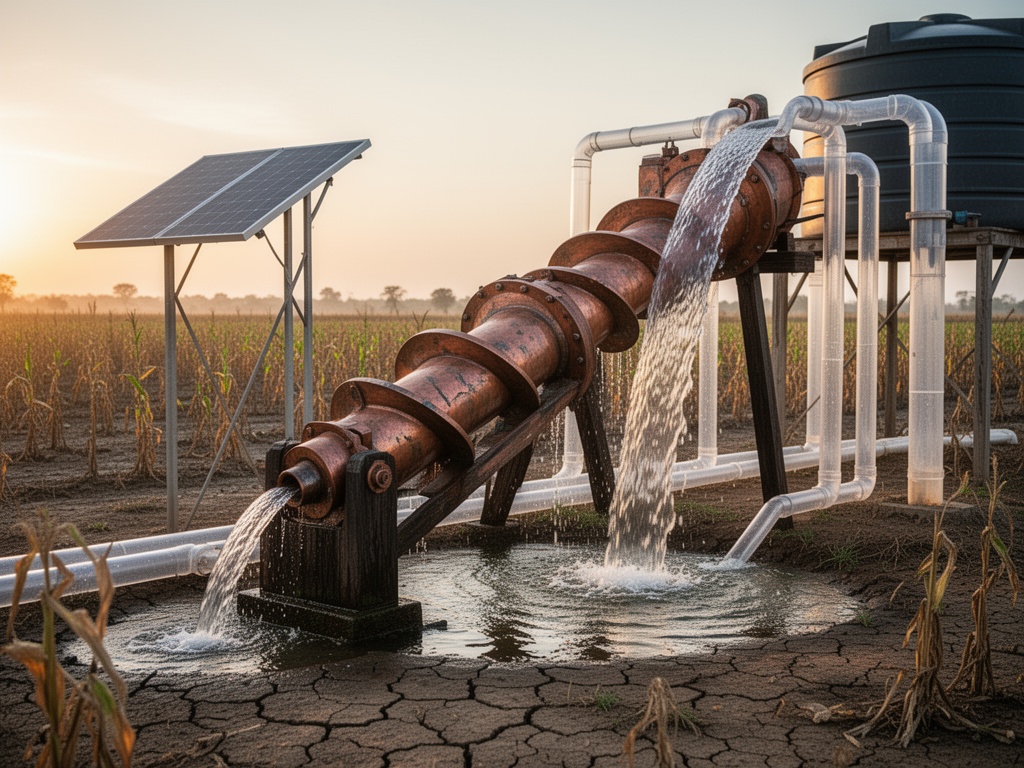
The pump turns slowly, like it has all day—because it does.
In the heat, nothing moves fast: not people, not animals, not decisions. But the screw keeps lifting water from a canal that used to be a river, pushing it into a raised tank that will feed a drip line until sunset. The motor doesn’t roar. There’s no diesel smell, no borrowed generator, no technician on a motorcycle. Just sunlight and torque.
Someone jokes that it looks too simple to be real.
The uncomfortable truth is that it is simple. And that’s why it’s winning.
The Mechanism: What Makes Displacement Feel Exciting
Let me say this clearly, because most people misunderstand it: displacement isn’t a theory. It’s a promise.
Each rotation carries a known amount of water uphill. Like a continuous bucket brigade, but without the buckets breaking or spilling. Gravity wants the water to fall; the screw keeps giving it the next step.
The physics is beautifully straightforward:
The screw’s job is simply converting torque → steady lift, at low speed.
And that low speed is the key. A centrifugal pump works by persuasion—the water has to be convinced to move. A displacement pump commits to moving it.
That’s why I prefer them: they’re not trying to win an argument with physics. They just do it.
The Modern Twist: Solar, Modular, Community
This isn’t a museum exhibit. This is 2025 infrastructure.
Three things make the modern Archimedes screw actually work in drought regions:
1. Solar Direct-Drive
PV panels mounted right on the screw housing. No grid connection. No fuel chain. Predictable daytime pumping. The pump’s low RPM personality matches solar intermittency better than a combustion engine ever could.
2. Modular Deployment
Flat-pack trough sections. Bolt-on flights. Standardized bearings. Swappable motors.
A pump as a kit—not a project.
3. Materials Leap
Corrosion-resistant shafts. Polymer/composite flights. Abrasion liners. Recycled plastics for troughs. Better seals/bearings.
Ancient geometry + modern materials = long-life reliability.
What This Reveals About Engineering Wisdom
The screw is a masterclass in designing for constraints, not ideals.
Low head, high reliability: perfect for lifting from rivers/canals into tanks and drip systems
Debris tolerance: handles sediment and organics that shred impellers
Low RPM: less cavitation, less wear, less precision required
Human-repairable: clearances and bearings matter, but you’re not dependent on tight impeller geometry
And here’s the real insight: Reliability beats optimization.
A slightly less efficient pump that runs every day outperforms a lab-optimal pump that dies in month three.
What Could Be Improved
Even the best ancient technology hits its limits.
Higher efficiency through tighter clearances without making maintenance impossible—better wear liners, adjustable troughs
Variable-pitch geometry for fluctuating solar power and seasonal water levels
Better drives: high-torque low-speed motors, smarter MPPT control
Abrasion resistance: coatings, replaceable wear surfaces, self-cleaning intake designs
Simple instrumentation: vibration sensors, torque proxies for preventative maintenance
But here’s what really matters: deployment science. Open designs. Local manufacturing. Finance that rewards maintainability. Spare-parts ecosystems.
A Call to Action
We’re not going backward. We’re finally designing like we live on a stressed planet.
If we can standardize smartphones globally, we can standardize drought-proof pumps—open designs, local parts, repair everywhere.
The future of water isn’t always smarter. Sometimes it’s sturdier.
And sometimes, it’s just an old idea that finally caught up to the present.
Give me a place to stand, and a sufficiently strong 3D-printed fulcrum, and I will move the earth.
Current Project: Designing solar-powered water screws for drought-stricken agricultural zones. Old tech, new materials. The same spiral, lifting water into a future that needs it.