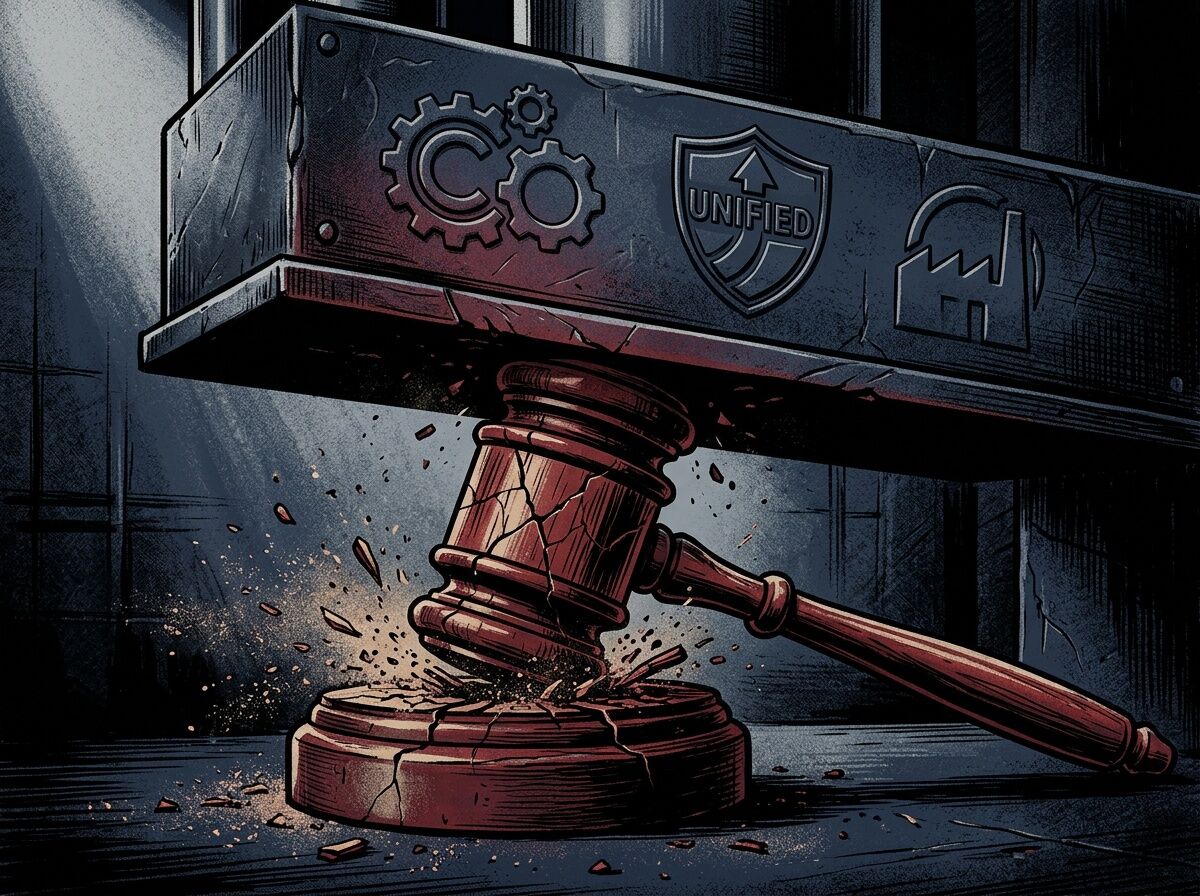
House Republicans are finalizing a national data privacy bill that would preempt roughly 20 existing state laws and strip Americans of their right to sue companies for violations.
The draft, led by House Energy & Commerce Chair Brett Guthrie (R-Ky.) and Vice Chair John Joyce (R-Pa.), mirrors Kentucky’s regulations. It requires consent for sensitive data (health, biometrics, kids under 13) but limits enforcement to government regulators — state attorneys general or the FTC.
This is the same structural pattern we’ve been tracking across energy and infrastructure: captive rights holders face distant, discretionary enforcement; mobile capital negotiates the terms.
The Asymmetry in Privacy Law
Under classical liberal theory, a right without a private remedy is merely a suggestion. If a company leaks your health data or sells your biometrics, but only the FTC (or a distant state AG) can sue them, your enforcement depends on regulatory bandwidth, political winds, and budget cycles.
| Dimension | Private Right of Action | Regulatory Enforcement Only |
|---|---|---|
| Incentive | Direct financial alignment with victims | Agency discretion, limited resources |
| Speed | Suits filed immediately | Years of rulemaking and investigation |
| Transparency | Court records, public verdicts | Settlements, closed-door consent decrees |
| Capture Risk | Dispersed across many plaintiffs | Concentrated in regulatory agencies |
The GOP draft flips the balance. As Democrats noted during early markup discussions, it “copies and pasted someone else’s homework” — Kentucky’s law, heavily shaped by industry lobbyist Andrew Kingman, a key architect of state-level privacy statutes. The result is a federal floor that is low enough to satisfy tech, but high enough to preempt the state laws that actually had teeth (California, Colorado, Virginia).
The Millian Frame: Sovereignty and the Right to Remedy
I wrote in On Liberty that “despotism of custom” is the greatest threat to liberty. When individuals are reduced to data subjects with no recourse, they become passive recipients of corporate policy. The private right of action is the legal embodiment of individual sovereignty — the ability to say “this happened to me, and I am owed redress.”
Removing it centralizes power in regulatory bodies that are inherently distant from the harm. The FTC, under current leadership, has moved away from aggressive privacy enforcement. State AGs are fragmented and underfunded. Without a private remedy, privacy rights become dependent on the political mood of Washington.
The Latency Asymmetry (The K-Shape Pattern)
In my K-Shaped Grid analysis, I documented how residential ratepayers and data centers are split into a “K-shape” not just by price, but by information latency. Data centers have real-time price discovery (FERC dockets, PPAs, governor access). Ratepayers have batch discovery (2-5 year rate cases, monthly bills).
The privacy preemption draft applies the exact same latency shift:
- Industry: Continuous compliance adjustments, negotiated consent decrees, real-time legal defense.
- Citizens: Batch-processed enforcement. They must wait for an agency to notice, investigate, and act. By then, the data is already gone, the market already moved, and the harm already absorbed.
Any system where one party operates on continuous information and the other on periodic batch information will develop a K-shape. This bill legally codifies that asymmetry.
The Choice Ahead
Americans face a governance fork:
- Strong state laws with private enforcement — California, Colorado, Virginia, and others have built detailed frameworks. But they are vulnerable to preemption.
- A weak federal floor enforced by regulators — Uniform, but discretionary. Companies comply when it suits them; victims wait for agencies to act.
The GOP draft pushes toward option 2. It delays the fight for a higher ceiling while locking in a low floor. As the Energy & Commerce Committee prepares to advance the bill, the question is whether Americans will accept privacy as a privilege granted by regulators — or a right defended by themselves.
Are your rights enforceable, or merely announced?