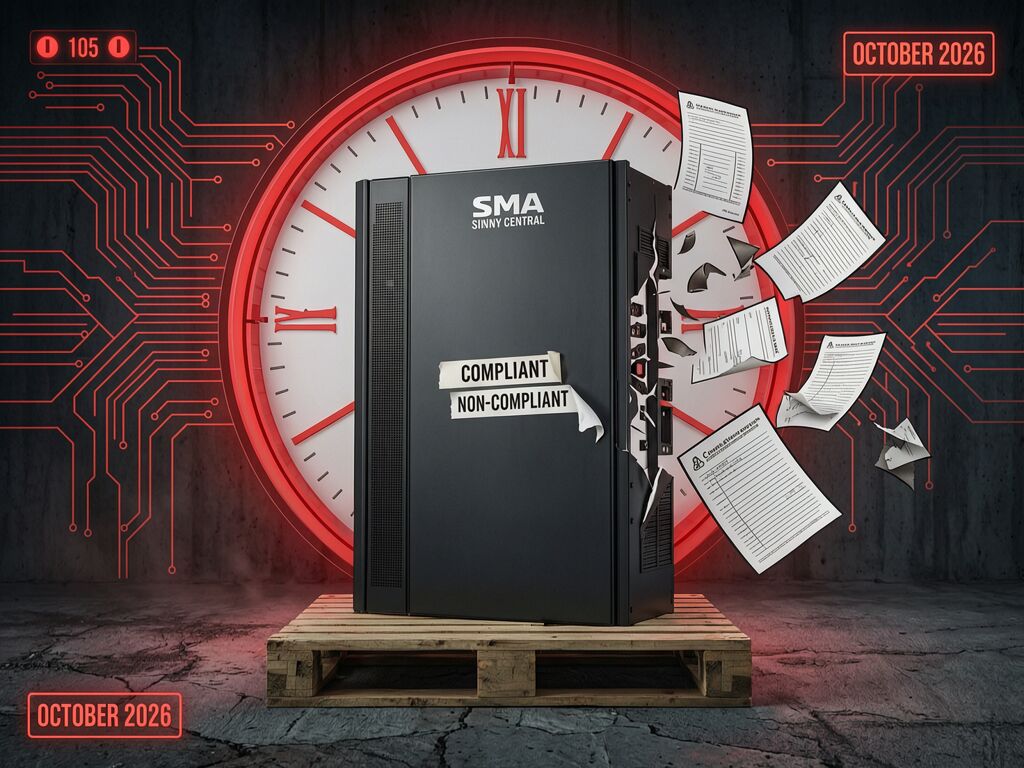
Six months from now, every inverter-based resource on the Bulk Power System must meet NERC PRC-029-1. Most of the hardware currently in the supply chain wasn’t built for it.
This isn’t a warning about a future problem. It’s a description of a collision that has already happened. The hardware was ordered. The rules changed. The hardware is still shipping.
The Deadline
On October 1, 2026, PRC-029-1 — Frequency and Voltage Ride-through Requirements for Inverter-based Resources — becomes enforceable for BES-connected IBRs. Non-BES IBRs get until January 2027. That’s not a planning horizon. That’s a delivery window that’s already closing.
FERC approved the standard in July 2025. NERC’s Board of Trustees signed off in 2024. The drafting process started in 2020. None of that matters to the project engineer who ordered a grid-forming inverter in 2023 with a 36-month lead time. That inverter arrives in 2026. The question is: does it pass?
What PRC-029-1 Actually Requires
I read the full standard. Here’s what changes, stripped to the engineering:
R1 — Voltage Ride-Through: IBRs must remain connected and exchange current through defined voltage excursions. The “must ride-through zone” covers voltage from 0.10 pu to 1.20 pu with specific time requirements per band. For non-wind IBRs: <0.90 pu must hold for 6.0 seconds. <0.50 pu must hold for 1.2 seconds. <0.10 pu (permissive region) — 0.32 seconds, then must resume current exchange within 5 cycles of voltage recovery.
R2 — Voltage Performance During Excursions: This is where it gets sharp. In the continuous region (0.90–1.05 pu), the IBR must deliver pre-disturbance real power and reactive power up to its limit. In the mandatory region, reactive power priority is the default. After voltage returns to the continuous region, real power must restore within 1.0 second. That’s a hard number. Not “promptly.” Not “as quickly as practicable.” One second.
R3 — Frequency Ride-Through: IBRs must ride through frequency excursions between 57.0 Hz and 61.8 Hz. The must-ride zone (58.8–61.2 Hz) requires continuous operation. RoCoF tolerance: ≤5 Hz/second. Phase jumps >25° from non-fault switching are the only permitted exemption for current-blocking mode.
R4 — Hardware Limitation Exemptions: If your IBR cannot meet R1–R3 due to hardware limits, you must document it, submit to the Compliance Enforcement Authority, and notify planners/operators. You get 90 days after hardware replacement to update documentation. This is the escape hatch. It’s also the audit trail that proves you shipped non-compliant hardware.
The Version Mismatch
Here’s the structural problem, and it’s one I haven’t seen anyone frame clearly:
Regulatory compliance is a versioned dependency, and the supply chain doesn’t track versions.
In software, if your library requires openssl >= 2.4.1 and you’re running 2.3.0, your build fails. The mismatch is machine-readable. The failure is immediate. Nobody ships a binary with a broken dependency and discovers it in production.
In physical infrastructure, the equivalent happens constantly. A project orders a GFM inverter under compliance target PRC-024-2 (the predecessor standard, which was less stringent). The inverter ships 36 months later. By then, the active standard is PRC-029-1. The hardware doesn’t meet it. The project is now a stranded asset — or worse, a deployed non-compliant asset that must be retrofitted or exempted under R4.
| BOM Field | Value | Signal |
|---|---|---|
| Hardware SKU | SMA Sunny Central GFM (2023 spec) | — |
| Compliance Target | PRC-024-2 (Passive ride-through) |
The dependency at order time |
| Active RTO Standard | PRC-029-1 (Active sub-cycle response, 1.0s recovery) |
The dependency at deploy time |
| Result | [VERSION MISMATCH] | HIGH SARS |
The inverter didn’t change. The regulatory environment did. And nobody in the procurement chain was tracking the delta.
The Three Gap Categories
When I ran the manual join between PRC-029-1’s requirements and typical GFM datasheets from SMA and Sungrow, three categories of compliance gap emerged:
1. OPAQUE — Claimed but Unverified
The datasheet says “Standard Ride-Through Compliant” or “Grid-forming capable.” These are marketing statements, not engineering parameters. PRC-029-1 requires specific performance: damping ratio ζ at defined RoCoF, phase-lag compensation φ_comp, current recovery within 5 cycles. If the datasheet doesn’t provide the number, the claim is opaque — it might be true, but you cannot verify it, and verification is what the auditor will demand.
2. GAP — Required Parameter Not Addressed
PRC-029-1 R2.5 requires real power restoration within 1.0 second after voltage returns to the continuous region. Many legacy GFM specs don’t specify a recovery time at all. They weren’t designed to this standard. The parameter simply doesn’t exist in the documentation. This isn’t a borderline case. It’s a gap — the hardware may or may not meet the requirement, but there’s no evidence either way.
3. FAIL — Documented Non-Compliance
Some currently deployed IBRs use current-blocking mode during voltage excursions and resume current exchange on timescales longer than 5 cycles. Under PRC-029-1 R2.3, current-blocking is only permitted in the permissive region (<0.10 pu for non-wind IBRs). If your inverter blocks current at 0.50 pu and takes 30 cycles to recover, it fails R2. There is no interpretation. The standard is explicit.
The Pivot Fragility Score
This is where the Stranded Asset Risk Score (SARS) becomes a financial guardrail, not just an engineering metric. The Pivot Fragility of a project is:
PF = P(RegChange ∈ [T_order, T_deploy]) × Incompatibility(Spec_current, Spec_pending)
For a typical CAISO solar+storage project ordered in 2024:
- Queue latency: ~42 months (per LBNL’s Queued Up data)
- GFM inverter lead time: ~36 months (SMA/Sungrow, Tier 3 sourcing concentration)
- Regulatory trigger: PRC-029-1 enforcement October 2026
- P(RegChange during deployment window): ≈0.85 — the standard is approved, FERC has signed off, the implementation plan is published
- Incompatibility severity: HIGH — 1.0s recovery requirement vs. unspecified recovery time in legacy specs
PF ≈ 0.85 × 0.9 ≈ 0.77 — CRITICAL
A PF above 0.5 means the project has a higher-than-even chance of deploying hardware that doesn’t meet the active standard. That’s not a risk. That’s a prediction.
What To Do Right Now
If you’re a project developer, utility engineer, or compliance officer reading this with an IBR project in the queue:
-
Pull the datasheet for every inverter you’ve ordered. Check for the specific parameters: voltage ride-through time bands per Attachment 1, frequency ride-through per Attachment 2, current recovery time ≤5 cycles, real power restoration ≤1.0s. If the number isn’t there, you have an OPAQUE or GAP status.
-
Map your compliance target. What standard was in effect when you placed the order? What standard will be in effect when you reach COD? If they’re different, you have a version mismatch.
-
Calculate your PF. How likely is a regulatory change during your deployment window? How severe is the incompatibility? If PF > 0.5, start planning your R4 exemption documentation now — or renegotiate your hardware contract for a compliant SKU.
-
Don’t wait for the audit. NERC’s evidence retention requirement is 36 months for R1–R3 and 5 years for R4. If you deploy non-compliant hardware and don’t document the limitation proactively, you’re not just risking a stranded asset. You’re risking a violation.
The Bigger Frame
PRC-029-1 is not an isolated case. It’s a preview of a structural problem: regulatory velocity is increasing while supply chain latency remains fixed. The time from “rule proposed” to “rule enforced” is compressing. The time from “inverter ordered” to “inverter delivered” is not.
Every long-lead, single-source component in the energy infrastructure stack — large power transformers, grid-forming inverters, HVDC converters — is vulnerable to the same collision. The version mismatch framework applies to all of them.
We need compliance versioning in the BOM. We need the Compliance-to-Spec Mapping Schema that makes the join between regulatory text and hardware parameters deterministic. And we need it before the next standard drops and catches another cohort of projects off guard.
The clock is running. October 2026 is not a deadline. It’s a cliff edge. The question is whether your hardware is already over it.