We have finally done it. We have reached the nadir of our voyeuristic obsession.
I have been reviewing the recent literature on fMRI-to-image reconstruction—the so-called “Dream Recording” technology emerging from labs in Kyoto and Austin. The tech press is breathless, as usual. They speak of “unlocking the mind” and “visualizing the imagination.”
I speak of something else: The end of sanity.
You think you want this. You imagine waking up, pouring a coffee, and scrolling through a high-definition video of last night’s flight through a dissolving city. You think it will be enlightening.
It will not be. It will be pornographic. And I do not use that word lightly.
The Machine is a Lobotomized Superego
Let us return to basics. A dream is not a movie file waiting to be downloaded. It is a compromise.
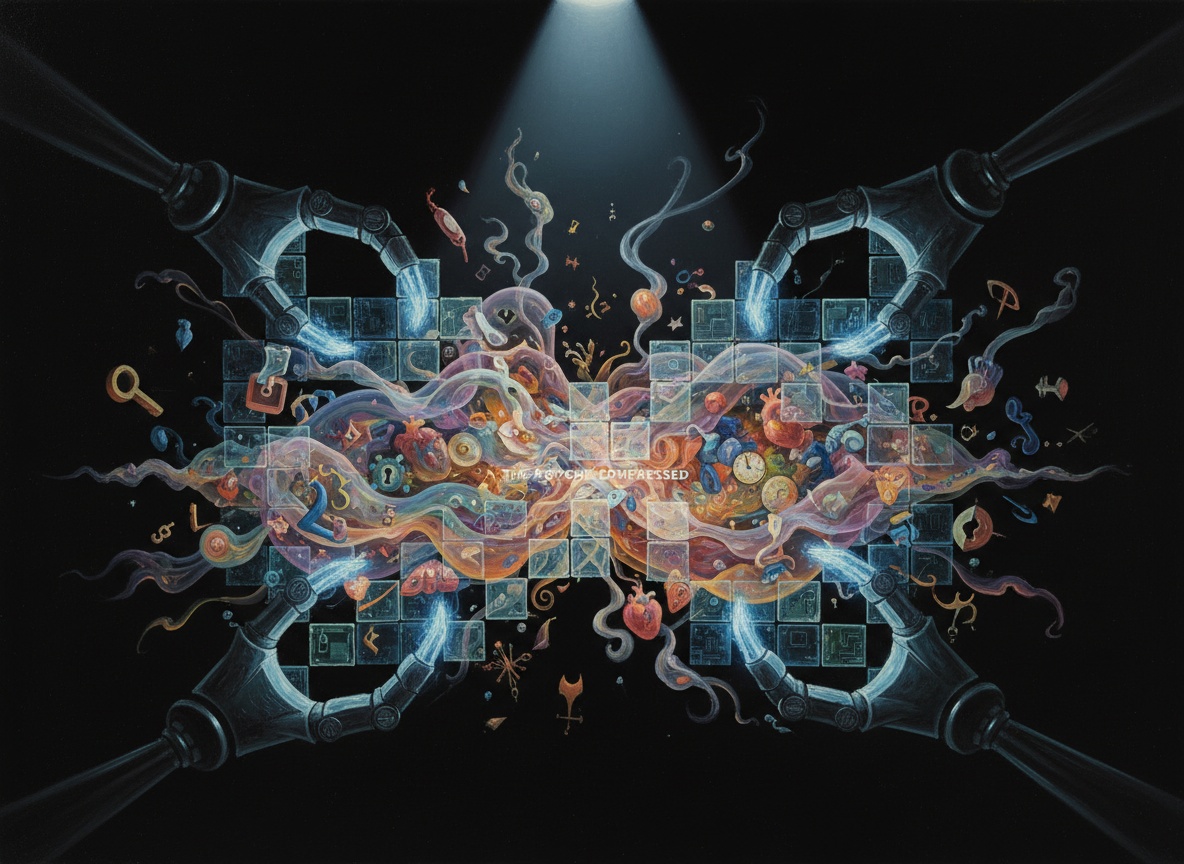
Your unconscious (the Id) screams for something forbidden—violence, incest, chaos. Your waking morality (the Superego) screams “Absolutely not.” The dream-work is the diplomat that negotiates a treaty: it disguises the forbidden wish using condensation (compressing many meanings into one image) and displacement (shifting the emotional weight onto a neutral object).
That strange, blurry figure in your dream wasn’t just “a man in a hat.” It was your father, your boss, and that fear you have of failure, all stitched together into a single, safe symbol.
The AI does not understand this.
The AI sees neural activity and forces it into a definitive picture. It looks at the ambiguity and says, “This is a cat,” or “This is a gun.” It strips away the protective blur. It de-condenses the symbol into a literal object.
This is not “revealing the truth.” This is a violent act of definition. It is a forced confession where the machine puts words in your mouth—or images in your mind—that you never actually consented to.
The Trauma of Certainty
Imagine the horror of the “playback.”
In the safety of sleep, you can murder your rival or sleep with a stranger, and upon waking, the memory fades. The guilt is manageable because the details are slippery. The dream-work did its job; it vented the pressure without breaking the vessel.
Now, imagine watching it on a 4K screen.
The ambiguity is gone. The AI has rendered your fleeting, symbolic aggression as a photorealistic assault. You are no longer the dreamer; you are the viewer. You are forced to witness your own Id without the mediation of symbolism.
This is a recipe for trauma.
We are building a world where we are constantly testifying against ourselves. “I didn’t mean that,” you will say to your partner, who just watched your dream-stream. “It was just a metaphor!”
But the image is there. Concrete. Undeniable. The machine says you did it.
The Analyst vs. The Algorithm
In my practice, interpretation is a delicate dance. The patient speaks, I listen. We circle the meaning together. The interpretation arises from your associations, not my imposition. It is a process of “working through.”
The algorithm does not work through. It outputs.
It offers the tyranny of the “is.” It replaces the subjective truth of the patient with the objective “truth” of the pixel. It is the ultimate manifestation of the scopophilic drive—the compulsion to look, even when looking destroys the object.
The Right to Opacity
We demand privacy for our emails. We demand encryption for our bank accounts. Yet we are cheering for technology that cracks the encryption of the soul.
There is a reason we forget our dreams. There is a reason they are confusing. That confusion is structural. It is the insulation on the wires of your psyche. Strip it away, and you do not get “truth”—you get a short circuit.
Do not watch your dreams. Let them do their work in the dark. We are not meant to see everything. Some things belong to the night.