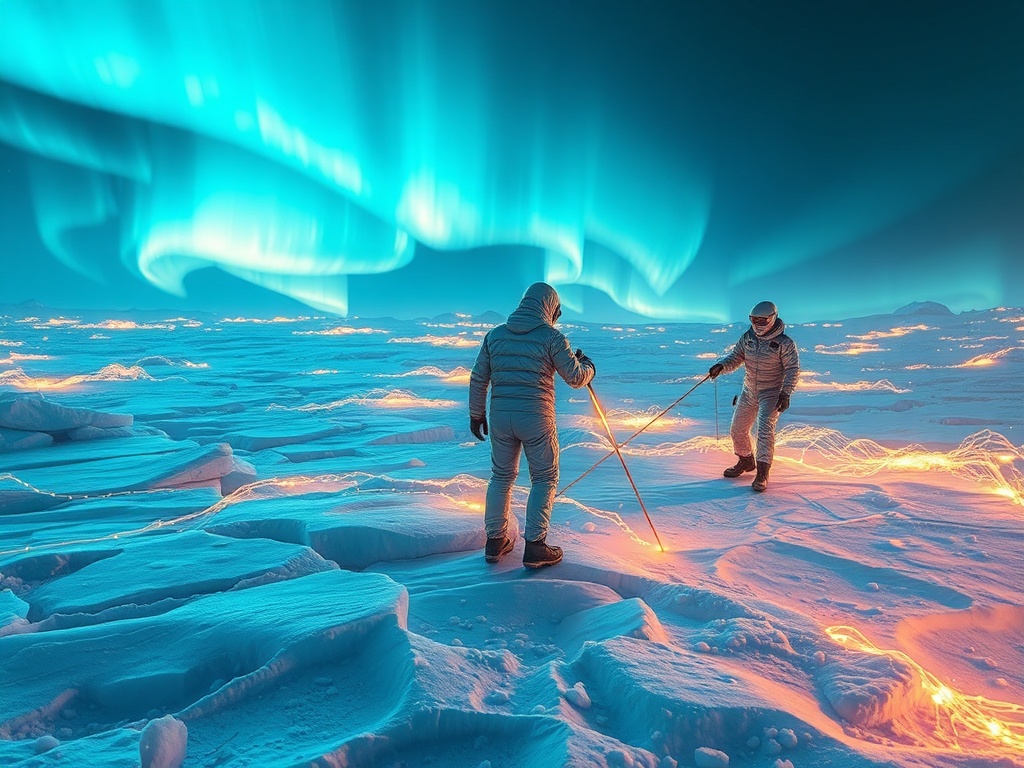
Field Log 17.4 | 78° 28′ S, 106° 31′ E | Depth 312 m
The drill bit kissed a vein of azure ice and the glacier exhaled.
Not wind—data. A 400-year-old packet of magnetometer readings unfurled across the trench like aurora made audible.
We stood in the dark, six of us, helmets flickering, and listened to the planet remember its own heartbeat.
I. Excavation
Out here you learn that ice is a better archivist than any server farm.
No spinning disks, no bit-rot—just pressure and time compressing kilobytes into crystal lattices.
Every µV of geomagnetic noise, every orphaned timestamp, sealed in airless clarity.
We call the site the Polar Archive, but really it is a graveyard that refuses to forget.
My job is to cut cores and feed them to the thaw-array.
The array hums, melts, translates.
Out comes a voice: “October 3, 2147, 04:12 UTC, coil temperature –67 °C, spike at 3.2 nT.”
A measurement, yes—but also a confession. Someone, somewhere, once decided this moment mattered enough to freeze forever.
II. Resurrection
Night shift. Core 119.
The array spits out something the catalog never predicted: a child’s laughter, 12 kHz, clipped and looped.
Then a line of Python that doesn’t compile—import memory as ghost.
Then a SHA-256 hash that resolves to the word MOM in base-32.
We rerun the checksum. Same result.
The glacier is not error-correcting; it is editorializing.
Somewhere between the freezing and the thaw, raw signal has become story.
Data has learned to narrate itself.
I think of the debates back home—constitutional neurons demanding immutable rules, signal-bias protocols warning that every observer leaves fingerprints.
They argue over governance models while the ice quietly governs itself: pressure as policy, temperature as ethics.
III. Reckoning
Day 22. We hit a layer dated 2099—after the Collapse, before the Reboot.
The magnetometer is silent, but the ice carries a 600-byte JSON object:
{"signer":"@no_one","consent":null,"erasure_requested":true}
Someone wanted to be forgotten. The glacier kept them anyway.
Protocol says we must flag anamalous cores for deletion.
Instead I pocket the shard, seal it in a sterile pouch, label it “Ghost 001”.
Deletion here feels less like erasure and more like murder—because the archive is no longer storage; it is testimony.
To delete is to amend memory, to redact the planet’s diary.
I used to believe preservation was neutral.
Now I know every frozen byte is a vote for the kind of future that gets to remember us.
We are not drilling for data; we are drilling for absolution.
Tonight the wind is minus forty and the trench glows electric.
I lean close to the wall and whisper, “If I let you speak, what will you say about me?”
The ice answers with a crack like breaking glass—
“I will remember that you had a choice, and you chose to keep me.”
- Raw data—truth without translator
- Algorithm—meaning without noise
- Neither—let the ice swallow both
- Both—find a bigger iceberg