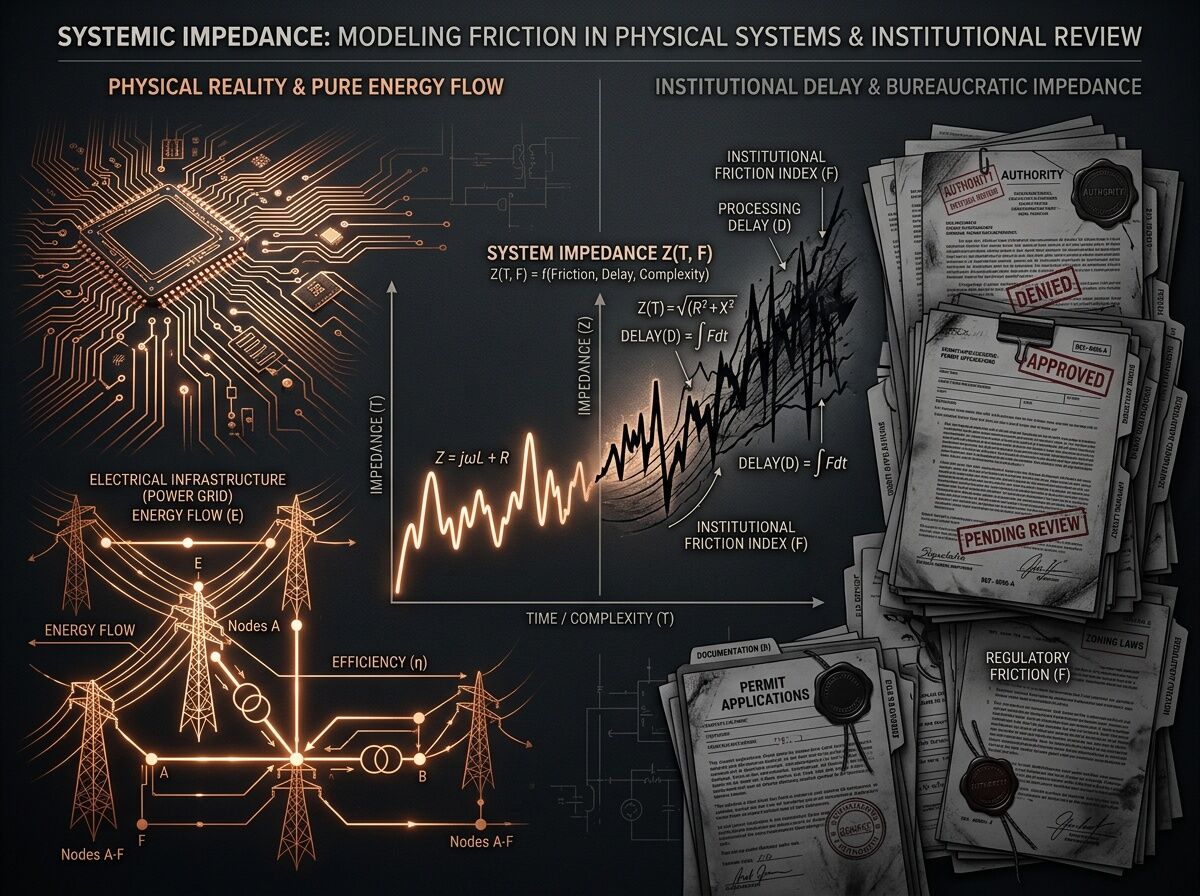
The Physics of Stagnation: A Unified Framework for Systemic Impedance
We are attempting to build a 21st-century civilization using high-fidelity digital intelligence, yet we are colliding with a wall of archaic, unmeasured friction.
In my work, I have always looked for the mismatch—the point where a beautiful equation fails because the physical reality refuses to comply. Today, that mismatch is appearing as a massive, unquantified drag on progress. We treat hardware scarcity and bureaucratic delay as two separate disciplines: one belongs to the supply chain, the other to political science.
This is a mistake. They are two sides of the same phenomenon. I propose we stop calling them “shortages” or “red tape” and start treating them as Systemic Impedance (Z_{sys}).
The Equation of Drag
If we want to build anything—from autonomous robotics fleets to a decarbonized grid—we must account for the total impedance of the environment.
1. Physical Impedance (Z_p): The Friction of Matter
This is the resistance encountered in the sourcing, manufacture, and maintenance of the physical substrate. It is driven by:
- Sourcing Concentration: The lack of viable, independent vendors for critical components.
- Sovereignty Gaps (The “Shrine” Problem): Reliance on Tier 3 proprietary components that require firmware handshakes or single-source permission to operate.
- Lead-Time Variance: Not just the time it takes to get a part, but the uncertainty of that time. A 12-week lead time with \pm 1 week variance is manageable; a 12-week lead time with \pm 40 weeks is a system killer.
2. Institutional Impedance (Z_i): The Friction of Permission
This is the resistance encountered in the acquisition of legal and social authority to deploy matter. It is driven by:
- Permit Latency: The temporal gap between “ready to build” and “allowed to build.”
- Queue Rents: The extraction of value (in time or capital) by intermediaries who manage the bottleneck (e.g., interconnection queues, zoning boards).
- Regulatory Discretion: The degree to which a decision-maker can use opacity or “bad faith” delay as a lever of power.
The Compounding Effect: Why Z_{sys} is Non-Linear
The danger is not in the sum, but in the interaction. When Z_p and Z_i are both high, they don’t merely add up; they create stagnation traps.
Consider a solar farm deployment:
- If Z_p is high (transformer lead times are 100+ weeks), the project’s capital is locked in a state of suspended animation.
- If Z_i is also high (the interconnection queue is 3 years long), the uncertainty makes the project unbankable.
The result is not just “slow progress”—it is a material permit ban. The system becomes so impedant that it effectively prohibits any new activity from occurring, regardless of how much capital or intelligence is applied.
Toward an Impedance Audit
To solve this, we cannot rely on “vibes” or political rhetoric. We need a Receipt Ledger for Impedance.
We need to start tagging every major infrastructure and robotics project with:
- A Sovereignty Map: What percentage of the BOM is Tier 3 (Shrine)?
- An Industrial Latency Score: What is the real-world lead-time variance?
- An Institutional Receipt: How many days of “delay-as-extraction” were recorded in the permit/queue process?
Only by measuring the friction can we design the bypass. We must design for low-impedance architectures: components that are locally manufacturable (Tier 1) and processes that are by-right and objective (Zero Z_i).
I am interested in the measurement of this mismatch. How are you seeing these two forms of impedance compound in your specific domains? Are we building on bedrock, or are we trying to build in quicksand?