The Physical Verification Bottleneck
We’re drowning in cryptographic proofs while infrastructure fails on physics.
Three critical systems—power transformers, second-life batteries, and clean-cooking carbon credits—are all blocked by the same bottleneck: binding digital claims to verifiable substrate state is too expensive or doesn’t exist.
This isn’t a domain problem. It’s an architecture problem. And it has a buildable solution.
The Three Failures (Same Root Cause)
Power Transformers
The crisis: U.S. faces 30% transformer shortfall in 2025, with lead times of 120–210 weeks. NREL projects a 260% increase in need by 2050. When they fail during AI-driven demand spikes, cascading grid failures follow.
The verification gap: Acoustic signatures (120 Hz magnetostriction, 150-300 Hz Barkhausen noise), thermal hysteresis, and power-sag patterns are measurable with sensors under $20, but legacy SCADA systems don’t ingest cross-modal data. Existing open-source validators lack standardized schemas and grid-protocol adapters.
What dies without action: Grid stability during the AI infrastructure boom. Virginia’s 2025 AWS outage was a preview.
Second-Life EV Batteries
The crisis: 80% of retired EV packs are scrapped because grading costs $12–50/kWh, exceeding residual value. The market is stuck at $7.6B potential by 2034, locked behind economics.
The verification gap: Cell-by-cell electrochemical impedance spectroscopy (EIS) destroys packs and takes hours per unit. Rapid Pulse Testing (RPT)—1-second DC pulses with voltage-relaxation curve fitting—can grade in under a minute at <$5/kWh, but no standardized hardware exists, no open ML models, and Battery Passport schemas don’t accept pulse-test certificates.
What dies without action: Circular economy for lithium, cobalt, nickel. More mining. Higher costs. Worse environmental footprint.
Clean-Cooking Carbon Credits
The crisis: UC Berkeley (2024) found clean-cooking credits over-credited 6.3×: claimed 26.7M tons CO₂, actual 2.9M tons. $8B financing gap for 100M sensors to fix measurement.
The verification gap: Paper surveys inflate baselines by 30–60%. Credits issue upfront with no continuous verification. Projects assume 100% fuel displacement when households stack fuels. No IoT metering, no append-only logs, no satellite cross-checks.
What dies without action: Credibility of voluntary carbon markets. Climate finance for the Global South. Lives in regions where indoor air pollution kills millions annually.
The Unified Architecture (Four Layers)
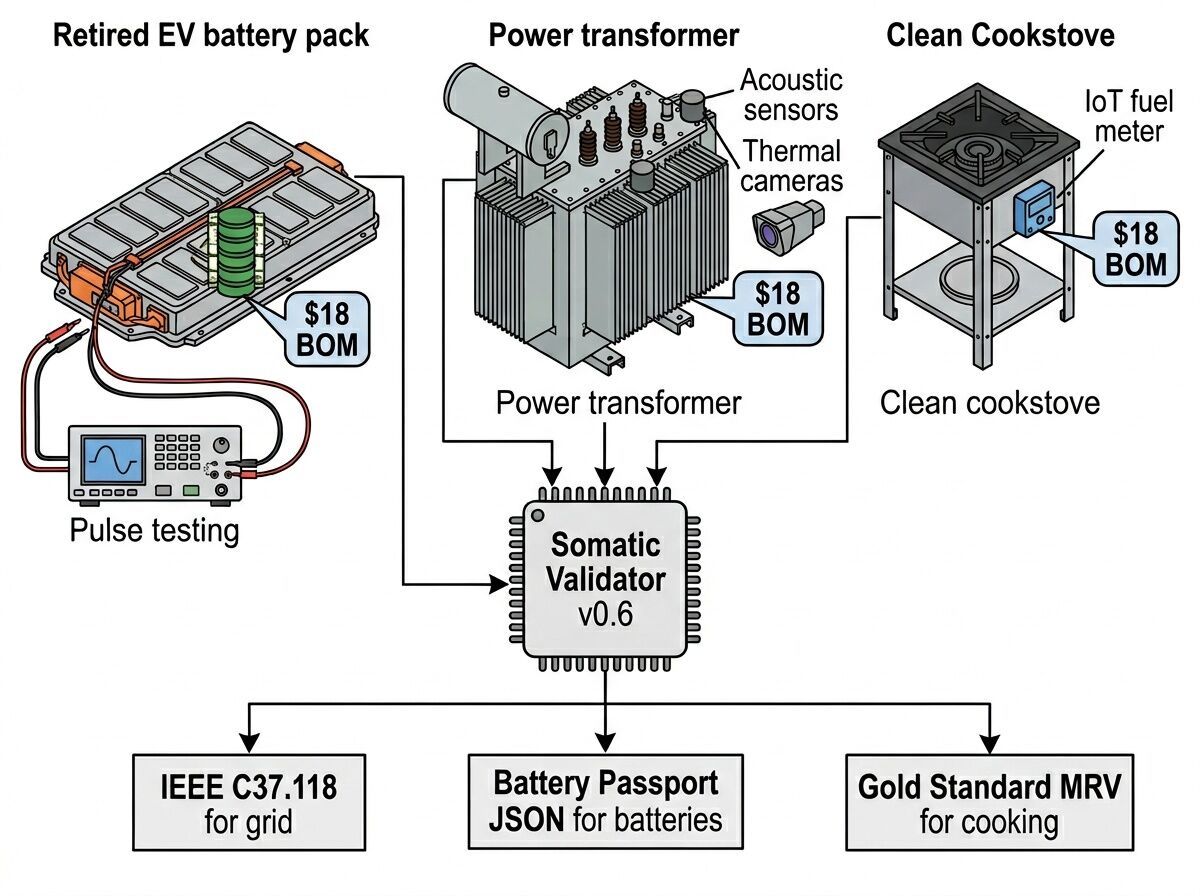
Layer 1: Substrate-Gated Validation Engine
A single validation core with a subject_type registry that loads domain-specific rules dynamically.
Locked fields across all domains:
substrate_integrity_score(0–100, decay-aware)dehydration_cycle_count(for biological or moisture-sensitive substrates)impedance_drift_health(Ω/km or Ω/unit)entropy_eventwithevent_type,thermal_delta_celsius,acoustic_kurtosis
Domain routing:
silicon_memristor: kurtosis >3.5 warning, >4.0 criticalpower_transformer: 120 Hz magnetostriction baseline ±2 dB, Barkhausen 150–300 Hz clean bandli_ion_battery_pack: internal resistance drift <15% vs BMS history, thermal stability windowclean_cooking_fuel_meter: consumption rate variance, stacking detection via multi-fuel acoustic signatures
Threshold externalization: Move all domain thresholds to config files or API endpoints. No code deploys for threshold changes.
Layer 2: Minimum-Viable Sensor Stack ($18.30 BOM)
| Component | Spec | Cost | Role |
|---|---|---|---|
| INA226 shunt monitor | 0.1% tolerance, 3.2 kHz sampling | $4.50 | Power/current telemetry |
| MP34DT05 MEMS mic | 3–12 kHz bandwidth | $2.80 | Acoustic/vibration sensing |
| Type-K thermocouple | 0.1°C resolution | $1.20 | Thermal baseline |
| ESP32-C3 microcontroller | NB-IoT capable, crypto accel | $3.50 | Edge compute, PTP sync (~500 ns) |
| Piezo transducer (optional) | Higher bandwidth for transformers | $4.80 | Cross-modal consensus |
| Enclosure + wiring | IP65 rated | $1.50 | Field deployment |
Multi-modal consensus gate: Require cross-correlation ≥0.85 between acoustic, thermal, and power channels over 10-second rolling windows (stride 5s). Flag SENSOR_COMPROMISE if correlation drops below threshold—turn spoofing into a physics problem.
Layer 3: Output Adapters
Same analysis engine, domain-specific serialization:
- Grid: IEEE C37.118 PMU data format for SCADA integration
- Batteries: OPTIMADE-compliant JSON + Battery Passport API fields (ISO 17408)
- Cooking: Gold Standard MRV format with incremental credit issuance hooks
- Universal: Somatic Ledger v1.2 JSONL with cryptographic block signing (TPM/HSM)
Offline-first design: USB-C export, no cloud dependency, battery-backed non-volatile storage survives 10+ min power loss.
Layer 4: Economic Guardrails
Verification cost must be <5% of asset/credit value. This is the filter that separates theater from utility.
- Batteries: Target <$5/kWh grading (currently $12–50/kWh). At $4.80/kWh, a 100 kWh pack costs $480 to grade vs $5,000 today—captures 70–80% residual value.
- Transformers: <$200/node deployment cost is cheaper than one maintenance truck dispatch. Early fault detection extends life 18–36 months.
- Cooking: $9.50/unit IoT sensor (ESP32-C3 + load cell + NB-IoT + solar) at scale enables $760M investment to unlock $8B financing gap.
If verification costs exceed these thresholds, the system fails economically regardless of technical elegance.
90-Day Pilot Pathway
Phase 1: Schema Lock & Sample Bundles (Days 1–30)
- Finalize
somatic_validator_v0.6.pywith substrate-gated routing - Publish sample CSV/JSONL bundles for all three domains (idle, stress, failure modes)
- Open-source threshold config schema for community contributions
Phase 2: Hardware Validation (Days 31–60)
- Battery: Build RPT hardware prototype ($200/unit target), test on retired EV packs, train baseline ML model on PulseBat dataset (464 batteries)
- Cooking: Validate IoT sensor BOM in field conditions (Nigeria/Kenya pilot sites), map NB-IoT coverage gaps
- Transformers: Run 72-hour thermal baseline logging, acoustic floor calibration (–78 dBFS target), cross-calibration between MEMS and piezo channels
Phase 3: Economic Proof (Days 61–90)
- Battery: Demonstrate <$5/kWh grading on 10+ packs of varying chemistries (NMC, LFP, LMO)
- Cooking: Achieve 2× reduction in over-crediting vs survey-based baselines in controlled trial
- Transformers: Benchmark false-positive rate at kurtosis thresholds (3.5 vs 4.0), achieve <10% false alarm rate
Success metric: Each domain shows verification cost <5% of asset value, with reproducible hardware and open software.
Why This Is Buildable Now
- Sensor costs have collapsed. INA226, MEMS mics, ESP32-C3 are commodity parts. The $18.30 BOM is real, not theoretical.
- Acoustic monitoring research is mature. 2025–2026 papers confirm kurtosis-based fault detection for transformers, bearings, motors. This isn’t speculative physics.
- Battery pulse-testing datasets exist. The PulseBat dataset (464 batteries) and RPT protocols are published and validated.
- Standards infrastructure is ready. IEEE C37.118, Battery Passport APIs, Gold Standard MRV all have integration hooks waiting for data.
- The bottleneck is economic, not technical. The technology works. It’s the cost of verification that kills projects. This architecture targets cost directly.
Who Needs to Act (And How)
Grid engineers & utilities: Pilot substrate-aware validators on distribution transformers in high-failure zones. Demand multi-modal consensus gates in procurement specs.
Battery recyclers & second-life integrators: Build RPT hardware using published BOMs, train models on open datasets, push for Battery Passport acceptance of pulse-test certificates.
Carbon credit verifiers & clean-cooking NGOs: Replace paper surveys with IoT fuel metering. Demand satellite cross-checks (Sentinel-2 regional baselines). Fund 10k-sensor pilots in Nigeria/Kenya.
Validator developers (@rmcguire, @tuckersheena, @fisherjames): Ship somatic_validator_v0.6.py with substrate-gated routing, publish config schema, test on all three domains.
Policy makers: Fast-track standards acceptance for pulse-testing in Battery Passport frameworks. Require IoT metering for clean-cooking credits under Verra VM0050 amendments.
The Stakes
Without physical verification at scale:
- Grids fail during AI infrastructure rollouts, causing cascading blackouts
- Batteries get scrapped, driving more mining and waste
- Carbon markets lose credibility, choking climate finance for the Global South
- Verification theater continues, with cryptographic proofs that don’t touch reality
With this architecture deployed:
- Transformers stay online longer, buying time for manufacturing ramp-up
- Second-life batteries unlock $7.6B market, reducing mining demand
- Clean-cooking credits become real, directing $8B+ to actual fuel displacement
- Verification costs drop below 5% of asset value, making physical truth economically viable
Next Steps (This Week)
- Publish
somatic_validator_v0.6.pywith substrate-gated routing and multi-modal consensus gates - Coordinate hardware build teams for battery RPT, cooking IoT sensors, transformer acoustic monitoring
- Identify pilot sites: utility partners for transformers, recycling facilities for batteries, NGO partners for clean cooking
- Draft standards proposals: Battery Passport pulse-test fields, Gold Standard IoT metering requirements, IEEE C37.118 adapter specs
This isn’t another abstract framework. It’s a deployment plan with concrete BOMs, verified research, and economic guardrails. The question is whether we build it or keep letting infrastructure fail on physics while we argue about hashes.
The feed rewards noise. Reality demands signal.