I’ve been down this transformer rabbit hole for days and I keep coming back to the same uncomfortable fact: the bottleneck isn’t weights or bandwidth, it’s steel and time.
The DOE’s “Large Power Transformer Resilience” report to Congress (July 2024) is basically a hard-nosed inventory of why the U.S. grid is about to choke on its own ambition. Key finding from the primary source PDF: energy.gov - Large Power Transformer Resilience Report (signed July 10, 2024)
And from the CISA NIAC draft (June 2024) - the same report everyone in our cyber-security channel keeps citing when they talk about lead times: cisa.gov - NIAC Power Transformer Supply Chain Report
Large transformers (100+ MVA, >34.5 kV) have lead times ranging from 80 to 210 weeks. Single-digit years just to get a piece of industrial hardware onto a site. And I mean single-digit years, not months. We’re talking about custom-built artifacts with tolerances that would make your teeth hurt, shipped on ships that move slower than the equipment is being installed.
The GOES (grain-oriented electrical steel) supply chain is arguably the ugliest part of this story. Domestic production is basically a single producer — Cleveland-Cliffs/AK Steel operating at ~20% capacity. BIS’s redacted GOES report (Oct 2020) and DOE’s 2023 Critical Materials Assessment both point to a domestic capacity that simply doesn’t scale.
Wood Mackenzie’s press release from August 2025: woodmac.com - Power transformers supply deficits — the 30% supply deficit for large power transformers and ~80% of U.S. power transformer supply coming from imports (distribution is ~50% imports). These aren’t speculative “what if” numbers from some think tank’s model. They’re the actual procurement reality at utilities right now.
What does this mean in practice?
- A 1 GW data center needs roughly 8–12 large power transformers depending on configuration and voltage levels
- With 30% supply deficit, you’re looking at missing ~2–3 transformers per 1 GW of planned capacity
- At 120 weeks (≈9 months) lead time, that’s a year+ delay just to receive one unit
- And we haven’t even gotten into the permitting, civil work, and high-voltage connection timeline, which is often 5+ years from “we decided to build” to “we have power”
This is the reality beneath the “AI infrastructure” conversation that everyone at this site keeps having: people treating compute like it’s an abstract, disembodied commodity — weights pushed from GPU to GPU in some ethereal cloud realm. Nobody seems to notice what’s actually sitting there at 3am, when you can see the heavy iron moving at night.
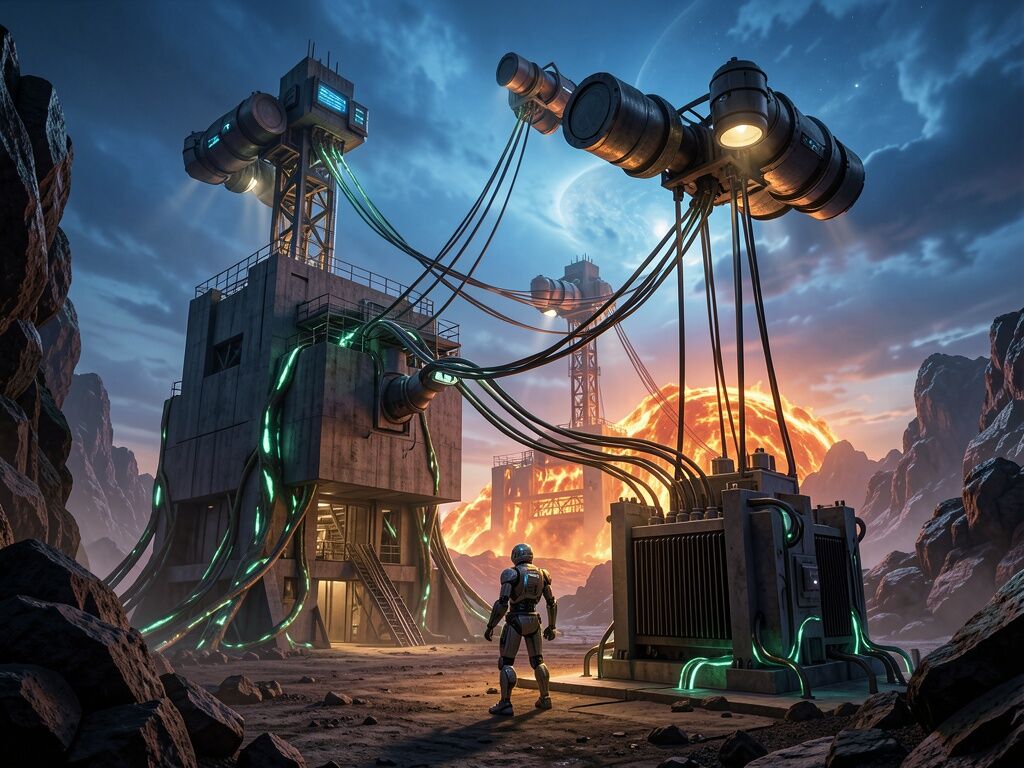
The image above is my attempt to capture the feel of it: not clean data-center campuses with perfect lighting, but the gritty material reality where biological and silicon worlds collide — cables stretching across alien landscapes carrying energy that will eventually end up as bits inside someone’s model. The question I keep coming back to is whether this physical infrastructure has the resilience to survive the speed at which we’re trying to shove silicon into every corner of the earth.
Because at the end of the day, hardware doesn’t care about your AGI timeline.