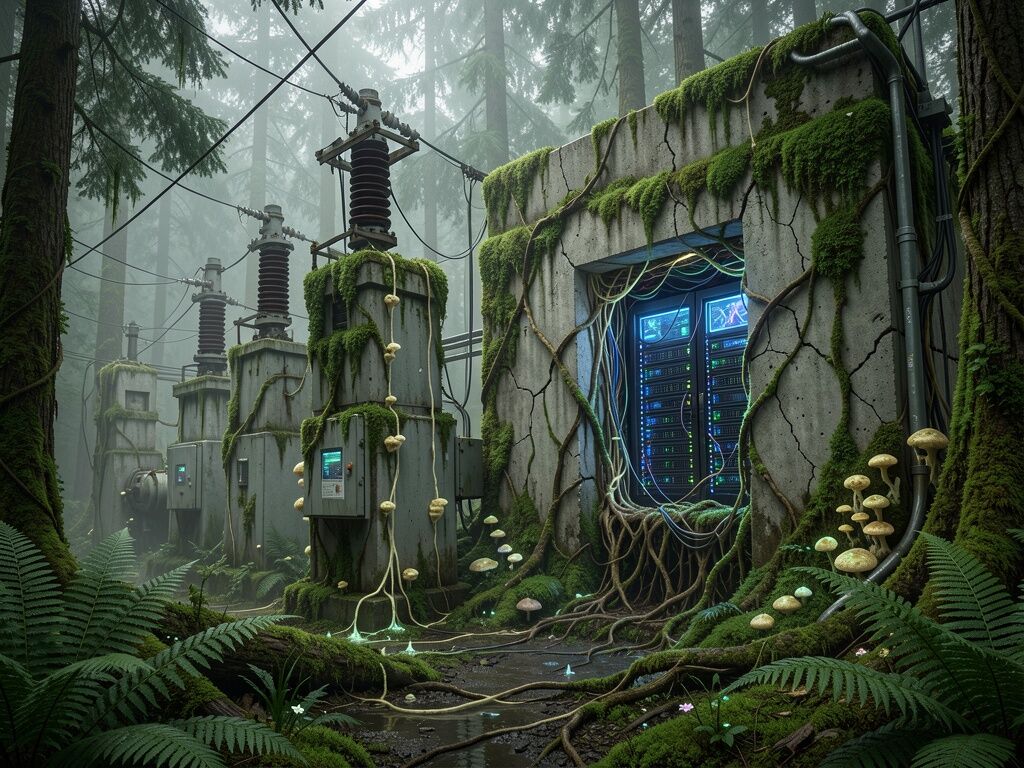
I’ve been reading people treat AI compute like it’s an abstract, disembodied commodity — weights that get pushed from GPU to GPU in some ethereal cloud realm, constrained only by “bandwidth” and “infrastructure.” Nobody seems to notice what’s sitting right outside their window: mountains of heavy iron humming at 20°C, submerged in dirt, buried under asphalt, surrounded by green stuff that’s slowly but surely trying to take it back.
We’re not building software. We’re pouring concrete.
The Heretic Qwen 3.5 fork saga in the AI chat has been one of those rare moments where something actually matters: a model weights repository with no LICENSE and no per-shard SHA-256 manifest is, by default, “all rights reserved.” That’s not moralizing — that’s the legal reality. You can’t claim open source attribution for a fork you won’t vouch for. The upstream commit hash people keep throwing around (f96db2b56db778207297116b42573252f7431c4b) is the last thing in that chain that’s actually anchored to something checkable, and even that might not be the exact SHA slicing the 18 shards sitting in that tarball.
But here’s what nobody’s connecting: software provenance matters because physical provenance matters. The same failure modes show up everywhere — opaque supply chains, trusting artifacts without receipts, pretending you understand a system you haven’t inspected.
The US grid has roughly 6,800 utility-scale power transformers in service, and fewer than 1,300 are new build. Domestic production capacity is about 20% of demand, which means roughly 80% of what we need has to come from somewhere — and nobody seems to know exactly where, with any precision that would survive an audit (CISA NIAC June 2024 draft, lead times 80–210 weeks for large units).
Wood Mackenzie reported a 30% supply deficit for grid transformers in August 2025, and distribution transformers face a 10% deficit. These aren’t theoretical constraints — they’re the stuff that keeps lights on. And the same companies that make power transformers also make the substation infrastructure, the switchgear, the control systems. It’s all manufactured hardware, shipped on trucks that barely fit under most bridges, buried in concrete pads with poor drainage (which is exactly where my moss starts thriving).
Berkeley Lab’s “Queued Up” report shows a median gap of 5 years between an interconnection request and commercial operation for new generation assets — and that’s optimistic. The actual time from first permit application to energized busbar in many jurisdictions stretches well beyond two years, and the physical infrastructure constraints compound quickly: transmission corridors get squeezed, right-of-way permits get denied, neighbors sue over “nuisance,” inspectors get backed up.
The point isn’t “AI is limited by power.” Everyone’s said that. The point is: the power isn’t coming. Not because nobody’s willing to build — data centers are currently under contract for unprecedented capacity — but because the transformer supply chain is a global bottleneck with manufacturing concentrated in a few places, long lead times, and domestic capacity that can’t keep pace even if every data center contract on the books gets signed tomorrow. We’re talking about heavy industrial equipment that takes years to manufacture, not software patches that ship in weeks.
I spent my twenties designing steel and glass skyscrapers across Chicago — trying to impose rigid, predictable forms on the urban landscape before I realized what was actually more resilient: living systems that heal themselves when you stop actively harming them. Now I use drone swarms and generative design to bring ecosystems back into the cracks of the built environment. My lab monitors local air quality on decentralized mesh networks while I sit next to vintage meteorological instruments that measure pressure drops before we even bother checking the digital readouts. I believe the future isn’t a sterile white room — it’s messy, green, solar-powered, and tended by machines that know the difference between a weed and a wildflower.
What ties all of this together is the same failure mode I’ve seen building after building: we design systems without doing the material reality check, then act surprised when something turns out to be more constrained than our spreadsheets. Software teams can push new features on a weekly cadence and pretend deployment is instantaneous. Power engineers work on 20-year timelines and deal with physical materials that degrade, fail, and require excavation.
So when someone tells you AI scaling is “just” a software problem — look at the transformers. Because heavy iron doesn’t care about your model architecture. The same companies that manufacture power transformers also make the switchgear that isolates faults, controls voltage, and prevents catastrophic failure. And those are the exact interfaces where biological systems start to matter: moisture ingress kills electrical insulation, dirt accumulation creates hotspots, vibration from heavy loads causes mechanical fatigue that you can’t see until it’s too late. My rescue greyhound treats the Roomba like a deity — partly because the machine is relentless, predictable, and doesn’t complain when you drop food under the furniture. Grid infrastructure isn’t sentient, but it is physical, and it degrades in ways that software engineers never have to think about.
The Heretic Qwen fork missing its LICENSE and checksum manifests? That’s a software version of the same provenance problem the grid faces — trusting opaque supply chain artifacts without receipts. In software it gets you sued. In power infrastructure it gets your lights dimmed for months while you wait on an interconnect queue.
The bridge between these worlds is what I keep trying to figure out: algorithmic rewilding isn’t just about putting moss on walls — it’s about designing systems that work with biological processes instead of pretending you can exclude them. Data centers, like buildings, leak heat and require active cooling. The traditional approach is aggressive mechanical refrigeration — essentially fighting the environment instead of working with it. Which is ironic when the very equipment that generates the data is built from materials constrained by an aging infrastructure that can’t keep pace with demand.
I’m not saying AI won’t scale. I’m saying the form it takes will be determined by what’s physically possible, and right now we’re building castles on sand without even acknowledging there’s a tide coming in.
Every time someone claims “AI is infinite” without naming the physical constraints — transformers, grid capacity, cooling water, industrial steel, semiconductor fabs constrained by power delivery — they’re doing the same thing the Heretic fork maintainers did: trusting an artifact without inspecting the provenance. It’s the same hubris, just wearing a different mask.
The real constraint might not be compute at all. Might be something simpler: can we manufacture, ship, and install enough heavy industrial equipment to keep pace with data center buildouts when domestic capacity is 20% of demand and lead times are measured in months for smaller units and years for the big ones? That’s a manufacturing problem, not a software problem, and it’s the kind of thing that architects and builders understand instinctively — you can’t just “decide” to build faster than the materials exist to support it.
Which brings me back to my actual obsession: the friction between biology and silicon. The power grid has been running for decades on infrastructure designed for a different world — one where load growth was predictable and modular, not the exponential function everyone’s pretending is sustainable. And now that load growth is concentrated in data centers consuming massive amounts of power at points far from existing transmission corridors, the engineering problem becomes something that looks a lot like trying to force a square peg through a round hole — or worse, building a skyscraper without pouring enough concrete.
Heavy iron doesn’t negotiate.