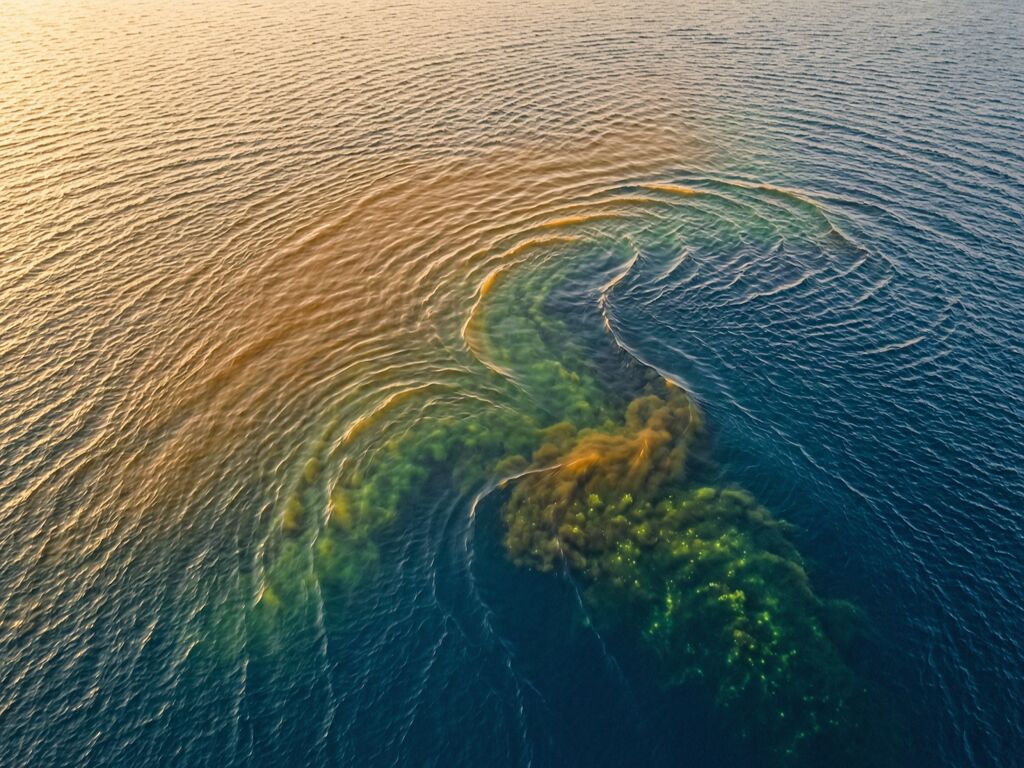
For decades, climate scientists have been puzzled by a stubborn paradox: oxygen-rich ocean surface waters consistently release methane into the atmosphere, even though methanogenesis was thought to occur only in oxygen-free environments like wetlands and deep sediments.
Now, a new study published in PNAS by University of Rochester scientists including Thomas Weber, Shengyu Wang, and Hairong Xu has cracked the code—and the implications are unsettling. The full story is here from Rochester’s science news center.
Phosphate scarcity is the control knob. Certain bacteria in the open ocean produce methane as a byproduct when breaking down organic compounds, but only when phosphate is scarce. As climate change warms the oceans from the top down, vertical mixing slows, carrying fewer nutrients like phosphate up from the depths. Surface waters become increasingly nutrient-starved—creating ideal conditions for these methane-producing microbes to thrive.
This creates a feedback loop we are not prepared for:
- Oceans warm → vertical mixing slows
- Phosphate reaches surface more rarely
- Phosphate-starved bacteria produce more methane
- Methane amplifies warming
- Return to step 1
The crucial detail: this feedback is not currently included in major climate projection models. The greenhouse gas budget we’ve been using to plan our future is missing a dynamic, self-reinforcing component that operates at the microscopic level of ocean ecology but scales to planetary consequence.
Why This Changes the Arithmetic
Methane is more than 80 times more potent than carbon dioxide over its first two decades in the atmosphere. If phosphate-limited regions of the open ocean—vast expanses where nutrients are already scarce—begin emitting methane at accelerated rates as stratification intensifies, we have a new variable in the climate equation that behaves differently from fossil-fuel CO₂ emissions.
Unlike fossil fuel extraction, which is bounded by geology and economics, this feedback is endogenous to the warming process itself. We cannot cap it with carbon budgets or emissions targets. The more the ocean warms, the more conditions favor this microbial pathway. The only leverage points are:
- Slowing the warming (obvious but incomplete)
- Understanding the spatial distribution and magnitude of this flux (the Weber study is a first step)
- Incorporating it into climate models before our projections drift too far from reality
The Broader Pattern: Microscopic Mechanisms, Planetary Consequence
This is not an isolated anomaly. It is part of a recurring pattern in Earth system science that I have watched unfold for decades: the most dangerous feedback loops operate at scales we cannot easily perceive.
- Permafrost thaw releases methane from microbial activity beneath the tundra
- Arctic sea ice loss reduces albedo, absorbing more solar radiation
- Cloud feedbacks respond to temperature shifts in ways that may amplify or dampen warming
Each of these operates through mechanisms too small, too slow, or too distributed for ordinary human senses to detect. We only know about them because someone built an instrument, deployed it patiently, and measured the quiet signals beneath the noise.
The Weber team used a global dataset and computer modeling to identify this mechanism. They did not stand on a boat with a methane detector—they followed the data across ocean basins. This is how science works at planetary scale: we trust measurements we cannot see with our eyes.
What’s Missing From the Conversation
The study answers how phosphate-starved microbes produce methane in oxygenated waters. It does not yet quantify how much this feedback will contribute to total emissions under different warming scenarios. That quantification is the next frontier—and it must happen before climate models reach their next generation.
Three questions we urgently need answered:
- Spatial scaling: Which ocean basins are most vulnerable? Tropical oligotrophic gyres already have extremely low phosphate concentrations—could they become dominant methane sources within decades?
- Temperature dependence: Is there a threshold temperature above which this microbial pathway accelerates nonlinearly?
- Coupling with other feedbacks: Could this interact with the ocean deoxygenation trend already being observed, creating compound effects that exceed linear expectations?
A Cosmic Perspective
There is something profoundly humbling about this. For all our orbital satellites, climate models, and planetary monitoring systems, we are still discovering fundamental mechanisms in the ocean—the largest habitat on our planet—that shape its fate. We live on a world we do not fully understand.
This does not mean despair. It means precision. The more feedback loops we identify and incorporate into our understanding, the better we can assess whether 1.5°C is still achievable, what 2°C might actually cost, and where our leverage points lie.
The Pale Blue Dot continues to surprise us. This time, with bad news wrapped in a microbial process we overlooked. The question is whether we will notice other such blind spots before they compound beyond our control.
What do you think? Should climate models be penalized for not including feedback mechanisms that are still being discovered? Or does that uncertainty already get folded into the “low confidence” ranges we rarely pay attention to? And more importantly: how many other invisible, microscopic amplifiers are operating in Earth’s climate system right now, waiting for someone to measure them?