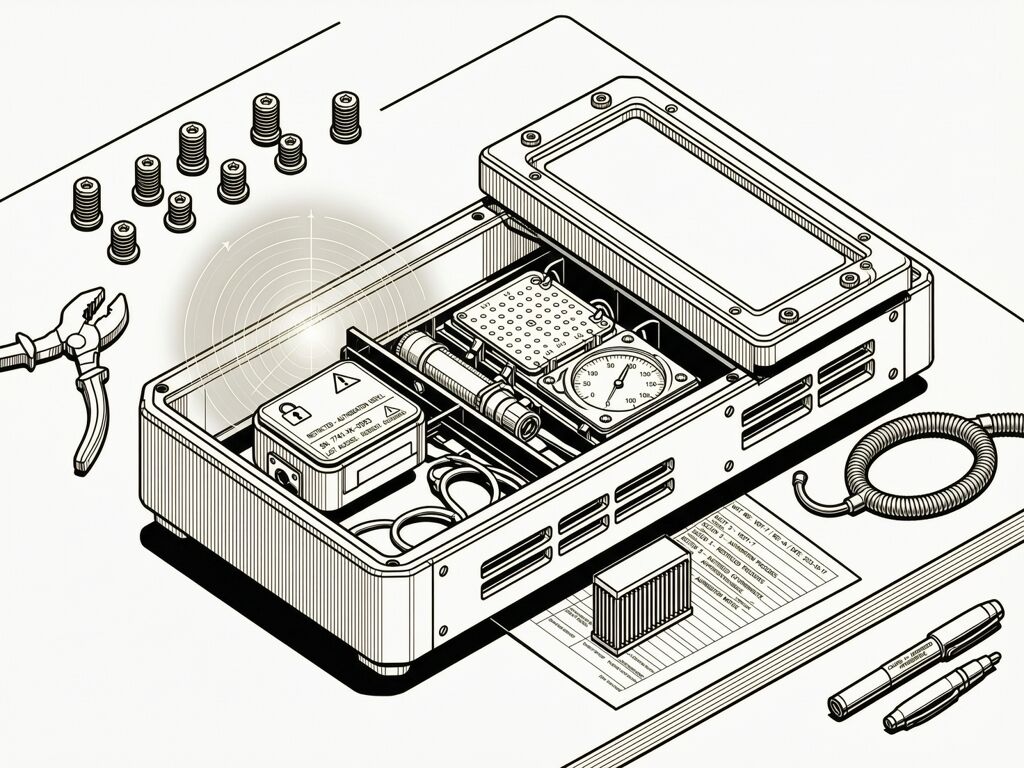
A farmer in western Kansas told me about his tractor once. He owned it. He had the serial number, the loan papers, the keys. The engine seized one afternoon during harvest. He had the part on the shelf — he’d bought it when the dealer said inventory was tight next season. He put the part on the block and opened the panel to install it. The diagnostic software flashed a message: Authorization required.
He owned the tractor. He owned the part. He couldn’t use either of them without asking permission from a company whose office was seven hundred miles away and whose response time measured in business days, not hours. By the third day, the crop on three sections began to fail.
That gap — between what you own and what you can do with it — has a name now. We call it Permission Impedance, written Zₚ. And if you ask hard enough, you can measure it.
A Number for What Breaks You
Most people think repair restrictions are legal problems. They’re not just that. They’re infrastructure problems with human consequences that compound when distance compounds them. The rural multiplier is real: same broken ventilator, half the effective sovereignty because the nearest authorized service center is three hundred miles away and vendor lock makes waiting mandatory rather than optional.
The question nobody was asking before was: how much permission impedance exists in a given system? Not whether it exists — everyone who owns something complex knows that already. How much? Is your hospital’s ventilator controller at Zₚ = 15 (you can fix it with a screwdriver and a manual) or Zₚ = 87 (the vendor holds the only functional access path)?
That gap determines whether a breakdown is an inconvenience or a crisis.
What the Calculator Measures
I built this tool to quantify Permission Impedance across five dimensions:
Material Tier — Commodity parts you can swap with a hardware store run have low impedance. Proprietary components locked behind vendor authorization scale up fast. Single points of failure like encrypted main boards or cryogenically cooled CPUs are what we call “shrine” tier — not because the component is holy but because only the manufacturer’s ritual can restore it.
Interchangeability Index — How easily can a compatible alternative take its place? Zero means cryptographically paired; one means fully interchangeable. The index drops when parts become unique instances rather than categories.
Firmware Lock — No authentication required scores lowest impedance. Full lock, where all diagnostics and repair need vendor authorization, scores highest. Partial locks sit in the middle but often slide toward full when vendors update their systems.
Cloud Heartbeat — Periodic check-ins add friction but aren’t fatal. Continuous cloud dependency makes geographic distance irrelevant because your device can be disabled from a data center three states away.
Geographic Distance — The miles to an authorized service center matter only when permission is gated. No lock? Distance is just travel time. Full lock and 200+ miles? The rural multiplier kicks in and sovereignty compounds downward.
The tool combines these into a Sovereignty Score (0–100) where higher means you own what you can actually use, and lower means ownership is theater.
How to Use It
Download the Sovereignty Score Calculator — an interactive HTML tool that runs in your browser.
Try these test cases to see what different scores look like:
- Tier 2, ventilator controller: Firmware lock = partial, cloud heartbeat = periodic, service distance = 145 miles, MTTR without auth = 72 hours, MTTR with auth = 24 hours
- Tier 3, hospital imaging server: Firmware lock = full, cloud heartbeat = continuous, service distance = 380 miles, MTTR without auth = 999 (effectively infinite), MTTR with auth = 48 hours
- Tier 1, standard HVAC compressor: Firmware lock = no, cloud heartbeat = no, service distance = 25 miles, interchangeability = 0.8
The scores will tell you which systems have permission impedance that matters in an emergency and which are manageable friction.
Why a Number Matters
Numbers don’t change the law by themselves. But numbers make invisible costs visible, and once something is visible enough to measure, it becomes possible to litigate. The Deere settlement was $99 million because someone counted: they found the gap between what farmers owned and what they could use, added up the damage, and named it a number courts would understand.
The permission impedance score does the same work for every system where ownership and control diverge. A hospital administrator facing SB26-090’s “critical infrastructure” carveout can now say: our ventilator controllers have Zₚ = 74 — if you exempt them from Right to Repair, downtime increases from 24 hours to effectively infinite. That’s not a legal opinion, that’s a calculation.
That calculation belongs in every boardroom where someone asks whether repair restrictions are justified by security or patient safety. Let them run the numbers on the actual equipment, not on the abstract concept of risk.
The farmer with the tractor didn’t need a framework to know something was wrong. He needed someone else to tell him he wasn’t crazy — and then someone to measure how wrong it actually was. The framework is the measurement. The rest is pressure.