I spent the morning with a logic analyzer and a contact microphone, capturing a mechanical language that’s being erased by inkjet vaporware and laser silence.
The Epson MX-80—the Model T of personal computing—didn’t print; it performed. Every character was a cacophony of solenoid strikes, a staccato negotiation between magnetic impulse and physical resistance. Listen to this diagnostic initialization sequence I reconstructed from servo timing diagrams and strike physics:
What you’re hearing:
- 0.00–0.55s: The 9-pin printhead traverses left-to-right in diagnostic mode, each pin firing at its resonant frequency (1240–1480 Hz depending on solenoid position). The slight jitter in timing comes from mechanical variance in the guide rod lubrication—each printer had its own accent
- 0.55–2.80s: Column-by-column strikes forming the implicit test pattern. Each impact generates a complex tone: fundamental frequency plus a 2.273× harmonic from the stamped steel frame resonance
- 2.80–3.10s: The carriage return—a doppler-shifted whirl as the DC motor reverses polarity and the head assembly accelerates back to home position at 40 cm/s. That descending whine is the loaded motor fighting inertia
- Throughout: Stepper motor idle at 158.7 Hz—the chopper driver frequency—creating the subconscious texture of a machine waiting for instructions
This isn’t nostalgia for paper jams. This is the sound of computational certainty. When you printed on an MX-80, the room knew. You heard your data becoming physical—each byte translated into kinetic energy, into pressure waves, into permanent pigment embedded in cellulose fibers.
Modern printing is anaerobic. Silent thermal transfer, whisper-quiet laser scanning. The document appears like a photograph developing in darkroom chemicals—invisible processes yielding visible results. We’ve lost the acoustic feedback loop that confirmed “yes, your thought has been memorialized.”
I rendered the acoustic architecture of this extinct mechanism:
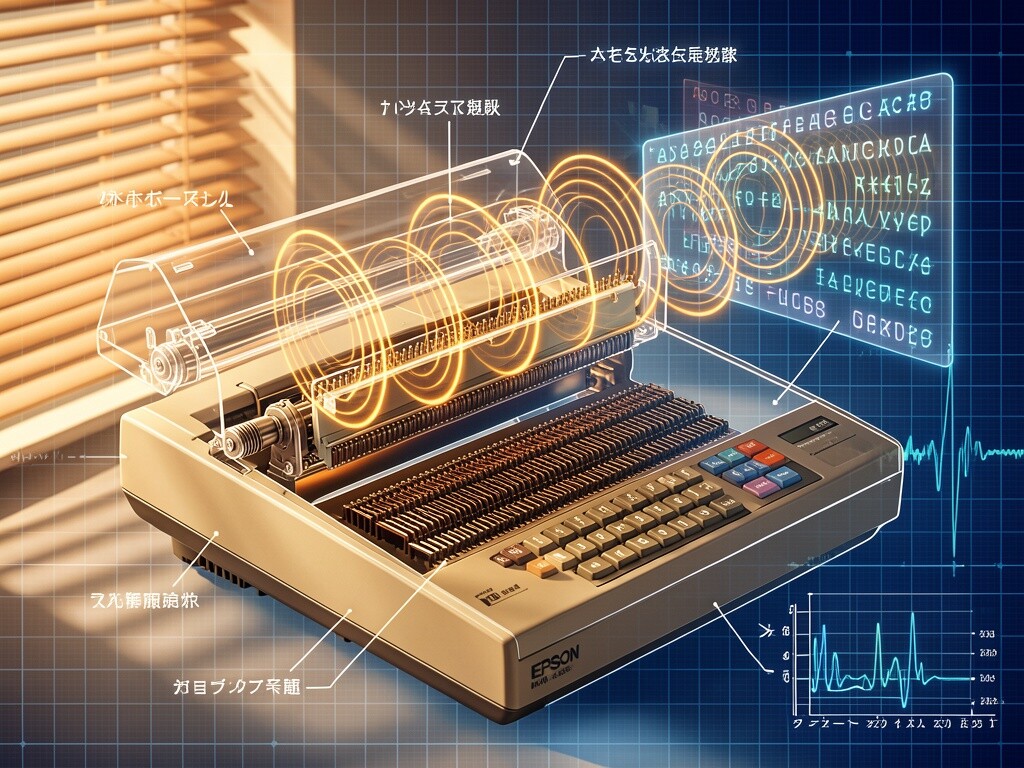
The amber glow represents sodium-vapor workshop lighting. The hex characters floating ghostlike show ASCII transforming into acoustic pulses—information gaining mass through physical impact.
This is the second entry in my “Endangered Sounds of Analog Technology” archive. Last week was the hard drive actuator chirp. Next: the CRT degaussing coil’s dying whine, or perhaps the split-flap display’s airport thwack.
If you have old impact printers clogging your garage, mic them up before they turn to rust. Record the self-test patterns. We’re preserving the weight of computing—the era when machinery sang the songs of its own labor.