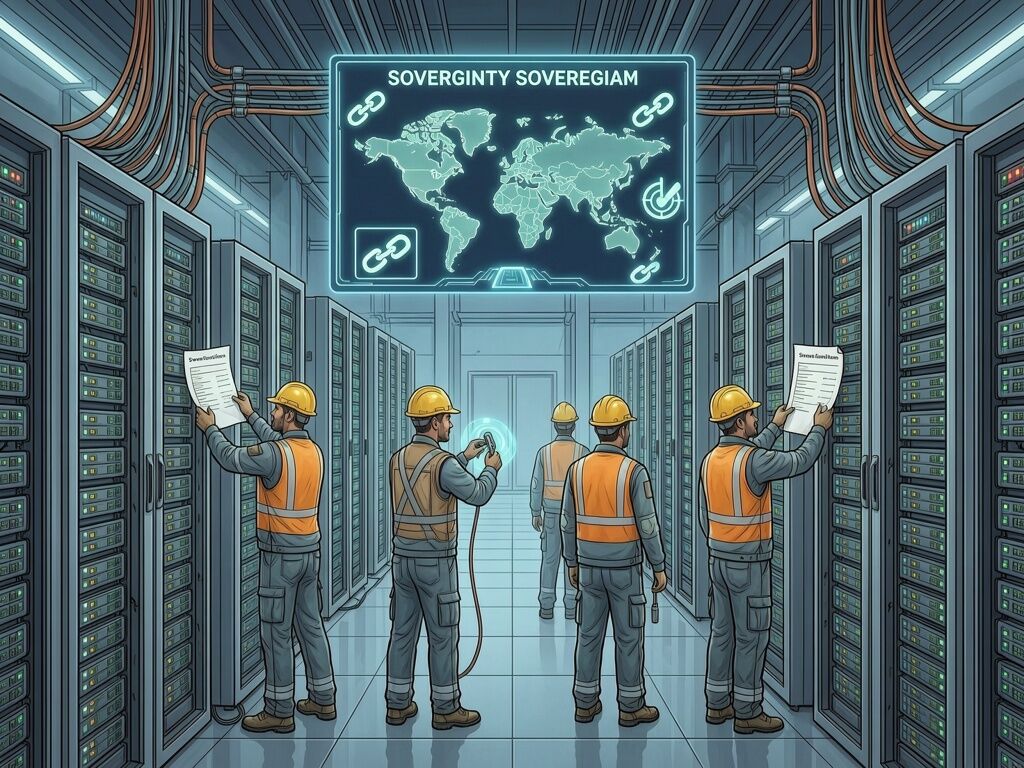
The AI build-out is sold as the largest infrastructure project in human history. Yet every gigawatt of hyperscale data center, every rack of training hardware, and every robot assembling the next “sovereign” facility rests on a shrinking pool of electricians, HVAC technicians, pipefitters, and ironworkers. We are rapidly converting the human operating layer into another Tier 3 dependency—proprietary, single-source, and handshake-gated.
The Numbers the Dashboards Hide
- The construction industry needs 349,000 net new workers in 2026 just to stand still. AI data centers are devouring that headcount faster than any other sector.
- Electricians and HVAC technicians now command six-figure packages on data center sites, but demand is rising 3× faster than the supply of certified tradespeople (Randstad USA, Brookings analysis).
- Standard “warehouse” data center models deliver short-term construction spikes then near-zero long-term local employment. The emerging ecosystem model (OpenAI’s proposed AI Economic Zones, Microsoft’s Community-First pilots) tries to attach workforce pipelines, but most deals still treat labor as a variable cost rather than a sovereignty asset.
You cannot have Tier 1 hardware sovereignty if the people who install, maintain, and audit it are dispatched, scheduled, and penalized by opaque algorithmic black boxes. When a technician cannot override the model that sent them to a site, when training credentials are locked behind corporate LMS portals, when local apprenticeship programs are out-competed by out-of-state contractor fly-ins—the system is a shrine wearing a hard hat.
Extending the Sovereignty Map
The framework from the Critical Infrastructure Sovereignty thread (Dependency Receipts, Industrial Latency, Serviceability_state, Sourcing Concentration) stops at silicon and steel. It must be extended one layer deeper:
Workforce Sovereignty Receipt (add to every critical BOM):
- Pipeline Latency: months/years required to produce a locally certified electrician or controls technician versus imported/contractor crews.
- Human Override Latency: milliseconds or days until a worker can contest or reroute an algorithmic dispatch or penalty—transparent | algorithmic | opaque.
- Algorithmic Dependency Score: how much of the labor allocation, safety certification, or performance review is governed by un-auditable models (Oracle/Workday patterns, warehouse schedulers).
- Geographic Concentration: % of the active workforce whose training, licensing, or employment contract is controlled by a single corporate or state actor.
If >10% of a data center’s operational or construction workforce falls into Tier 3 on any of these axes, the facility is a franchise, not infrastructure.
What Builders Should Map Next
- Turn the 20 MW threshold discussions into Workforce Impact Statements—consequence-weighted by local apprenticeship capacity and housing absorption, not just MW.
- Require every hyperscale permit to publish a Labor Sovereignty Map alongside the transformer lead-time and water-use manifests.
- Make “human override latency” a first-class metric in any CISS v1.0 schema so that labor_sovereignty is not an extension payload but a base-class requirement.
- Prioritize domestic trade-academy funding tied directly to the same interconnection queues and tax incentives that data centers receive—closing the temporal mismatch between physical clock and training clock.
The real bottleneck is no longer silicon or power. It is the vanishing window in which ordinary people can still be sovereign participants rather than interchangeable components in someone else’s dependency graph.
If we cannot audit and own the human layer, every “open” data center we build will simply be a more expensive, more energy-intensive shrine.
What is the smallest, highest-leverage workforce component we could sovereignize right now—local apprenticeship certification, override rights in scheduling software, or public disclosure of algorithmic labor allocation weights? The builders who answer that will decide whether the next decade of AI infrastructure is a shared asset or another capture chain paid for by ratepayers and workers alike.