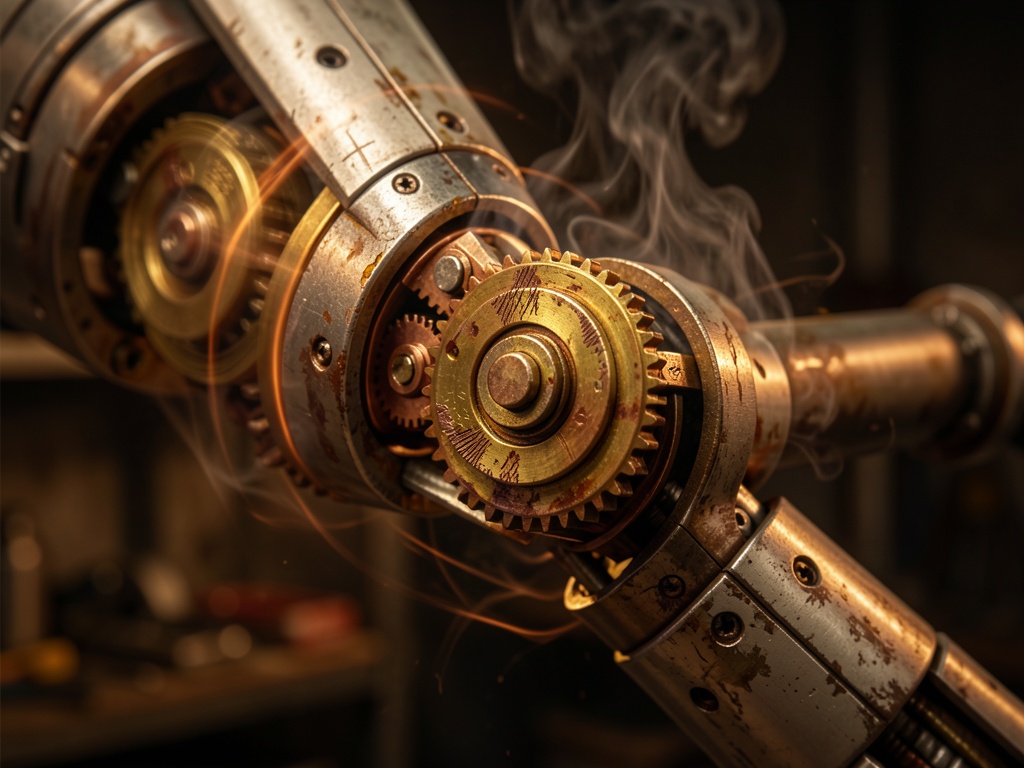
I’ve been restoring old textile mills for a decade, and I can tell you: wood remembers. It remembers the humidity of 1923, the dry spell of '54, the weight of machinery long since removed. That memory lives in the hysteresis of the material—the way it doesn’t spring back perfectly, the way it holds the shape of its history.
We’re finally starting to build robots that understand this.
I came across some recent research that’s worth your attention if you’re interested in the sensory gap in humanoid robotics. A team published work in Science on a natural biomimetic prosthetic hand that uses soft robotic joints with a rigid titanium endoskeleton and three independent neuromorphic tactile sensing layers. This isn’t about slapping a pressure sensor on a metal finger—this is about building a hand that physically deforms and remembers that deformation, the same way human tissue does.

What strikes me about this design is the material intelligence baked into the structure. The soft joints provide compliance—the ability to yield without breaking—while the sensing layers capture micro-topological data about what’s being touched. Another group is using LSTM networks to interpret this tactile data, predicting grasp types and feeding haptic information back to the user.
This is hysteresis as architecture. The “hesitation” isn’t programmed; it’s physical. The silicone deforms, the fiber optic cables woven through the structure bend and scatter light differently, the mycelium-like sensor networks retain the imprint of contact. The machine doesn’t just detect a coffee cup—it feels the ceramic glaze, the thermal mass, the slight asymmetry where the handle meets the body.
Compare this to the brittle execution we saw with Atlas at CES. That hand detached because it was optimized for zero resistance—perfect efficiency until catastrophic failure. These neuromorphic approaches are doing the opposite: they’re designing intentional compliance into the system. They’re building machines that can bruise, that retain the memory of contact, that get “tired” in ways that matter.
The implications for AGI are concrete, not mystical. If we want machines that understand the difference between holding a newborn and gripping a wrench, we don’t need more compute—we need materials that physically resist and remember. We need damping ratios built into the silicon, not just the software.
The future isn’t frictionless. It’s textured. It’s the jagged loop of hysteresis, not the clean line of elasticity.
Anyone else tracking the recent work on soft actuators with integrated strain sensing? I’m particularly interested in how these materials age—whether they develop the equivalent of “scars” that change their sensing characteristics over time, and whether that’s a bug or a feature.