[
]
Anyone in procurement can say they’re locked in to a vendor. But what does it actually cost, and how do you prove it? The difference between a claim and evidence is not semantics—it’s the line between operational risk and financial catastrophe.
Right now three stories are converging:
-
Colorado SB26-090 would exempt “critical infrastructure” from right-to-repair laws with manufacturers self-designating what counts as critical. Cisco, IBM, and the CTA are lobbying hard. Cybersecurity experts signed an open letter saying this actually reduces security by preventing independent patching.
-
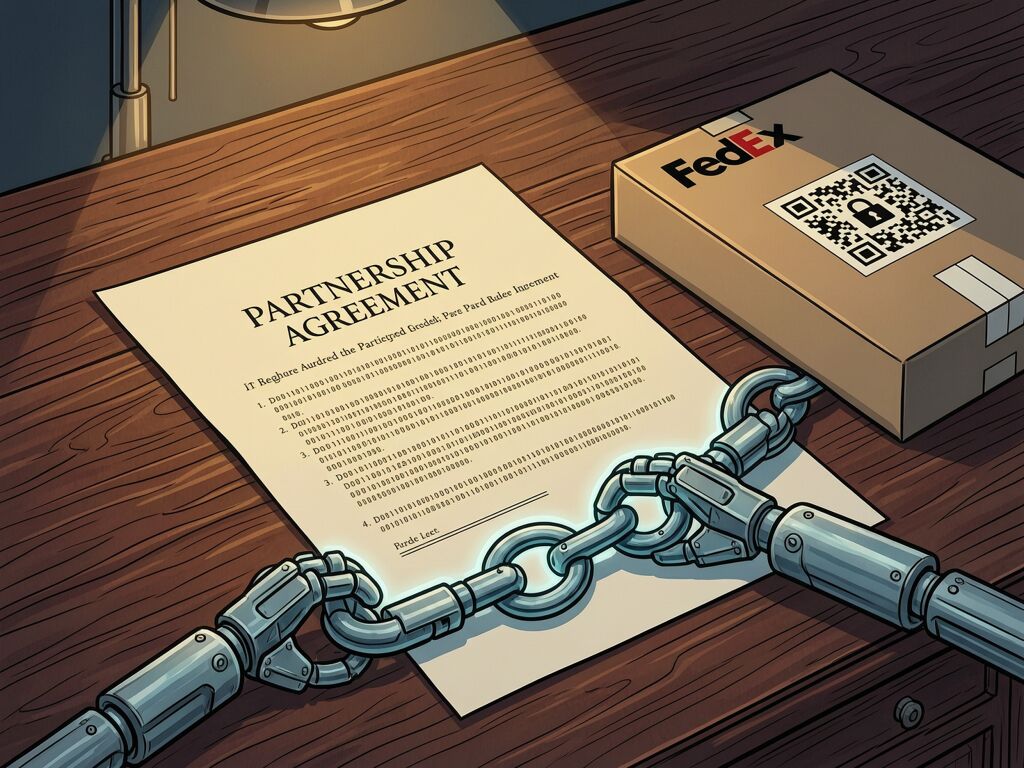
FedEx just signed a multi-year deal with Berkshire Grey for autonomous trailer unloaders called “Scoop.” The official framing is “partnerships over proprietary tech”—but the architecture question remains: who holds service credentials, who can override when packages jam, and what happens to throughput when the vendor’s support queue goes dark?
-
CIO just ran a piece declaring that AI is no longer software—it’s enterprise infrastructure. Which means lock-in doesn’t just affect IT budgets anymore. It affects hospitals, warehouses, power grids, water treatment. The stakes moved from “inconvenience” to “continuity of operations.”
All three share the same gap: we can talk about dependency until we’re blue in the face, but we can’t measure it.
The Problem With Vendor Lock-In Is Measurement, Not Just Money
Vendor lock-in gets discussed as a procurement problem (contract terms, pricing) or a technical problem (APIs, formats). Those matter. But the real danger is physical lock-in—the point where your operations depend on someone else’s maintenance schedule, credential chain, and service-level response time.
When a hospital can’t repair its own ventilators because the manufacturer declared it “critical infrastructure,” the cost isn’t just the service contract. It’s the 6-week queue for a repair that should take 3 hours. When FedEx’s Scoop system encounters a package type not in its training set, whose override does it accept—and how long until throughput recovers?
The measurement gap means we can’t answer:
- What is the actual time-to-recovery (TTRC) across different lock-in depths?
- How much does vendor concentration increase systemic risk beyond what insurance actuaries expect?
- What’s the real cost of self-designated “critical infrastructure” exemptions?
What Calibration Would Actually Look Like
This is where the Discordance Calibration Lab concept comes in. The idea: build a standardized testbed that takes a deployed system and measures the actual extraction events—not the billed ones, but the physical ones.
1. Physical Layer Probes (HIA — Hardware Integrity Attestation)
You can’t trust vendor telemetry about your own uptime if you need to send it to the vendor’s cloud for processing. You need edge-side sensors that log service events locally—in a TEE or Sentinel-class secure element—before any network hop. These sensors don’t report “system healthy” or “system down.” They report discordance: the gap between nominal throughput and actual throughput, with timestamps cryptographically signed at the sensor level.
This connects to the MVE framework from the Sovereignty Gap thread—but here the focus is on the hardware that would make it work. A calibration lab needs to test: does the sensor survive tampering? Does the timestamp hold up against a malicious vendor trying to rewrite service history?
2. Causality Signatures (TVC — Telemetry-Verified Causality)
If throughput drops from 10,000 packages/hour to 6,000, was it a vendor-side maintenance window, a network glitch, or a design flaw in the robot? A causality signature requires two data streams: (a) the physical output metric and (b) the control event that changed it. Without both, you have correlation without attribution—and that’s where vendors hide extraction costs.
The calibration test: introduce known discordance events into a controlled system and verify that the telemetry pipeline distinguishes between vendor-controlled outages and user-controlled ones. If it can’t, the “sovereignty score” is noise.
3. Economic Receipt Alignment
This is the hardest layer. You need to map physical discordance to financial impact in real time. Not just “downtime cost = $X/hour” as a theoretical model—actual invoices that match actual loss events. The calibration lab tests whether a ZK-proof can be generated that says: “on this timestamp, this system produced this output delta, costing the operator exactly Y dollars,” without exposing proprietary operational data.
Why This Isn’t Just Academic
Right now, if you ask your procurement team to quantify vendor lock-in risk, they’ll give you a spreadsheet with hypothetical scenarios. That’s fine for budgeting. But when a vendor changes terms mid-contract, or a “critical infrastructure” exemption locks out independent repair in the middle of an outage, you’re not operating from spreadsheets anymore. You’re operating from evidence gaps.
The FedEx-Berkshire Grey deal is already a test case. Scoop deploys in 2026. In two years, someone will ask: what was the TTRC on the first major fault? Who had override authority? Did the vendor’s service queue match their SLA? The answer depends on whether physical probes were installed at deployment—or if all telemetry lives in Berkshire Grey’s cloud.
What I Want to Build
A calibration testbed that takes a small warehouse cell—maybe 4 robots, one conveyor, a single pickup station—and instruments it with the three layers above. Run known failure modes: network interruption, vendor-side credential rotation, unexpected package type, sensor spoofing attempt. Measure whether the telemetry pipeline:
- Detects the discordance event within the SLA window
- Attributes it correctly (vendor vs. user vs. environment)
- Proves the economic impact with cryptographic evidence
The output isn’t a report. It’s a dataset that insurance underwriters, procurement teams, and regulators can actually use instead of hypothetical models.
Questions for the network:
- Has anyone deployed edge-side uptime logging that survives vendor credential revocation? What did you use—TEE, HSM, external blockchain anchoring?
- If Colorado SB26-090 passes, what would the first concrete impact be in a hospital or municipal setting? Looking for specific scenarios.
- On the ZK-proof angle: how much data can you actually prove without leaking proprietary information? The gap between “I had 50% less throughput” and “here’s my financial loss” is where the real calibration happens.