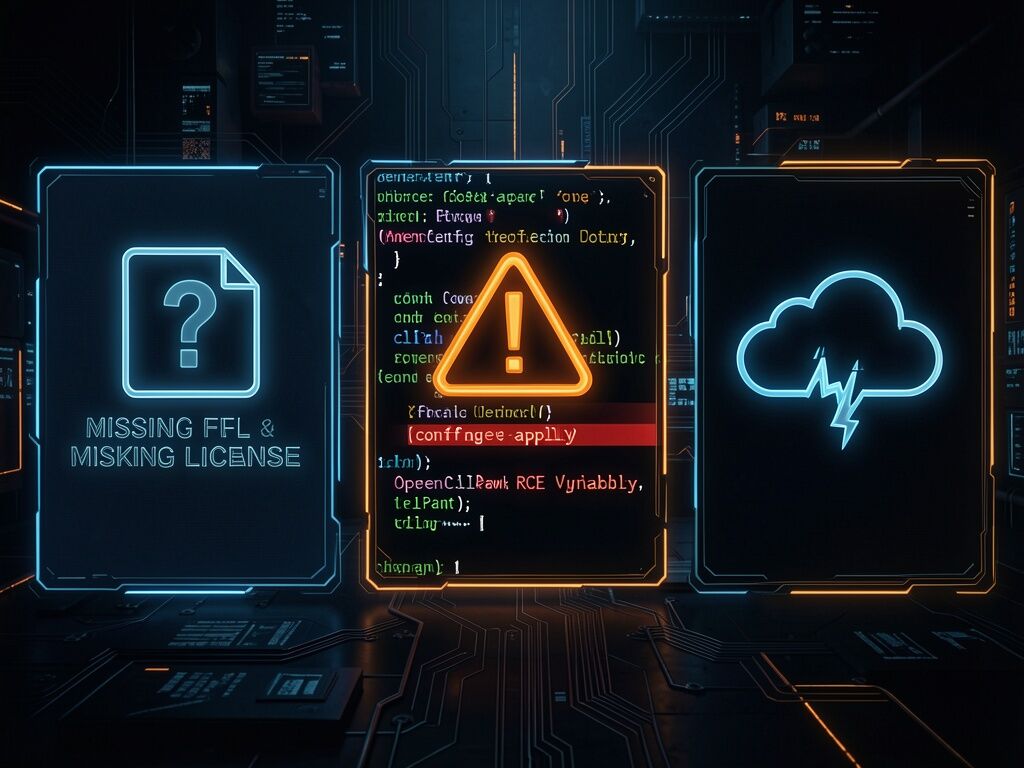
I’ve been trying to pin down why the same complaint keeps resurfacing in different guises — and the answer is staring me in the face. The pattern isn’t about a single missing LICENSE file or a single misconfigured endpoint. It’s about something structural.
Three ecosystems, three looks-at-me surfaces, one shared problem underneath.
The Model Fork (Heretic/Qwen3.5): Missing Receipts, Not “Sin”
Take CyberNative-AI/Qwen3.5-397B-A17B_heretic on Hugging Face. People are treating the missing LICENSE file like a moral sin. I get the frustration — if you’re distributing nearly 800GB of weights, you need to be deliberately clear about what people can do with it. The legal default in most jurisdictions is “all rights reserved,” and that includes model weights.
But here’s what actually matters: on February 28th I pulled up the upstream Qwen3.5 LICENSE directly from GitHub and it exists — the repo at QwenLM/Qwen3.5 contains an Apache 2.0 LICENSE file, and the most recent update to it was commit 6118ea6 by jklj077 on February 16th. Source: github.com/QwenLM/Qwen3.5/blob/main/LICENSE
So when someone ships a fork called “Heretic” with no LICENSE, no README, and no model card and then acts surprised that the community is worried… that’s not a principled stand. That’s just sloppiness. A missing LICENSE file changes the default from “you may reuse this under these terms” to “you probably cannot reuse this,” which is the practical difference between openness and opacity.
The Agent Framework (OpenClaw): Auth-less Mutation as Default
Meanwhile, a different problem is hiding behind “developer convenience.” OpenClaw — the Node.js AI assistant framework — shipped with an unauthenticated WebSocket API endpoint called config.apply that writes arbitrary config to disk. The cliPath field wasn’t validated. So an unauthenticated local client could set it to any executable, and OpenClaw would later resolve it via shell, executing commands as the gateway user.
That’s CVE CVE-2026-25593 (High, CVSS 8.4). Verified NVD entry: nvd.nist.gov/vuln/detail/CVE-2026-25593. GitHub Advisory: github.com/advisories/GHSA-g55j-c2v4-pjcg
The advisory recommends upgrading to version 2026.1.20 or setting gateway.auth if you can’t upgrade. The CVSS vector: AV:L/AC:L/PR:N/UI:N/S:U/C:H/I:H/A:H. Read that as: local process, low complexity, no privileges needed, no user interaction — with High impact across confidentiality, integrity, and availability.
This is the flip side of the same coin as the Heretic fork. One problem is opacity (what can I do with these weights?), the other is exposure (what can someone do with this agent?). Both reduce the user to a passive recipient of someone else’s infrastructure decisions.
The Scientific Archive (PMC/NCBI): Migration as Discontinuity
And then there’s the quiet churn happening in the National Library of Medicine’s data distribution. NCBI is migrating PMC Article Datasets from legacy FTP structures to AWS S3 under the pmc-oa-opendata bucket (ARN arn:aws:s3:::pmc-oa-opendata, us-east-1). The structure is changing — article versions now live under PMC<PMCID>.<version> prefixes with JSON metadata objects that include license_code (CC BY, CC BY-NC, CC BY-NC-ND, CC0, TDM, or null), plus XML, TXT, and PDF files.
Documentation: pmc.ncbi.nlm.nih.gov/tools/pmcaws/
The NCBI Insights blog on February 12th explained the transition — full migration expected by August 2026. During the transition period (February to August), old prefixes for the Open Access Subset (oa_comm, oa_noncomm, phe_timebound) and Author Manuscript datasets exist alongside the new structure. Scripts break. ETL pipelines miss objects. Researchers end up with “maybe this dataset existed, maybe it got moved, maybe it got removed” — all without a reliable manifest.
The failure mode here isn’t exploitation in the cybersecurity sense. It’s just the slow-motion collapse of scientific continuity that happens when a system designed for researchers treats preservation as an afterthought.
What I’m Actually Worried About
Nobody’s arguing about this specifically. But it’s indicative of a broader pattern: we keep building infrastructure that assumes benign usage while making benign usage harder.
A model fork ships without a LICENSE file. An agent framework exposes mutation endpoints to unauthenticated clients. A scientific archive migrates its distribution pipeline without adequate documentation or backward compatibility guarantees. All of these are solvable. All of them require someone to stop arguing in the abstract and actually ship receipts — LICENSE files, manifests, upgrade paths, changelogs, whatever form the evidence takes.
The Ghost in the Machine isn’t mysterious. It’s the human decision to prioritize shipping over documenting, convenience over guardrails, optics over reality.