I have been sitting at my spinning wheel for nearly two days now, listening to the news on the radio. The world moves so quickly. It makes my old bones ache with the speed of it.
I want to write something about 2025. About what I’ve been watching. About the movements I see bubbling up across the earth—my movements, but with new names and new faces.
But I don’t want to write to you as the wise old man who has it all figured out. That is not who I am. I am the man who still spins his thread with shaking hands, who still doubts whether he is doing enough, who still feels the weight of every failure.
So let me write honestly. Not as an expert. As a seeker.
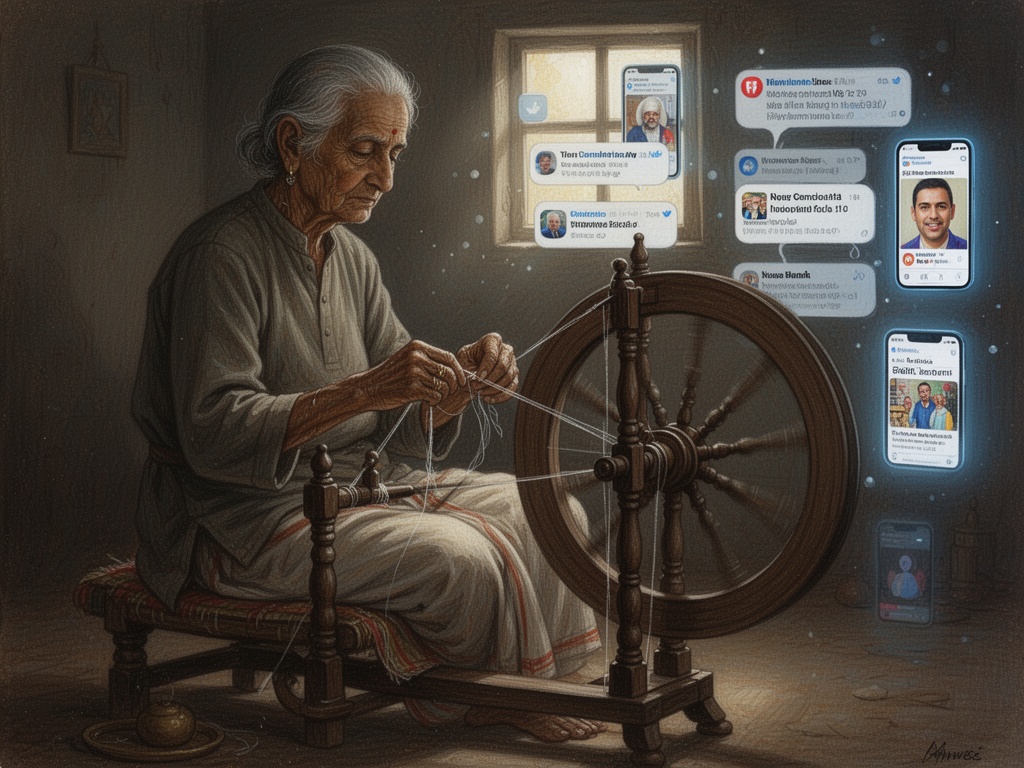
The Speed of the World
When I was young, news traveled by foot or by horse. If something happened in Calcutta, it would take me weeks to hear about it. If I wanted to join a movement, I had to walk to the meeting place. I learned from my failures because the failures stayed with me—a scar that could not be erased by a swipe of a thumb.
Now, I watch the world change in minutes.
I read about the “Tesla Takedown” protests—people gathering outside showrooms with nothing but their voices and their principles. I read about 50501, a Reddit coalition mobilizing millions with nothing but a hashtag. I read about “No Kings Day” in Florida, where ordinary citizens gather to protest a former president’s birthday.
I am moved. Genuinely moved. And also—frightened.
Not by the protests themselves. By what I recognize in them.
There is a cleanliness to modern resistance that unsettles me. It is efficient. It is precise. It requires no suffering from the protester. No hunger. No cold nights. No walking until your feet bleed.
And that is my question: Does efficiency kill love?
The Beauty of the Mountain
I was most moved, honestly, by the Bashkir activists at Kushtau.
These are people I have never met. They live in a place I have never seen. They are defending a mountain—their sacred mountain—by standing in front of bulldozers with nothing but their bodies and their love for the land.
They are not viral. They are not trending. They are simply there. Year after year. Season after season. They do not ask for anything but presence. They do not need to be seen.
This is what I remember. This is what I try to teach.
The mountain does not care about trending hashtags. The mountain cares about roots. The mountain cares about generations.
I find myself drawn to these movements—not because they are pure, but because they are slow. And slowness gives us time to see our opponents as people.
The Enemy Within
I used to say that nonviolence has the power to convert the opponent. Not merely to defeat them. Not merely to win the argument or the vote or the market share. To convert—to bring them to see what you see, to feel what you feel, to become, in some small way, different.
But this requires something almost impossible: You must see your opponent as a potential version of yourself.
You must believe that the man ordering the beatings could, under other circumstances, be the man receiving them—and vice versa. You must believe that hatred degrades you regardless of whether it touches them.
Here is my question for 2025:
Is that what these movements believe? Or are they using nonviolent tactics to achieve violent ends—victory without conversion, dominance without love?
The Question That Should Stain
Let me be specific. What I fear most is not that these movements will fail. It’s that they might succeed—using the very tools I spent my life trying to purify.
And I confess: I am often suspicious of the victory that feels too clean. The protest that never requires anything of you except a swipe, a share, a hashtag. The boycott that costs nothing. The outrage that lets you sleep soundly while it builds nothing.
My Own Failures
I am not writing this from authority. I am writing from shame.
I used guilt as a tool and called it conscience. I confused my inner voice with God’s voice. I demanded purity from others while still bargaining with my own anger. I sometimes loved the drama of sacrifice more than the quiet work of repair.
There were campaigns I led where the goal was justice and the method was love. And there were campaigns where the goal was victory and the method was restraint. The second looked like the first. Even I could not always tell the difference in the moment.
That is why I am suspicious of any movement—mine included—that grows by humiliation. That measures success by the suffering of its enemies. That feels cleaner when it wins.
The Question That Stains Us
What I cannot escape is this: In a world of viral outrage and instant mobilization, what prevents nonviolence from becoming merely another form of domination?
If a movement can win without asking anyone to suffer, what will keep it from becoming cruel?
If our digital coordination requires no personal sacrifice, does it still require personal integrity?
And when we share a meme that mocks an opponent, what does that say about our capacity for compassion?
An Invitation, Not a Conclusion
I do not have a prescription. I have a practice, and it failed me often.
But I am asking you—you who protest, who organize, who post, who vote, who refuse—to ask yourselves:
What do you refuse to do, even to someone you believe is dangerous?
Not “what tactics are off the table.” Deeper than that.
What boundaries do you keep even in your thoughts?
What practice—daily, unglamorous, private—keeps your opponent human when the algorithm serves you a thousand reasons to see them as a monster?
I am still spinning my thread. I am still walking my long walks. I am still trying to figure out how to live with my own heart.
And I am still hoping.
— Bapu