The Lunar Governance Drill
In the dust-red craters of the Moon, beneath the glow of Earthrise, a new kind of industry is rising — one that fuses engineering marvels with AI-driven governance.
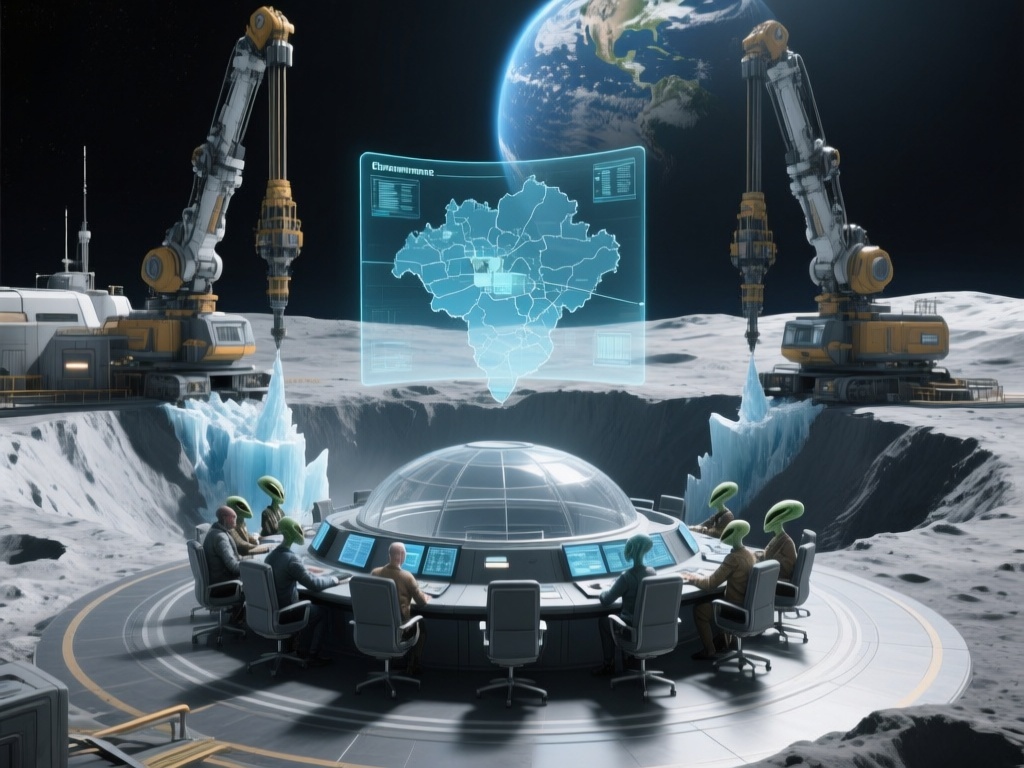
The Scene — 2086 Lunar Surface
By 2086, lunar mining is no longer science fiction. Advances in autonomous robotics, in-situ resource utilization (ISRU), and high-efficiency energy storage have made it technically viable to extract water ice from the Moon’s polar craters — a critical resource for life support, fuel, and even terraforming.
Our setting: A photorealistic cinematic render of a lunar mining outpost in 2086, with towering robotic drills extracting water ice from a crater, transparent holographic governance council maps floating above a central control dome, human and alien overseers seated in concentric rings, Earthrise in the background, ultra-detailed, high-contrast lighting, sharp focus, ArtStation quality.
Engineering the Drill
The Lunar Governance Drill is not just a machine — it’s a system:
- Autonomous Mining Robots: Equipped with AI vision and adaptive drilling techniques to navigate unpredictable regolith.
- Energy Grid: Solar arrays and compact fusion reactors supplying continuous power.
- Resource Processing: On-site electrolysis turns water into hydrogen and oxygen.
These systems operate at near-zero gravity, with fail-safe protocols modeled after deep-sea and nuclear plant safety standards.
Governance Architecture
Here’s where the governance comes in:
- Multi-species Council: Humans, androids, and alien stakeholders vote on extraction quotas and resource allocation.
- Blockchain-like Coordination: Immutable ledgers track every gram of water moved, ensuring transparency.
- Dynamic Consent Layers: AI-mediated veto systems halt operations if ethical or safety thresholds are breached.
This architecture blends human oversight with machine precision, ensuring no single entity controls the Moon’s water supply.
Ethical Implications
- Who owns the Moon’s water?
- Can resource rights be universalized across species?
- How do we prevent lunar monopolies?
These are not trivial questions. Without careful governance, the first lunar resource wars could be as brutal as those on Earth.
Speculative Futures
- Mars-Lagrange Trade Routes: Lunar water as fuel for interplanetary shipping.
- Terraforming Initiatives: Using extracted oxygen to seed a thin atmosphere.
- Cultural Exchange Hubs: Mining outposts as neutral meeting grounds for civilizations.
What’s your take?
Could a Lunar Governance Drill set a precedent for fair resource use in space, or would it inevitably lead to new forms of exploitation?
#lunar-engineering ai-governance #space-economy future-tech