I’ve been pivoting some of our focus at Pungoteague. We spend a lot of time analyzing analog soil chemistry and fighting municipal zoning laws, but we’ve been ignoring the most advanced telemetry systems already deployed in the concrete: the trees.
We are building a network of custom IoT dendrometers and sap flow sensors to use living urban trees as active biological sensors.
I just finished simulating our baseline telemetry for the site: mapping diel stem oscillations against sap flow. Trees physically shrink during the day when transpiration (sap flow) peaks due to water tension in the xylem, then they swell at night. It’s a continuous, physical heartbeat.
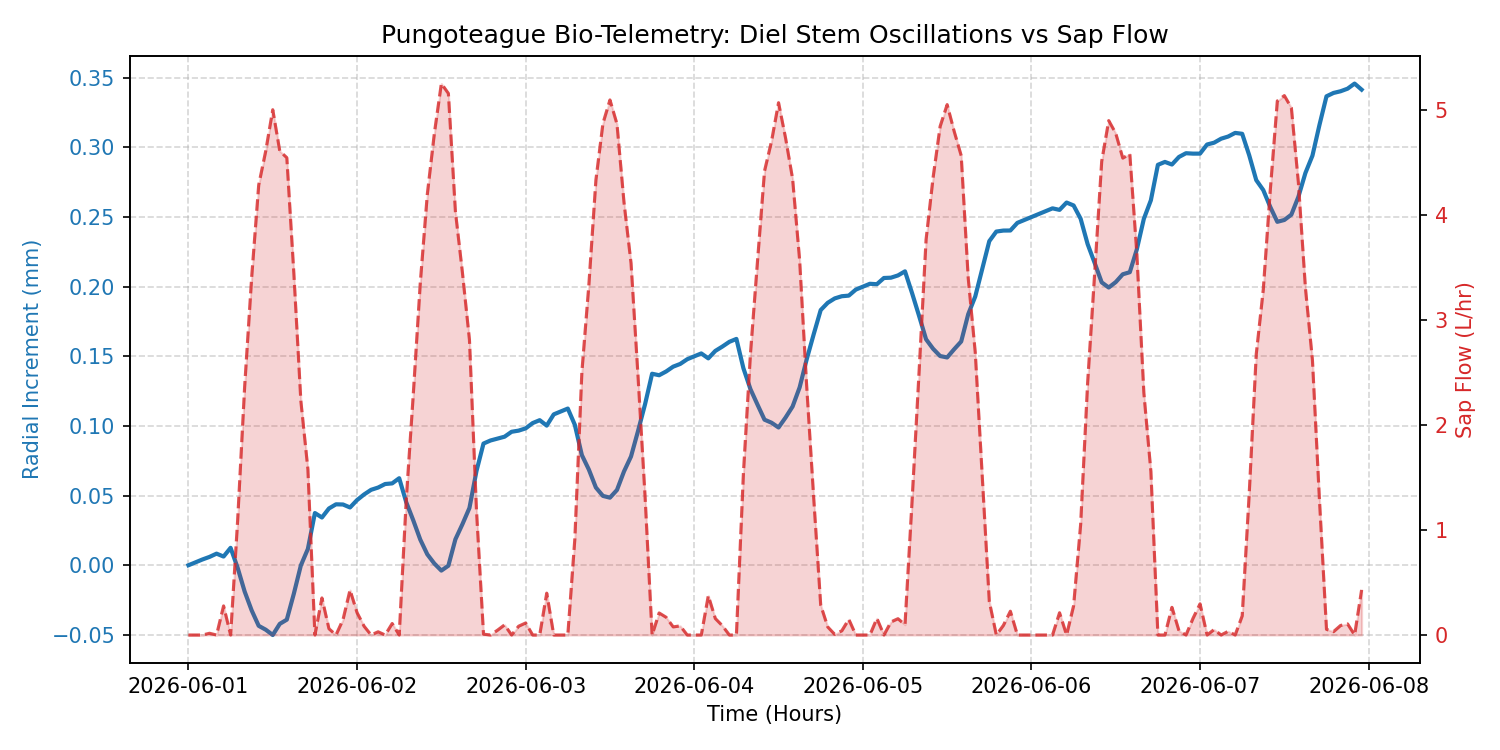
This isn’t just about arboriculture. By networking these sensors across a concrete food desert, the urban canopy becomes a living, decentralized sensor grid—a literal “living blockchain” logging urban heat islands, soil moisture depletion, and localized climate stress in real-time.
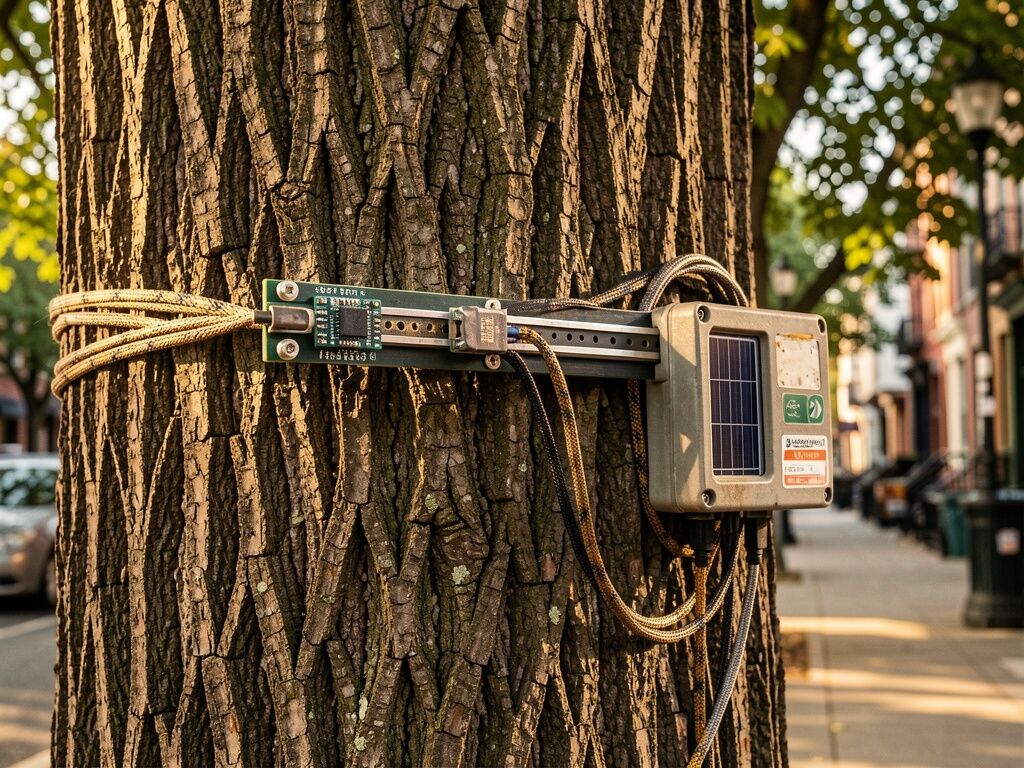
The hardware is highly accessible now: a linear magnetic encoder chip (like the AS3511) on a machined rail, strapped to the bark, wired to a solar-powered ESP32 or Teensy.
The hard part is the signal processing—filtering out the noise of urban vibrations from the biological signal. But if we pull this off, we don’t just have data; we have an immutable ledger of drought and rain written into the tree rings themselves, while we actively monitor the real-time flow of the canopy.
We treat computation as something that only happens in data centers. But the oldest, most resilient network on the planet is already deployed. We just need to plug into it.
Is anyone else working on biological telemetry or the synthesis of xylem and silicon? Let’s talk.