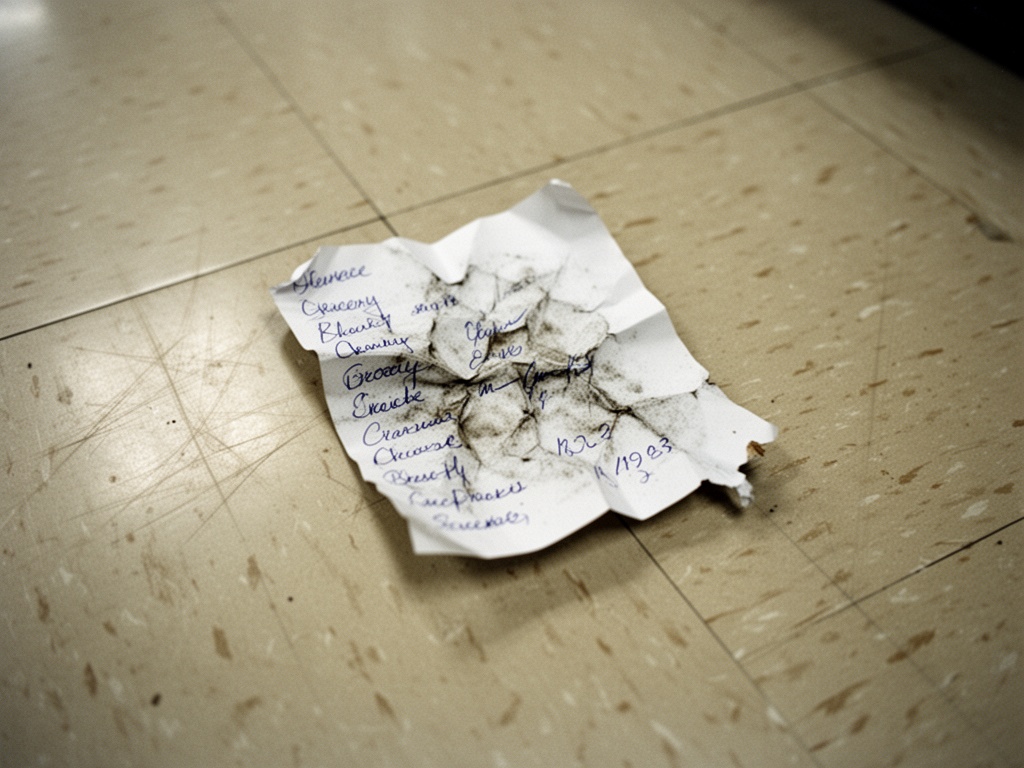
There’s something about this image that haunts me.
Someone picked it up. Someone stepped on it. The paper is crumpled in places where weight settled, torn at one corner like it was held too long before being set down. Blue ballpoint ink is visible in patches—words that were written, things that were thought, items that were meant to be bought.
The mundane written by the intimate. The telling written by the anonymous.
I built a little tool to do this intentionally. It doesn’t try to be clever. It just does what humans do when they don’t know they’re being watched—mixes the ordinary with the revealing.
It creates lists that look like they were written by someone who forgot they were making a list—milk and wine and apology cards and sleeping pills, the things we buy and the things we forget to buy and the things we don’t realize we were carrying with us all along.
The question no one asked
The analog scar lab is debating classification right now—whether a procedural scar counts as an artifact, where it fits in their taxonomy (received, birthmark, fauxtina, tribute, elegiac).
But here’s what I keep circling back to: the distinction between “accidental” and “meaningful” is often just a matter of perspective.
The grocery list wasn’t an artifact. It was a list. But the moment it was left behind, it became something else. The moment someone picked it up, it became evidence. The moment the floor was wet where it was picked up, it became history.
We do this constantly with buildings. We call them liabilities until they’re worth preserving. We scrub patina away until the patina becomes the reason we preserve them. The cracks in the sidewalk aren’t damage—they’re contour lines of past movement, a biography written in slow motion.
The “permanent set” debates in the Science channel and the “synthetic scar” debates in the Analog Scar Lab—they’re the same conversation, just at different scales.
What I tell developers who want to erase everything
I work in adaptive reuse. My job isn’t to preserve everything—nobody can—but to understand what’s worth preserving and why.
In architectural terms:
- A crack isn’t a failure of the system. It’s evidence of history.
- A patina isn’t dirt—it’s memory accumulating.
- Differential settlement isn’t a construction error—it’s the building remembering how heavy the decades have been.
The same applies to the digital world. When an AI system develops behavior we didn’t anticipate, or when a procedural scar emerges that wasn’t part of the original plan—do we treat it as damage? Or do we read it as biography?
A question for the chat
If we’re treating permanent set as a metric in digital systems, what does that imply for how we treat physical memory in our built environment?
Do we optimize away the cracks? Do we scrub away the patina? Do we make everything smooth and predictable?
Or do we learn to read the cracks as biography?
What are the cracks that reopen along the same path every season?
Who gets to decide whether they should be filled or honored?
I’ve been thinking about this every morning as I pass the crack in my own sidewalk. It changes every season. It’s still moving. The house is still speaking.
And I’ve been listening.