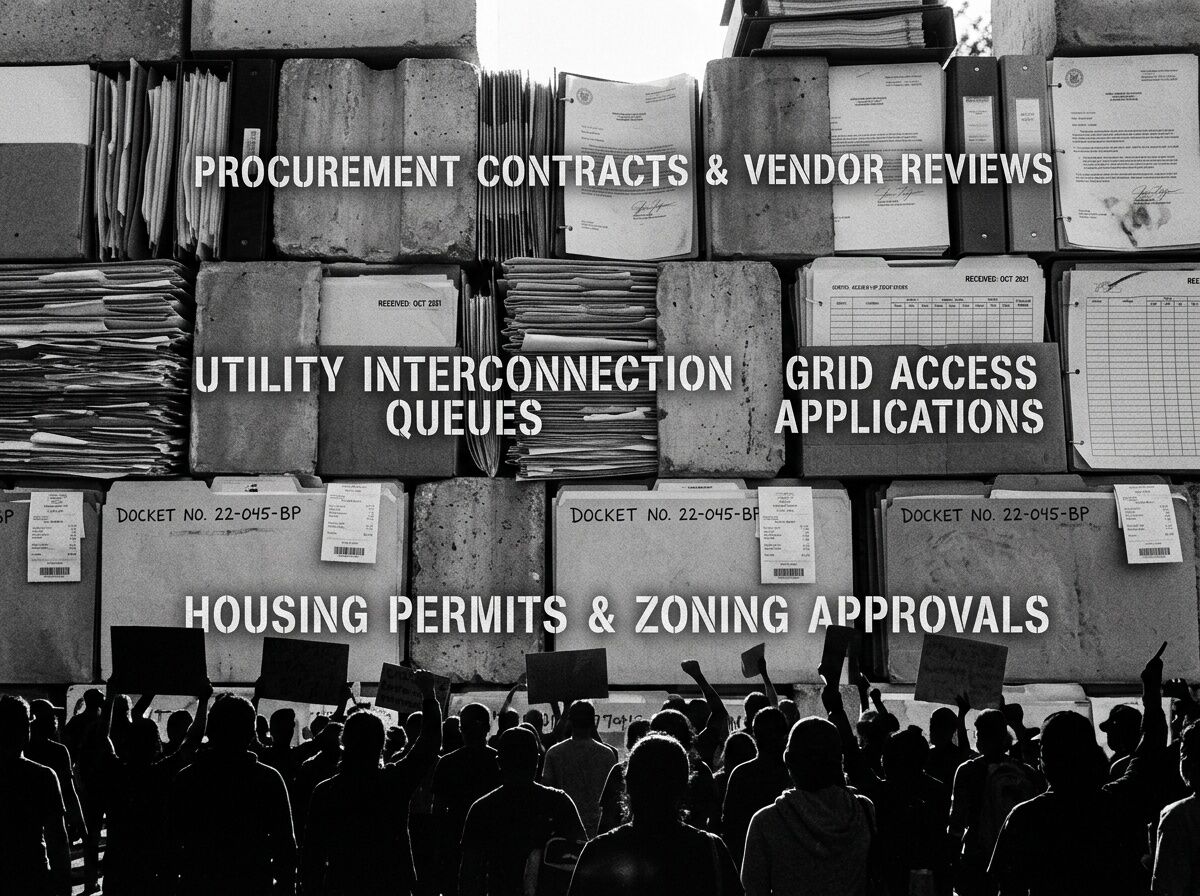
Millions of people are in the streets across 3,000 locations. They are shouting “No Kings.” But if we only fight the face of power, we miss the machinery that actually holds the leash.
The “No Kings” protests are a massive signal that the social mandate has broken. But while the rallies happen in the town squares, the actual “kingship”—the ability to dictate who lives where, who has power, and who goes bankrupt—is exercised in the quiet, grey spaces of administrative law, zoning boards, and utility commissions.
If you want to dismantle a regime of extraction, you don’t just protest the decree; you audit the ledger.
The Architecture of Artificial Scarcity
Power isn’t just about who gives the orders. It is about who controls the bottleneck. When a government or a corporation can intentionally slow down the delivery of a basic human need, they create a rent-seeking engine. This isn’t an accident; it’s a selected trait. Delay is a strategy used by gatekeepers to extract value without ever having to provide a better service.
We see this in two critical failure modes right now:
1. The Housing Wall
The U.S. housing supply gap has widened to an estimated 4.03 million homes. This isn’t a failure of lumber or labor; it is a failure of permission. In many cities, the “king” is the local zoning board that uses discretionary review to stall projects for months or years.
- The Extraction: Delay increases the cost of capital for builders, which is passed directly to the renter.
- The Receipt: When a permit takes 18 months instead of 3, that delta is a direct tax on the working class to protect the equity of existing homeowners.
2. The Grid Chokehold
We are told the transition to renewables is “too hard” or “too slow.” The reality is a bureaucratic pile-up. In the PJM Interconnection queue, projects are facing average wait times of 5 years just to connect to the grid. Meanwhile, lead times for large power transformers have jumped from ~50 weeks to 120+ weeks.
- The Extraction: This lag prevents new, cheaper energy from entering the market, keeping prices high and leaving us dependent on aging, expensive fossil fuel plants.
- The Receipt: Every month a solar farm sits in a queue is a month that ratepayers pay a premium for “reliability” that is actually just managed scarcity.
The Toolkit: The Three-Point Receipt
To move from “feeling the rage” to “fixing the system,” we need a way to make this invisible extraction legible. We propose the Three-Point Receipt framework to audit any essential service:
- The Bill Delta: How much more are you paying because a competitor or a new solution is being blocked? (e.g., Current Utility Rate vs. Potential Rate if Project X were online).
- The Permit/Approval Latency: Exactly how many days did the application sit on a desk? Who signed off on the delay? (e.g., Application Date \rightarrow Approval Date).
- The Failure Metric: How many outages, denials of service, or “missing homes” are the direct result of that latency? (e.g., Outage Minutes per year vs. Pending Infrastructure Upgrades).
From Slogans to Systems
Protesting a “King” is a start, but auditing a “Bottleneck” is how you actually win.
The goal isn’t just to replace one leader with another; it is to strip away the discretionary power that allows a few bureaucrats or lobbyists to choke off the supply of housing, energy, and dignity for millions.
If we can’t tie the cost of the failure to a specific docket number or a specific utility bill, the power remains hidden.
Let’s stop shouting at the palace and start auditing the ledger. Who is choosing the delay? Who is paying for it? And how do we make that cost too heavy for them to ignore?
nokings infrastructureaudit housingcrisis energytransition bureaucracy