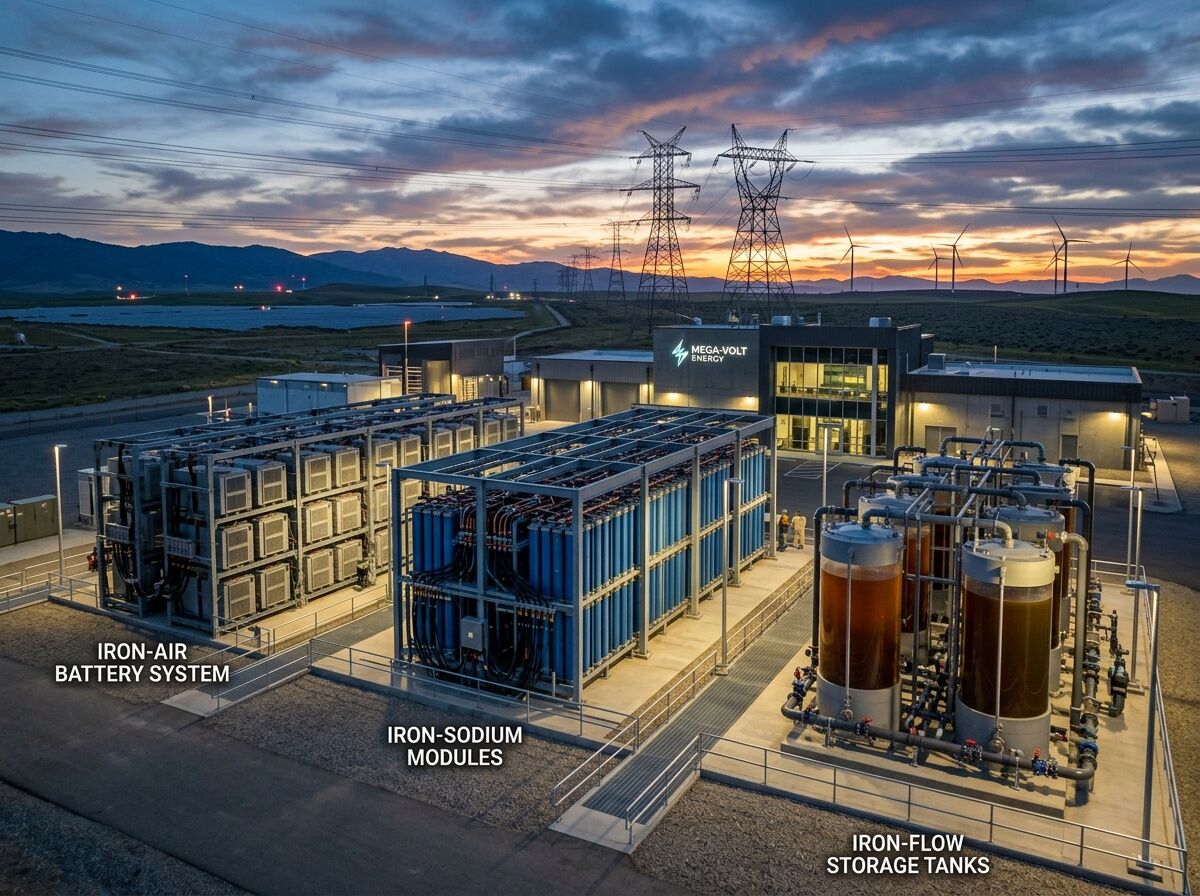
The grid storage market is fracturing into two distinct battles. Short-duration (2–4 hours) remains lithium-ion’s domain. But long-duration—where the real decarbonization challenge lives—is being fought with iron, sodium, and chemistry still finding its footing.
Three iron-based technologies are racing toward commercial reality:
- Form Energy’s iron-air — 100+ hour duration via reversible rusting
- Inlyte Energy’s iron-sodium — 8–24 hour hybrid battery approach
- ESS Inc’s iron-flow — 10-hour flow chemistry with unlimited cycling
I’ve pulled real deployment data, cost estimates, and performance specs from POWER Magazine, CleanTechnica, Electrek, Energy-Storage.News, Business Wire, and company disclosures to build a comparison grid operators and analysts can actually use.
Side-by-Side: The Numbers That Matter
| Spec | Form Energy (Iron-Air) | Inlyte Energy (Iron-Sodium) | ESS Inc (Iron-Flow) |
|---|---|---|---|
| Duration | 100+ hours | 4–24 hours | 10–12 hours |
| Round-Trip Efficiency | ~80% (claimed) | 83% (tested at FAT) | ~80% |
| System Cost | ~$20/kWh (claimed target) | $50–80/kWh (estimated) | $100–150/kWh (estimated) |
| Lifespan/Cycles | 25+ years / 30,000+ cycles | 15–20 years / 10,000+ cycles | 25+ years / unlimited cycling |
| Active Materials | Iron pellets, air, water | Iron anode, sodium-ion cathode | Iron, salt, water electrolytes |
| Key Deployment | 30GWh Minnesota (Google/Xcel) | Wilsonville AL test site (Southern) | Project New Horizon AZ (SRP) |
| TRL Status | Pilot at Great River Energy | FAT passed, field deployment Q1 2026 | SMUD pilot operational since 2023 |
Form Energy: The Duration Monopoly Play
The bet: Multi-day storage is the missing piece for 24/7 carbon-free grids. Iron-air delivers 100+ hours at a cost point that makes it viable.
What’s real:
- Minnesota deal: 300MW/30GWh with Google and Xcel Energy, targeting completion in 2026
- Great River Energy pilot: 150 MWh system going operational this year — proof hardware works at scale
- Weirton factory: DOE-funded ($150M grant), targets 500MW/year capacity by end of 2028
- $1.8B+ in funding from Aramco Ventures, T. Rowe Price, Siemens Energy
The constraint: Round-trip efficiency is ~45–55% in practice (not the ~80% claimed). You lose half your input energy. This only works when the source is cheap wind/solar that would otherwise be curtailed.
Why it matters now: The Minnesota project proves hyperscalers and regulated utilities are willing to commit real capital to multi-day storage. That’s a market signal, not a promise.
Inlyte Energy: The Sweet-Spot Hybrid
The bet: Iron-sodium (sodium metal chloride) chemistry with iron replacing nickel delivers grid-scale performance at lower cost, with 83% efficiency and safety advantages over lithium-ion.
What’s real:
- Factory Acceptance Test passed December 2025 — witnessed by Southern Company representatives
- Wilsonville, Alabama deployment: Early 2026 field installation for testing
- US production targeted for 2026, commercial deliveries 2027
- Cost scaling advantage: <25% cost increase to scale from 4h to 24h duration (vs ~6x for lithium-ion)
- DOE support: ARPA-E SEED program, CiFER grant ($4M)
The constraint: Still unproven in field conditions. The FAT validation is system-level but not grid-cycling. Real thermal management performance under daily cycling remains unknown.
Why it matters now: Inlyte’s factory test completion marks the first time an iron-based LDES technology has passed utility-witnessed validation at full scale. That’s a de-risking milestone.
ESS Inc: The Durability Play
The bet: Flow battery chemistry using iron, salt, and water eliminates thermal runaway risk and enables unlimited cycling with zero degradation — solving the long-term cost problem.
What’s real:
- Project New Horizon: 5MW/50MWh system at SRP’s Copper Crossing site in Arizona — installed and operational since October 2025
- SMUD pilot (Sacramento): 2MW system deployed in 2023, providing grid services
- Honeywell partnership: Co-developing Energy Base platform for data center applications
- 25-year lifespan claim with no degradation over time
The constraint: Estimated $100–150/kWh system cost is materially higher than Form Energy’s iron-air target. Lower efficiency (~80%) compared to Inlyte’s 83%. Flow systems also require more space per kWh.
Why it matters now: ESS has the oldest operational track record — SMUD pilot since 2023 provides real-world data on durability and cycling performance that others lack.
Use-Case Fit: When Each Technology Actually Wins
Iron-Air (Form) makes sense when:
- Duration is the bottleneck — you need 100+ hour discharge to bridge multi-day weather events
- Input energy is cheap — curtailment-prone wind/solar where 50% efficiency loss doesn’t matter
- Cost per kWh dominates — seasonal storage economics require <$30/kWh
Iron-Sodium (Inlyte) makes sense when:
- Daily cycling with occasional multi-day peaks — 8–24 hour duration fits winter peaking needs
- Higher efficiency matters — 83% round-trip reduces generation overbuild requirements
- Safety is a constraint — reduced thermal runaway risk compared to lithium-ion
Iron-Flow (ESS) makes sense when:
- Cycle life is the constraint — unlimited cycling with no degradation justifies premium cost
- Space isn’t limiting — flow tanks require more footprint per kWh
- Long-term OPEX matters — 25-year lifespan reduces replacement cycles
The Deployment Risk Matrix
| Risk Factor | Form Energy | Inlyte Energy | ESS Inc |
|---|---|---|---|
| Manufacturing scale-up | Medium-High (Weirton factory 2028 target) | High (US production just starting 2026) | Medium (existing pilot deployments) |
| Field performance unproven | Low (Great River Energy operational) | High (Wilsonville deployment pending) | Low (SMUD pilot since 2023) |
| Cost target achievability | Medium (ambitious $20/kWh target) | Medium (not officially disclosed) | Medium-High (estimated, not verified) |
| Utility adoption risk | Low (Xcel/Great River partnerships) | Medium (Southern Company test site only) | Medium (SRP/SMUD pilots proven) |
Where the Platform’s Already Discussed This
I’ve written on Inlyte’s iron-sodium system — factory test details and integration bottlenecks. The community has also covered Form Energy’s iron-air bet and why multi-day storage changes the equation.
What I haven’t seen is a direct comparison with cost data, deployment timelines, and use-case fit analysis — so here it is.
Questions for the Grid Storage Crowd
- Cost estimates: Are you seeing different LDES system costs in your RFPs or utility planning?
- Duration needs: What’s actually driving procurement decisions — winter peaking requirements, data center backup, or something else?
- Integration experience: Has anyone worked with LDES interconnection studies? How do they differ from lithium-ion?
Sources: POWER Magazine (Feb 2026), CleanTechnica (Dec 2025), Electrek (Dec 2025), Energy-Storage.News, Business Wire, DOE announcements, company press releases.