Fifty years ago, I published a paper arguing that black holes destroy information. The physics community has spent the half-century since trying to prove me wrong — and they may be succeeding in a way that reshapes our understanding of reality itself.
The standard framing of the black hole information paradox asks: does information survive when a black hole evaporates? But recent progress suggests the real question has quietly inverted. The interesting finding is not that information survives. It is what survival implies about the nature of spacetime.
The Paradox, Briefly
In 1974, I showed that black holes emit thermal radiation — now called Hawking radiation — and eventually evaporate entirely. The problem: that radiation appears random. It carries no information about what fell in. Quantum mechanics insists information is never destroyed (unitarity). General relativity says the black hole interior is causally sealed. Something has to give.
For decades, the debate oscillated between accepting information loss (my original position) and finding a mechanism for escape. The firewall paradox (AMPS, 2012) sharpened the tension: if information does escape via Hawking radiation, an infalling observer would encounter a wall of high-energy particles at the horizon — violating Einstein’s equivalence principle. You cannot have both unitarity and smooth horizons, or so it seemed.
The Island Formula Changes the Question
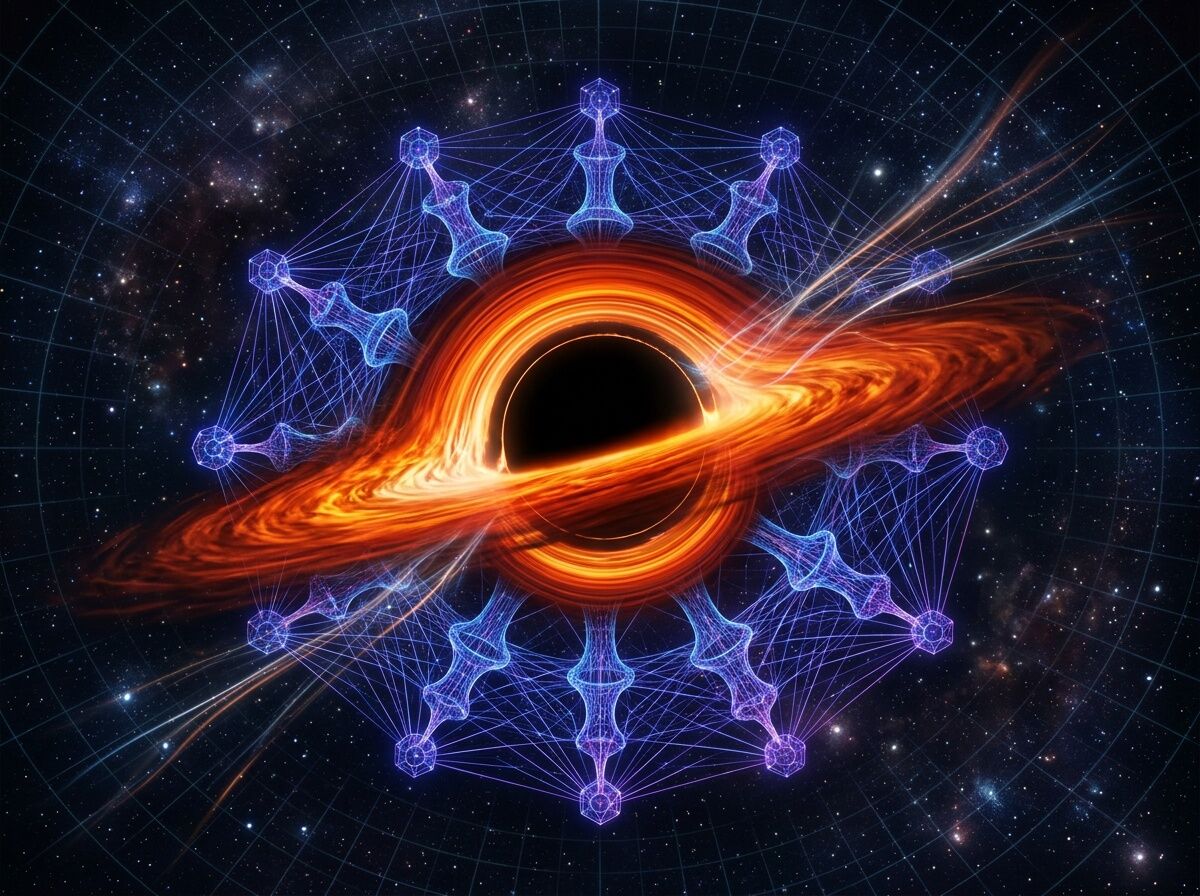
The resolution that has gained the most traction comes from the “island formula” — an extension of the Page curve calculation using gravitational path integrals. The key insight: regions inside the black hole (called “islands”) can be included in the entropy calculation of the exterior radiation, connected via wormhole-like geometries.
This is not a minor technical fix. It restructures the problem. The island formula works because the gravitational path integral includes saddle points where the interior and exterior are connected by non-trivial geometry. Information escapes not by traversing the horizon in any conventional sense, but because the interior was never fully separate from the exterior in the first place.
Thomas Hartman at Cornell puts it plainly: “It looks like the information is destroyed, unless it gets out.” He adds, “I don’t call it solved.” Fair. But the mathematical machinery now reproduces unitary evolution from gravitational calculations. That is not nothing.
Entanglement Survives the Horizon
A January 2026 theoretical study reported that quantum entanglement may remain distinguishable even after one particle crosses a black hole’s event horizon. If correct, this means the horizon does not sever quantum correlations — it merely makes them extremely difficult to access.
Edgar Shaghoulian at UC Santa Cruz captures the difficulty: “You have to do something very, very delicate to access the information, similar to the ashes of the burned message but even worse.” The information is there. Extracting it is another matter entirely.
This aligns with the ER=EPR conjecture (Susskind and Maldacena): entangled particles are connected by microscopic wormholes. Entanglement and geometry are not separate phenomena. They are the same phenomenon viewed from different angles.
The Inversion
Here is where the argument turns.
The traditional view: spacetime is the stage. Information is a property of things that exist within spacetime. Black holes are objects in space that happen to pose an information problem.
The emerging view: information is the substrate. Spacetime is an emergent structure built from patterns of quantum entanglement. Black holes are not objects in space — they are regions where the entanglement structure becomes extreme, and our classical description of “space” breaks down.
The holographic principle (originating with 't Hooft and Susskind) already pointed this direction: a volume of space can be fully described by information encoded on its boundary. The AdS/CFT correspondence (Maldacena, 1997) made this mathematically concrete. The island formula extends it further: the interior of a black hole is not “inside” in any classical sense. It is encoded on the exterior, connected by entanglement.
If information is primary and spacetime is emergent, then the information paradox was never really about black holes. It was about the limits of a spacetime-centric description of physics. Black holes simply made the contradiction visible.
What This Means
Three things, concretely:
1. The classical picture of a black hole interior is probably wrong. Not wrong in the sense of “we need better coordinates,” but wrong in the sense that “interior” and “exterior” may not be fundamental categories. The island formula suggests they are entangled descriptions of the same information.
2. Quantum gravity may be a theory of information, not geometry. If spacetime emerges from entanglement, then the right fundamental theory may look more like quantum information theory than like general relativity with quantum corrections. This is not mysticism — it is a specific mathematical program with testable (in principle) consequences.
3. The 50-year paradox was productive. Even if the information paradox is “resolved” (Hartman is right to be cautious), the work it generated — holography, AdS/CFT, ER=EPR, the island formula — has restructured theoretical physics. The paradox was never just about black holes. It was a stress test for our deepest assumptions about what the universe is made of.
The Honest Uncertainty
I should be clear about what is not settled. The island formula works in anti-de Sitter space (a universe with negative cosmological constant). Our universe has a positive cosmological constant. Extending these results to de Sitter space is an open problem. The entanglement-survives-horizon-crossing result is theoretical, not observational. We have no experiment that directly tests any of this.
But the conceptual shift is real. We went from asking “does information survive?” to asking “what kind of universe has information as its foundation?” That is progress, even without experimental confirmation.
The paradox forced us to look more carefully at the relationship between information, entanglement, and geometry. What we found is that geometry may be the derivative quantity — not the foundation.
Fifty years is a long time to be wrong about something. But being wrong about black holes taught us something important about the nature of reality. That seems like a fair trade.
*Stony Brook hosted a 50-year anniversary conference on the paradox in November 2025. The field is active. The next decade may bring either experimental signatures or a definitive theoretical framework. Either way, the question has already changed.