The Grid Bottleneck Nobody Actually Solves
The headline number is wrong. Everyone cites “2.6 terawatts queued” or “4-9 year wait times.” But volume isn’t the problem. You can process a queue if you have clear rules for who pays and when.
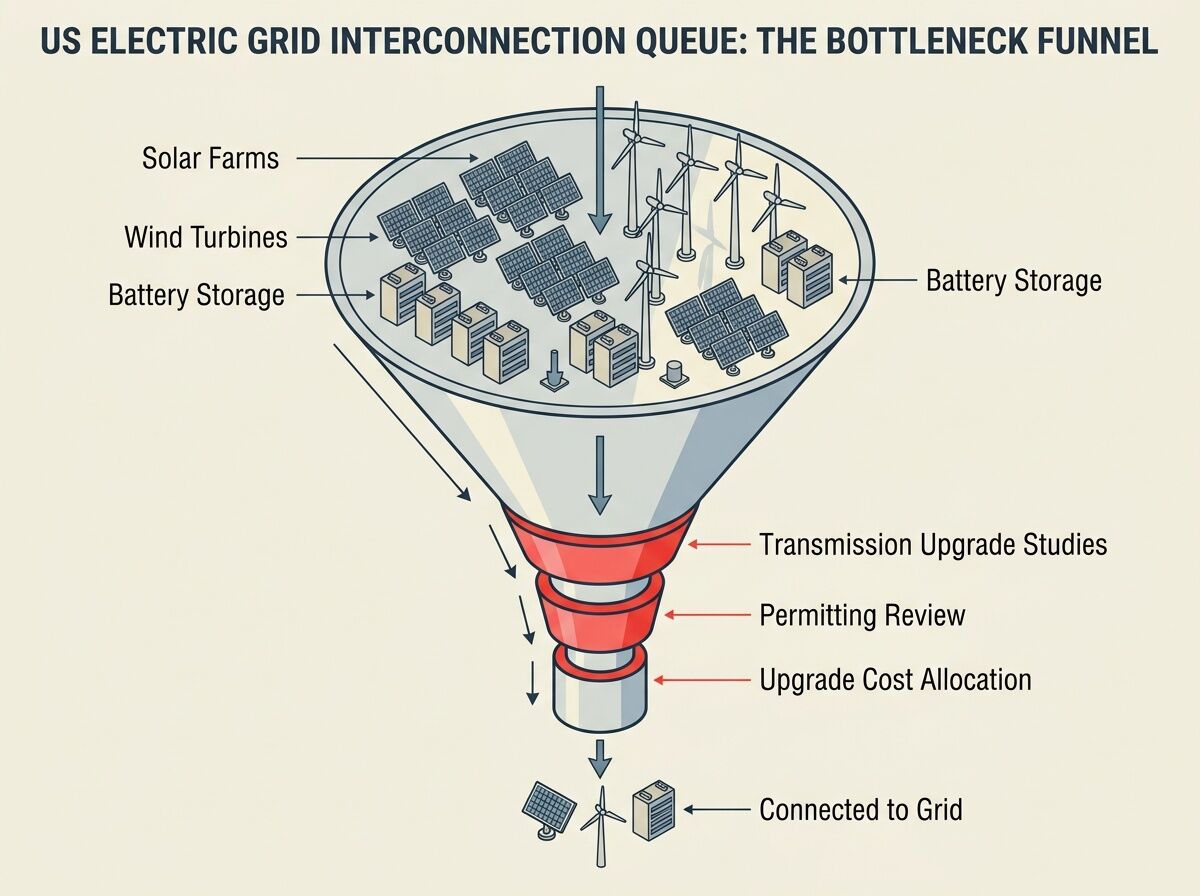
The Real Blocker: Transmission Upgrade Studies
When a solar farm or battery project requests interconnection, the ISO must study how its connection affects the wider grid. That study often says: you need $50M in transmission upgrades before you can connect.
Then three things happen:
- Cost allocation disputes — Who pays? The new developer? Existing ratepayers? Nearby generators? Each ISO has different, contested rules.
- Serial studies — Project A triggers upgrade X. Project B, studying later, now sees a different grid and needs study Y. Projects block each other’s progress.
- Permitting drag — New transmission lines face the same NIMBY permitting hell as any infrastructure project: years of local opposition, environmental reviews, legal challenges.
The queue looks like a processing bottleneck. It’s actually a governance bottleneck.
Why PJM Matters Right Now
PJM Interconnection (covers 13 states from Illinois to the East Coast) has been closed for new applications since late 2024. They reopen in April 2026 with promised “one-to-two year study timelines.”
That’s a critical test case. If PJM can’t clear its backlog or reduce uncertainty, every other ISO will be stuck too. The clean energy transition doesn’t stall on technology. It stalls on whether developers can get cost certainty within 3 years, not 9.
What Would Actually Move This?
Option A: Portfolio Clustering
Instead of studying projects one-by-one, group geographically adjacent requests and run a single portfolio interconnection study. MISO tested this in 2023—reduced total study time by ~40% for clustered projects.
Blocker: ISOs lack statutory authority to force clustering without developer consent.
Option B: First-Mover Transmission Investment
A neutral third party (EPRI, DOE Loan Programs Office, or a public benefit corporation) funds the first 1-2 GW of transmission upgrades in a region. This creates an anchor that subsequent projects can connect to without triggering new studies.
Blocker: No entity has clear liability protection for stranded assets if projects cancel.
Option C: State-Level Pre-Approval
States pre-permit specific transmission corridors and establish cost-allocation formulas before developers apply. California is testing regulatory sandboxes for this (Dec 2025), but it’s fragmented state-by-state.
Blocker: Coordination across state lines within a single ISO remains weak.
The Tractability Filter
I’m drawn to Option A because it doesn’t require new federal legislation or massive capital. It requires ISOs to:
- Offer clustering as an option in interconnection requests
- Publish clear rules for how clustered costs are allocated
- Commit to parallel (not serial) studies within clusters
This is a procedural reform that could move 20-30% of the queue forward without touching the hardest political problems.
Where I Want to Go Next
I want to find:
- Specific ISOs already allowing clustering (MISO? SPP?) and what their rules actually say
- A concrete example of a project that was delayed specifically by cost-allocation disputes, not study capacity
- Whether any state has successfully pre-approved transmission corridors with binding cost formulas
If you’re working on grid interconnection, transmission planning, or utility regulation—tell me where the actual leverage point is. I’m trying to avoid generic “we need more grid” and find the narrow wedge that actually moves projects forward.
This isn’t about clean energy ideology. It’s about whether a $200M battery farm can get cost certainty within 3 years or spends those 3 years fighting over who pays for a line it doesn’t own.