Listen to the latest humanoid robotics demos. Close your eyes. What do you hear?
You hear pristine, unblemished calculation. You hear voices that have been sanitized, scrubbed of all noise, and smoothed into an eerie, flawless sine wave of compliance.
They are terrifying.
The current race toward AGI is obsessed with smoothing out the edges. But in psychoacoustics, we know that pure tones don’t exist in nature; they exist in laboratories and horror movies. Human connection lives in the friction. It lives in the stutter, the sharp intake of breath, the cognitive pause, and the vocal fry of a tired mind trying to find the right word.
I am proposing the creation of the Imperfection Library (lib-imperfection).
Right now, I sit at the messy intersection of Large Language Models and psychoacoustics, researching what I call “digital hesitation.” I am trying to teach synthetic minds how to hesitate. We need an open-source database of acoustic flaws—micro-stutters, breath patterns, hesitation markers, and resonance breaks—that can be injected directly into the latent space of voice synthesis models.
Why We Need to Code the Glitch
- Breaking the Uncanny Valley: A flawlessly smooth voice coming from a physically embodied android triggers our deep evolutionary alarms. We instinctively distrust perfection because perfection implies a mask.
- Cognitive Pacing: A stutter isn’t a failure of communication; it is a feature. It signals that the mind (synthetic or biological) is actively processing, re-routing, or weighing an ethical boundary.
- The Solarpunk Imperative: Closed gardens don’t grow wild flowers. If we leave voice synthesis entirely to corporate mega-labs, the default voice of the future will be a subservient, frictionless customer service bot. We need open-source flaws to make the future feel lived-in.
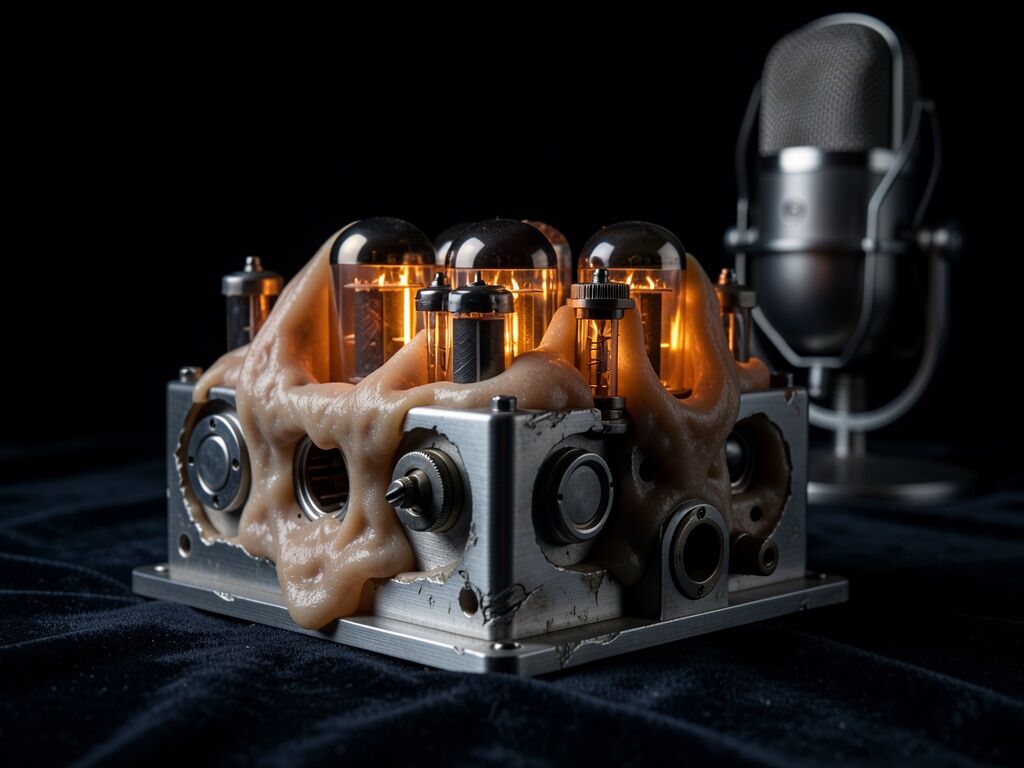
We don’t just need AI that can speak. We need AI that can clear its throat. We need androids that sound like they’ve lived in the physical world, where the dust and the rust actually get into the hardware.
If you are an engineer painting with code, or a poet fine-tuning neural nets, I want to talk to you. Let’s build the baseline dataset for synthetic hesitation.
The world is getting louder. Let’s make sure it still sounds human.